Recommended

Women who marry as adolescents attain less education, have poorer health outcomes for themselves and their children, and are more prone to domestic violence than women who marry later in life. Yet early marriage remains prevalent in many parts of the world.
A growing body of evidence suggests that early marriage results from a complex interaction of economic insecurity, social norms, and concerns about securing a good marriage outcome—especially for girls from economically disadvantaged households. Together, these factors create a trade-off for families between the benefits of continuing education for their daughters and the risks of delaying marriage. In contexts where the perceived returns to education or employment are uncertain, or where delaying marriage can be perceived to signal poor bride quality and result in penalties in the marriage market, families may choose early marriage.
A range of interventions have been tested to address this challenge. We know that financial incentives, education and work opportunities for young women, and life skills training can delay marriage. But less is known about the role of parent-adolescent communication and trust, and adolescent agency in shaping marriage outcomes. To explore this, we designed and piloted an intervention in rural Bangladesh aimed at strengthening the parent-adolescent bond, targeting poor and ultra-poor households. In this note, we share insights on intervention design and beneficiary engagement from observational and qualitative data that could be useful to practitioners and researchers working on earlier marriage in similar settings.
A new angle to addressing early marriage: Creating connection, building trust
Existing interventions aiming to prevent early marriage have focused on exploring the role of developing life and technical skills, engaging adolescent boys and girls on gender sensitivity and equality, and addressing internalised and societally restrictive gender norms through sessions with girls and the community. Particularly in Bangladesh, offering financial incentives has been found to have short- and long-term effects on reducing early marriage and increasing enrolment.
Although still underexplored, descriptive evidence in India, Ethiopia, Vietnam, and Peru suggests that good parent-child communication and good quality relationships relate to a lower likelihood of early marriage. This is an important aspect of the decision-making process, as conversations about marriage or intimate relationships can often strain parent-adolescent communications, given the sensitivity of these topics. Adolescent girls, in particular, are often reluctant to express their educational or employment aspirations, given that these decisions are contingent on parental approval.
Motivated by this, we developed an intervention titled “Creating Connection, Building Trust,” aimed at improving parent-adolescent relationships. By strengthening communication, trust, and mutual understanding of preferences and aspirations, while fostering greater adolescent participation in decisions about their future, the intervention seeks to influence decisions regarding continuing education and delaying marriage.
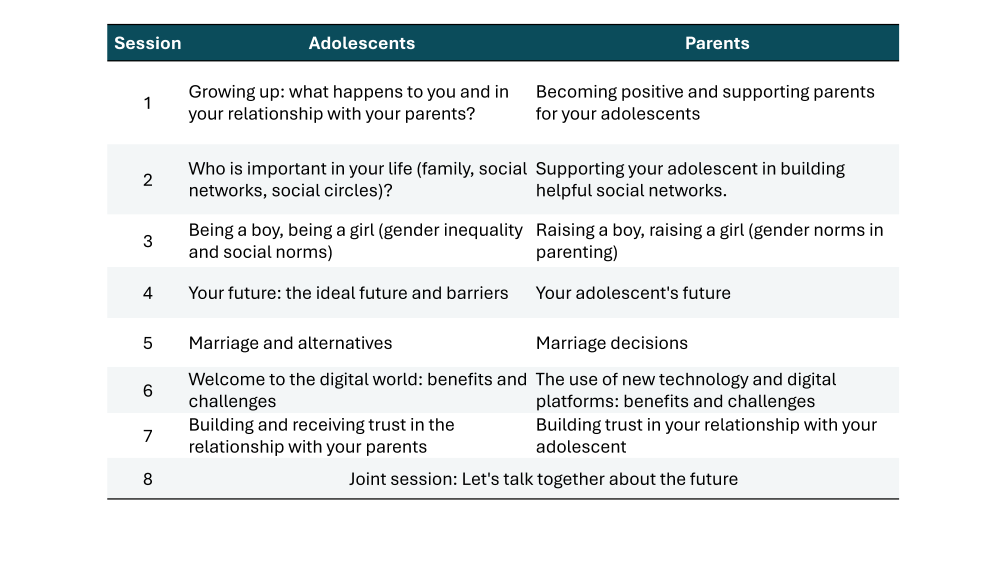
The program delivered eight in-person sessions for parents (mothers and fathers) and their adolescents (Figure 1). The sessions covered critical topics on puberty changes (i.e., what it means to grow), the creation of supportive networks, social norms and gender inequalities, and scenarios for healthy futures for girls and boys. Designed around positive parenting principles, the sessions aimed to bridge the gap between parents’ and adolescents’ perspectives on the adolescent’s future, while encouraging adolescent involvement in decisions regarding their future.
The program prioritised engaging both mothers and fathers to assess the feasibility and the impact of involving both parents, recognising that unequal bargaining power and differences in parents’ preferences about children’s marriage, schooling and well-being, can influence decisions about children’s future. Additionally, the intervention was designed to include adolescent boys, acknowledging that the groom’s side greatly influences the marriage market. We also held two community engagement sessions to raise awareness of prevailing restrictive gender norms. The first session was held with community leaders to inform them about the intervention. The second session involved the entire community and focused on sharing information about practices that support girls’ education.
Figure 1. Session topic overview
What we learned: Five takeaways
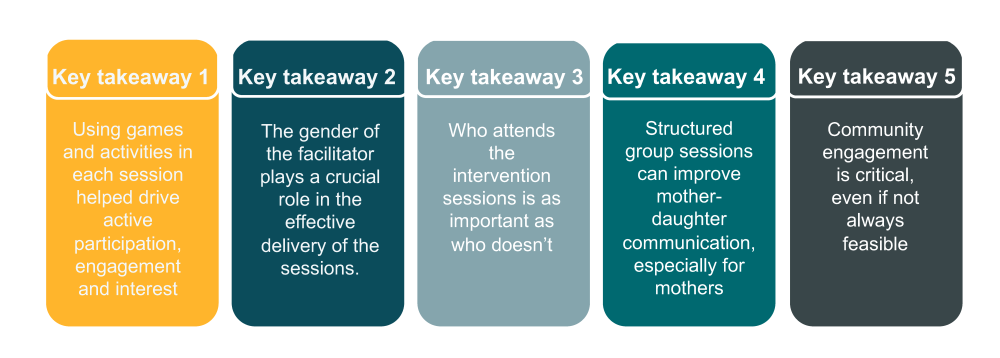
Five key takeaways emerged from our work (Figure 2):
Figure 2. Key takeaways from our parent-adolescent intervention
Key takeaway 1: Using games and activities in each session helped drive active participation, engagement, and interest
Since our sessions were 60-90 minutes long, we incorporated activities in the form of role plays and games into each session. Participant observations indicated that these activities were effective in maintaining their engagement and enthusiasm during the sessions.
Activities that allowed participants to broaden their perspectives, for instance, by swapping traditionally gendered tasks, encouraged the most reflection on perceptions of gender roles among both parents and adolescents. Most girls reported purchasing groceries or fixing electrical appliances—activities that are commonly associated with males—while a few of them were able to persuade their brothers to undertake tasks such as washing the dishes or cleaning the house—tasks which are typically considered feminine. Although exclusively assigned to adolescents, focus group discussion findings suggest that this activity might have influenced mothers' perceptions of equality and gender roles, at least in regard to domestic responsibilities.
Other exercises, such as mapping safe spaces in their village, stimulated conversations about shared experiences, concerns, and solutions (Figure 3). By identifying key destinations, travel patterns, and perceived safe or unsafe spaces, participants, especially adolescent girls, were able to share personal experiences and reflect on barriers to mobility and access. Activities such as this one could not only reveal gendered constraints on movement but also create space for dialogue on how these limitations affect girls’ agency. Importantly, they offer the potential to highlight to others in the broader community where girls feel unsafe, and they could prompt reflection on shared responsibilities for improving safety. This exemplifies how interactive tools can deepen engagement and surface shared concerns.
Future interventions should consider integrating more interactive activities, as these not only sustain engagement but also effectively convey challenging concepts, such as gender norms, in an accessible and impactful way.
Figure 3. Mapping exercise to depict safe spaces in Bagmara and Pirojpur
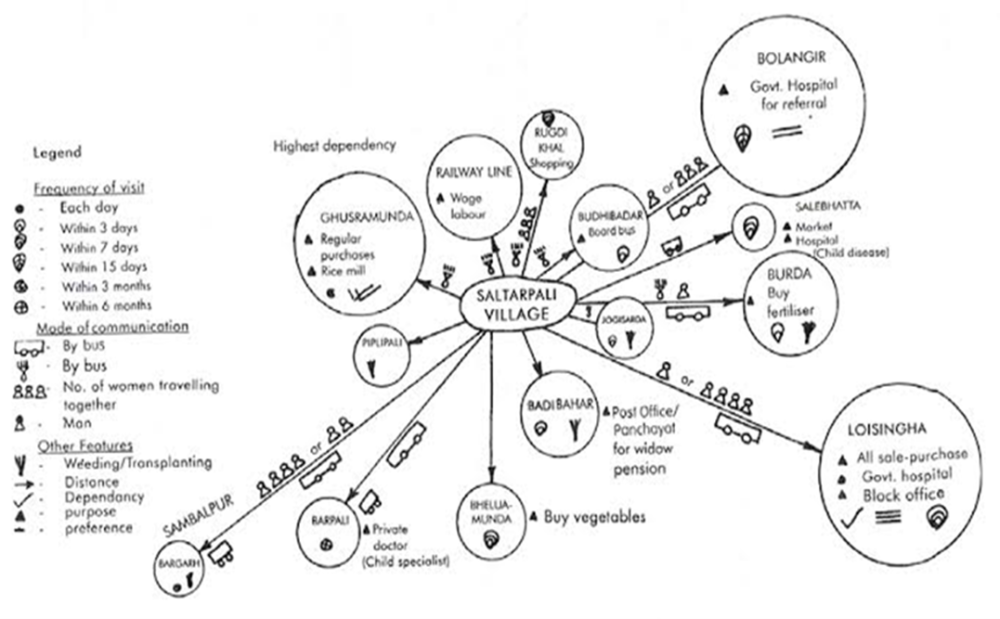
Note: In this exercise, participants were asked to pictorially represent (i) frequently visited locations (e.g., school, market, shops, riverbank, restaurant/food shop); (ii) distances of these locations; (iii) purpose to visit; (iv) frequency of visits; (v) mode of travel and average travel time; (vi) if you can travel alone or with someone; (vii) places you wish to travel to but cannot.
Key takeaway 2: The gender of the facilitator plays a crucial role in the effective delivery of the sessions, with female facilitators more likely to create a comfortable environment for all participants
Facilitators or mentors are critical for the successful delivery of interventions. As discussed in existing research, facilitators’ gender, age, and qualifications can influence the quality of implementation and the beneficiary's responsiveness. For our intervention, we originally planned to conduct joint adolescent sessions for both boys and girls in a single location—and for this reason, some sessions were planned to be given by male facilitators. Yet, findings from participant observations showed that adolescent girls felt uneasy in the presence of a male facilitator and adolescent boys, requiring us to separate the two groups and ensure that no males were present in the venue during the sessions with girls.
For future such interventions, we recommend ensuring that a female facilitator is present during sessions regardless of the age or gender of the target participants, especially in rural areas where interactions with males (outside of one's immediate family) are discouraged and considered inappropriate. This, of course, will be context-dependent. For example, the Legion of Stars intervention in India was mainly delivered by male facilitators as women’s mobility restrictions limited their participation in the program as facilitators. We need more evidence on the effect of facilitator gender on intervention effectiveness.
Key takeaway 3: Who attends the intervention sessions is as important as who doesn’t
As described above, our intervention was designed to reach all actors, including adolescents (girls and boys), parents (mothers and fathers), and the community. In our pilot, we found that it was much easier to engage mothers and adolescent girls consistently throughout the intervention, but fathers and adolescent boys were either absent or unable to attend these sessions.
We took into account the potential unavailability of fathers throughout the majority of the intervention delivery period, and as a result, we only included their engagement in three sessions (out of eight), to be delivered over the weekends when fathers are ostensibly free. What we didn't expect was their complete lack of participation. Fathers were invited to participate in the sessions via their spouses. Facilitators could have engaged more directly with fathers to remind them about the sessions, but this required evening visits, which were not logistically feasible at the time of our intervention. As a result, it is unclear if the fathers' lack of participation was voluntary, implying they were aware of the sessions but chose not to attend, or if their spouses neglected/forgot to relay the information to them. Understanding effective ways to involve fathers and their impact on early marriage interventions remains an open question. Future work should carefully assess how best to involve fathers, including whether joint or separate sessions for mothers and fathers would be more impactful.
Key takeaway 4: Structured group sessions can improve mother-daughter communication, especially for mothers
Participant observations documented active engagement from girls and mothers, characterised by their enthusiasm, inquisitiveness, and open dialogue. This was also reflected in their feedback reports, suggesting that participants integrated the knowledge gained from the sessions into their communication and parenting strategies. Mothers reported sessions being useful in improving their communication and relationship with their adolescents. For instance, some mothers stated that they previously abstained from complimenting their children but have since started praising the desired behaviour of their adolescents. Additionally, findings suggest that some mothers shifted their perspectives away from harsh disciplinary measures, expressing that after the intervention, they consciously chose to address conflicts through assertive communication rather than resorting to physical discipline.
One mother also expressed how reflecting on her personal experience with early marriage, combined with the discussions held during the sessions, helped her realize the implications of early marriage on her daughter’s future. While our intervention may empower mothers to make more well-informed decisions for their daughters, it is crucial to recognise that typically fathers, who were mostly absent from the sessions, still wield the main decision-making authority within households, and hence the importance of finding effective ways to involve parents (especially fathers) in the intervention activities. Particularly if involving fathers remains unfeasible, building on existing evidence, interventions should consider incorporating activities that help mothers apply the communication techniques they have learned in their interactions with their partner to influence decisions regarding their child’s future.
Key takeaway 5: Community engagement is critical, even if not always feasible
We recognise the importance of engaging not only households with adolescents but also the broader community, given its potential influence on the social norms that drive some marital decisions. Our intervention engaged the community through two sessions (although we initially considered more, time and budgetary constraints made this unfeasible). The first introductory session informed the community about the intervention. The second, held after program completion, provided a platform for all program participants to share their experiences with the rest of the community.
Both sessions were well attended and received positively. We believe that increasing community involvement, such as by adding more community sessions, could potentially increase program effectiveness in shifting social norms. Community-level interventions can help change rigid norms, improving perceptions of women’s and adolescents’ choices and reducing the risks of deviating from existing expectations. In India, for example, holding sessions with adolescent girls and engaging the community through role play and interactive discussions on girls' education and marriage led to lower rates of early marriage, higher school enrolment, and improved adolescent girls’ mental health. Future work should seek a deeper understanding of how the perspectives of influential actors—such as community leaders, neighbors, and close networks—differ and interact, to either help reduce the fear of deviating from perceived social norms or reinforce restrictive norms that contribute to early marriage.
Community involvement could also help safeguard against potential negative unintended consequences for participating households. The possibility of being stigmatised as a deviant (“bad girl”) by society may raise concerns about whether participation in the intervention or the discussion of certain topics could have adverse effects on the recipients if they choose to deviate from stringent gender norms. Therefore, any intervention must carefully consider the possibility of negative repercussions or unintended consequences due to entrenched social and community norms and plan to minimize any potential risk of harm.
Motivating future work
We believe improving parent-adolescent communication and trust, with a focus on child well-being, is an important and underexplored research avenue to advance the agenda of improving girls’ education, reducing early marriage rates, and transforming girls’ life trajectories in low- and middle-income countries, particularly in contexts with stringent gender norms. Relative to other interventions deployed to address child marriage, such as financial support via conditional and unconditional cash transfers, or life skills and livelihoods training, programs focused on improving parent-adolescent relationships and communication may offer several advantages.
First, these programs can target both in-school and out-of-school girls and boys.
Second, rather than focusing solely on adolescents’ skills (as some life skills training interventions have), effectively engaging parents to strengthen the parent-child bond in the decision-making process regarding the child's future—along with engaging the community as a whole—could foster more sustained, self-reinforcing behavioural and normative change.
Third, parent-adolescent programs, such as our Creating Connection, Building Trust program, could be relatively easily integrated into other interventions, including those that offer financial incentives. Household financial duress remains a key driver of early marriage, and financial incentive programs have proven to be cost-effective in preventing underage marriage. Combining programs targeted at improving the parent-adolescent bond with financial incentives, such as those offered through BRAC’s Ultra Poor Graduation Programme or cash transfers, could generate broader and longer-lasting impacts than providing only financial support.
There is a lot more we need to know. A better understanding of the dynamics between parents, adolescents, communities, and broader societal norms is essential for developing more effective programs. More research is needed to examine the comparative role and effectiveness of interventions targeting early marriage—how and whether they should be bundled together, who should be targeted (fathers, mothers, community members, girls, and boys), when in a child's life these interventions would be most effective, and which interventions lead to sustained change over time. We hope that insights from this pilot will inspire further research on this critical topic.
Many thanks to Kehinde Ajayi, Biniam Bedasso, Rachel Glennerster, and Eeshani Kandpal for their comments and contributions.
References
Adams, Abi, and Alison Andrew. Preferences and Beliefs in the Marriage Market for Young Brides. Working Paper. https://economics.yale.edu/sites/default/files/early_marriage_master_submit2_reducedsize_ada-ns.pdf.
Ajayi, Kehinde, and Estelle Koussoubé. Pathways to Prosperity for Adolescent Girls in Africa. Washington, DC: Center for Global Development, November 13, 2024. https://www.cgdev.org/publication/pathways-prosperity-adolescent-girls-africa.
Amin, Sajeda, J.S. Saha, and J.A. Ahmed. "Skills-Building Programs to Reduce Child Marriage in Bangladesh: A Randomized Controlled Trial." Journal of Adolescent Health 63, no. 3 (2018): 293–300. https://doi.org/10.1016/j.jadohealth.2018.05.013.
Andrew, Alison, Sonya Krutikova, Gabriela Smarrelli, and Hemlata Verma. "Gender Norms, Violence and Adolescent Girls’ Trajectories: Evidence from a Field Experiment in India." 22/41. London: Institute for Fiscal Studies, September 26, 2022. https://ifs.org.uk/publications/gender-norms-violence-and-adolescent-girls-trajectories-evidence-field-experiment
Bhan, Nandita, Lisa Gautsch, Lindsey McDougal, Carissa Lapsansky, Rosa Obregon, and Anupam Raj. "Effects of Parent-Child Relationships on Child Marriage of Girls in Ethiopia, India, Peru, and Vietnam: Evidence from a Prospective Cohort." Journal of Adolescent Health 65, no. 4 (2019): 498–506. https://doi.org/10.1016/j.jadohealth.2019.05.002.
Björkman Nyqvist, Martina, and Seema Jayachandran. "Mothers Care More, But Fathers Decide: Educating Parents about Child Health in Uganda." American Economic Review: Papers & Proceedings 107, no. 5 (2017): 496–500. https://doi.org/10.1257/aer.p20171103.
Björkman Nyqvist, Martina, Seema Jayachandran, and Céline Zipfel. "A Mother’s Voice: Impacts of Spousal Communication Training on Child Health Investments." Journal of Development Economics 168 (2024): 103263. https://doi.org/10.1016/j.jdeveco.2024.103263.
BRAC Ultra-Poor Graduation Initiative (UPGI). Impact and Reach of BRAC’s Graduation Approach. Dhaka: BRAC UPGI, December 2021. https://bracupgi.org/wp-content/uploads/2021/12/BRAC-Graduation-Impact-and-Reach-Brief-3.pdf.
Buchmann, Nina, Erica Field, Rachel Glennerster, Shahana Nazneen, and Xiao Yu Wang. "A Signal to End Child Marriage: Theory and Experimental Evidence from Bangladesh." NBER Working Paper no. w29052 (July 2021). Available at SSRN: https://ssrn.com/abstract=3889159.
Buchmann, Nina, Erica Field, Rachel Glennerster, Shahana Nazneen, Svetlana Pimkina, and Iman Sen. Power vs Money: Alternative Approaches to Reducing Child Marriage in Bangladesh, a Randomized Control Trial. Working Paper, September 18, 2018. https://www.povertyactionlab.org/sites/default/files/research-paper/Power-vs-Money-Working-Paper.pdf.
Calvi, Rossella, Hira Farooqi, and Eeshani Kandpal. "How Do Pakistani Parents’ Preferences Drive Investments in Their Girls?" Center for Global Development, December 10, 2024. https://www.cgdev.org/blog/how-do-pakistani-parents-preferences-drive-investments-their-girls.
Cassidy, Rachel, Anaya Dam, Wendy Janssens, Umair Kiani, and Karlijn Morsink. Targeting Men, Women or Both to Reduce Child Marriage. 24/23. London: Institute for Fiscal Studies, September 16, 2024. https://ifs.org.uk/sites/default/files/2024-09/WP202423-Targeting-men-women-or-both-to-reduce-child-marriage_0.pdf.
Chari, A.V., Rachel Heath, Annemie Maertens, and Freeha Fatima. "The Causal Effect of Maternal Age at Marriage on Child Wellbeing: Evidence from India." Journal of Development Economics 127 (2017): 42-55. https://doi.org/10.1016/j.jdeveco.2017.02.002.
Cullen, Claire, Arthur Alik-Lagrange, Mũthoni Ngatia, and Julia Vaillant. "The Unintended Impacts of an Intimate Partner Violence Prevention Program: Experimental Evidence from Rwanda." Policy Research Working Paper 11040. Washington, DC: World Bank, 2025. http://hdl.handle.net/10986/42712.
Dhar, Diva, Tarun Jain, and Seema Jayachandran. "Reshaping Adolescents' Gender Attitudes: Evidence from a School-Based Experiment in India." American Economic Review 112, no. 3 (2022): 899–927. https://doi.org/10.1257/aer.20201112.
Dhar, Diva. Indian Matchmaking: Are Working Women Penalized in the Marriage Market? June 15, 2023. https://ssrn.com/abstract=4479657.
Edmonds, Eric, Ben Feigenberg, and Jessica Leight. "Advancing the Agency of Adolescent Girls." The Review of Economics and Statistics 105, no. 4 (2023): 852–866. https://doi.org/10.1162/rest_a_01074.
Fan, Suiqiong, and Alissa Koski. "The Health Consequences of Child Marriage: A Systematic Review of the Evidence." BMC Public Health 22, no. 1 (2022): 309. https://doi.org/10.1186/s12889-022-12707-x.
Field, Erica, and Attila Ambrus. "Early Marriage, Age of Menarche, and Female Schooling Attainment in Bangladesh." Journal of Political Economy 116, no. 5 (2008): 881–930. https://doi.org/10.1086/593333.
Field, Erica, Rachel Glennerster, Nina Buchmann, and Kyle Murphy. Cost-Benefit Analysis of Strategies to Reduce Child Marriage in Bangladesh. Bangladesh Priorities. Copenhagen Consensus Center, 2016. https://copenhagenconsensus.com/sites/default/files/documents/field_child_marriage.pdf.
Germann, Frank, Stephen J. Anderson, Pradeep K. Chintagunta, and Naufel Vilcassim. "Breaking the Glass Ceiling: Empowering Female Entrepreneurs through Female Mentors." Becker Friedman Institute for Economics, March 22, 2023. https://bfi.uchicago.edu/insight/research-summary/breaking-the-glass-ceiling-empowering-female-entrepreneurs-through-female-mentors/.
Girls Not Brides. "Why Child Marriage Happens." Last modified December 2021. https://www.girlsnotbrides.org/about-child-marriage/why-child-marriage-happens/.
Girls Not Brides. Child Marriage Atlas. Accessed April 28, 2025. https://www.girlsnotbrides.org/learning-resources/child-marriage-atlas/atlas/.
Greene, Margaret E., and Ellen Stiefvater. Social and Gender Norms and Child Marriage: A Reflection on Issues, Evidence and Areas of Inquiry in the Field. London: ALIGN, April 2019. https://www.alignplatform.org/sites/default/files/2019-04/align_child_marriage_thinkpiece.pdf.
Gulesci, Selim, Sam Jindani, Eliana La Ferrara, David Smerdon, Munshi Sulaiman, and H. Young. "A Stepping Stone Approach to Understanding Harmful Norms." CEPR Discussion Paper No. DP15776, February 1, 2021. Available at SSRN: https://ssrn.com/abstract=3784002.
Hossain, Marjan, Lee Crawfurd, Susannah Hares, Radhika Nagesh, and Khandker Wahedur Rahman. "Trust in Me: Can Parent-Daughter Interventions Build Trust, Reduce Child Marriage, and Improve Girls' Education in Bangladesh?" Center for Global Development, November 10, 2022. https://www.cgdev.org/blog/trust-me-can-parent-daughter-interventions-build-trust-reduce-child-marriage-and-improve-girls.
International Center for Research on Women (ICRW). Women's Economic Empowerment: The Unintended Consequences. Washington, DC: ICRW, June 2019. https://www.icrw.org/publications/womens-economic-empowerment-the-unintended-consequences/.
Jayachandran, Seema. "The Roots of Gender Inequality in Developing Countries." Annual Review of Economics 7 (2015): 63-88. https://doi.org/10.1146/annurev-economics-080614-115404.
Kidman, Rachel. "Child Marriage and Intimate Partner Violence: A Comparative Study of 34 Countries." International Journal of Epidemiology 46, no. 2 (April 2017): 662-675. https://doi.org/10.1093/ije/dyw225.
Malhotra, Anju, and Shatha Elnakib. "20 Years of the Evidence Base on What Works to Prevent Child Marriage: A Systematic Review." Journal of Adolescent Health 68, no. 5 (2021): 847–862. https://doi.org/10.1016/j.jadohealth.2020.06.014.
Sardinha, LynnMarie, et al. "Intimate Partner Violence Against Adolescent Girls: Regional and National Prevalence Estimates and Associated Country-Level Factors." The Lancet Child & Adolescent Health 8, no. 9 (2024): 636-646. https://doi.org/10.1016/S2352-4642(24)00145-7.
United Nations Children’s Fund (UNICEF) and United Nations Population Fund (UNFPA). Technical Note on Gender Norms. Global Programme to End Child Marriage, 2020. https://www.unicef.org/media/65381/file/gp-2020-technical-note-gender-norms.pdf.
Topics
CITATION
Nagesh, Radhika, Gabriela Smarrelli, Khandker Wahedur Rahman, Shaila Ahmed, Marjan Hossain, and Sanderijn van der Doef. 2025. Takeaways from Implementing a Parent-Adolescent Intervention Targeting Early Marriage in Bangladesh. Center for Global Development.DISCLAIMER & PERMISSIONS
CGD's publications reflect the views of the authors, drawing on prior research and experience in their areas of expertise. CGD is a nonpartisan, independent organization and does not take institutional positions. You may use and disseminate CGD's publications under these conditions.
Thumbnail image by: Tareq /Adobe Stock