Recommended
Blog Post
Letting Asylum Seekers Work Is Not a “Pull Factor”
Blog Post
USAID Cuts: New Estimates at the Country Level
REPORT
2022 Global Refugee Work Rights Report
WORKING PAPER
Aid and Attitudes Toward Refugees
In recent years, the US has funded about 40 percent of the United Nations refugee agency (UNHCR) and 30 percent of the overall refugee response. The Trump Administration’s major cuts and restructuring, as well as those from other donors, are having “immediate and devastating” impacts on refugees and the countries that host them.
We need to find a way to meet as much need as possible with less money. UNHCR has announced layoffs and closures; the UN office coordinating humanitarian affairs has called for a focus on the most severe contexts and local actors; and civil society representatives are pushing to expand cash and local leadership. These are important avenues to pursue.
Above all, however, reform efforts should focus on accelerating refugee inclusion: ensuring refugees can support themselves, thereby reducing the overall need. Refugees need jobs, freedom of movement, and access to basic services equivalent to the rights enjoyed by host communities—not less, and also not more.
How do we get there? We propose a way to help manage this retreat. It will represent an uncomfortable change for some actors but is necessary in our view to minimize the harm to refugees—and some hosts—from these aid cuts. It certainly does not offset the catastrophic effects of dismantling aid in the short-term but may offer a more sustainable medium- and long-term path.
First, host countries have to expand access to labor markets; the cost of maintaining restrictions is simply not tenable. Second, development aid should be used to support countries with inclusive practices to help offset costs. Third, refugee-serving organizations must facilitate the transition to inclusion and avoid blocking potential progress.
Host countries: expand access to labor markets
Refugees who cannot work or move freely require aid to meet basic needs, and most refugees are displaced for years. Our 2022 Refugee Work Rights Report found that at least 55 percent of refugees live in countries with significant barriers to labor market access in practice. All of the 51 included countries imposed meaningful barriers.
The system can no longer afford to waste money on those who could find jobs. Figure 1 shows the average amount of humanitarian aid—intended for short-term basic needs—spent per refugee in 2020 and 2021. We disaggregate spending by the host country’s de facto work rights score from our 2022 report. While not necessarily causal, the pattern is clear: host countries that restrict access to labor markets use significantly more humanitarian resources per refugee. Countries receiving a two (out of five) use US$160 more per year per refugee than countries scoring a four. (Only Tanzania received a one, though its spending reflects the same pattern.) This mechanism is also described in research from the World Bank and UNHCR using individual-level data from 11 countries.
Figure 1. Host countries that restrict access to labor markets use significantly more humanitarian resources per refugee
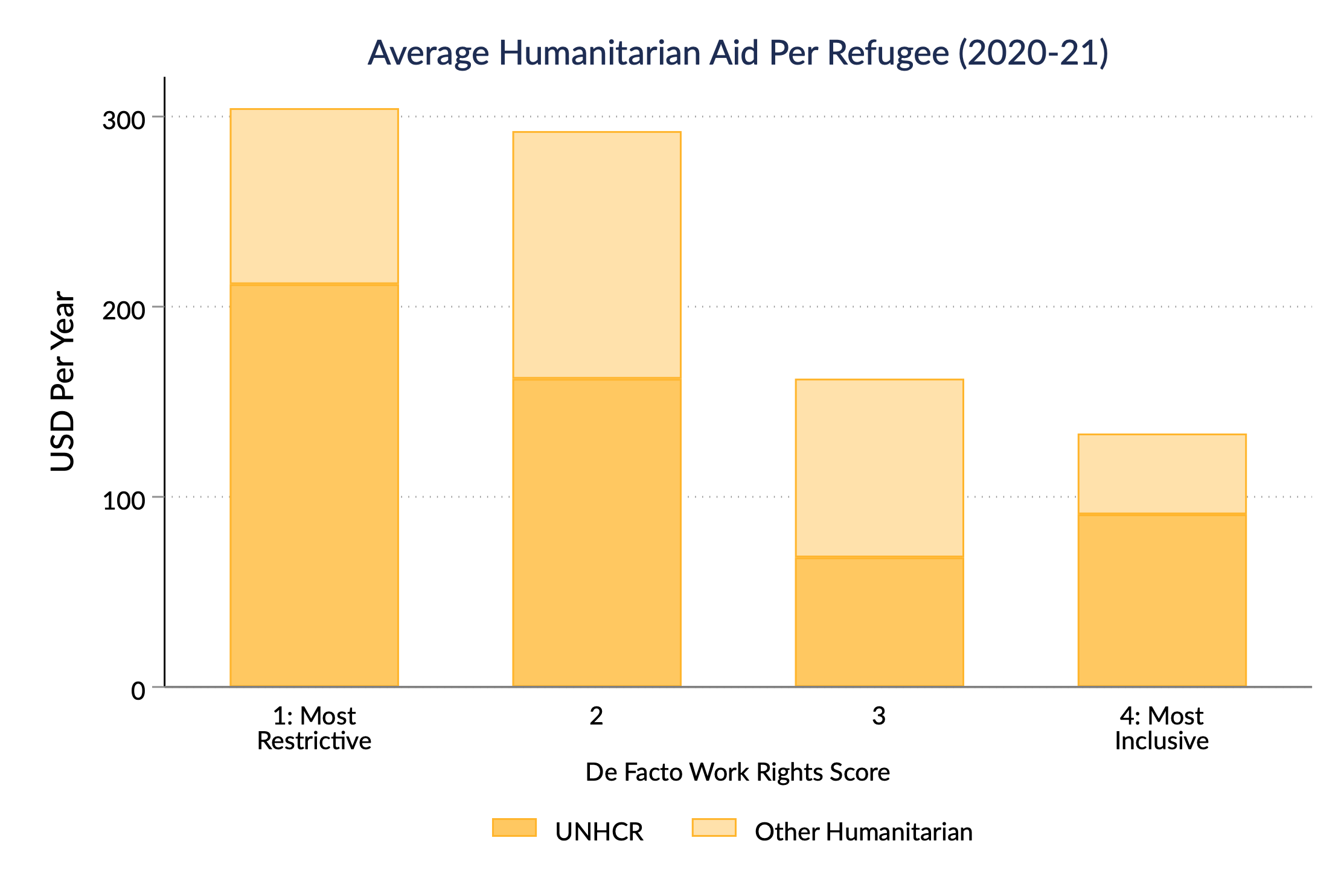
Sources: UNHCR Budget and Expenditure Dashboard; data provided from the “Development Finance for Refugee Situations: Volumes and trends, 2020-21” report by the OECD; UNHCR Refugee Data Finder; and the “2022 Refugee Work Rights Report” by CGD, Refugees International, and Asylum Access. Refugee population totals are from UNHCR and include Refugees (including people in refugee-like situations), Asylum-Seekers, Other People in Need of International Protection (Venezuelans Displaced Abroad), and Palestine refugees under UNRWA’s mandate, which is consistent with the financing data. UNHCR data are expenditures on pillar 1, the Refugee Programme. This likely includes some funding for development and peace programs, which OECD estimates at 6 percent and 3 percent, respectively, of UNHCR overall disbursements. However, in the OECD data much of UNHCR’s spending is not disaggregated at the country level, so we instead use UNHCR’s expenditure dashboard, which combines humanitarian, development, and peace spending.
Host governments worry that expanding refugees’ labor market access will negatively affect economic outcomes of some host citizens. There is some evidence of this. To mitigate these effects, countries facilitating labor market access should receive development aid that targets hosts who would be negatively affected. We expand on this below. However, review after review finds the average effects are mostly small. Some hosts benefit, others are crowded out, and the magnitudes of the effects are significantly smaller than the gains to refugees.
Inclusion in many places is politically feasible, as citizens often support these policies. For example, in Kenya—which has embodied the wasteful paradigm of restrictive policies and never-ending aid—citizens overwhelmingly support a more inclusive approach. Colombia’s landmark inclusive policy changes toward Venezuelans had no significant effect on elections. Overall, attitudes toward refugees in countries with and without significant restrictions evolve similarly.
Host countries and donors can build support for inclusion by sharing some of the humanitarian savings from refugees’ labor market access with host communities directly. In experiments in Uganda and Kenya, we find that cash transfers have large, persistent effects on hosts’ support for inclusive policies, especially when they are labeled as aid coming through the refugee response.
Donor countries: prioritize inclusive countries and cost effectiveness
In the OECD’s data from 2020-21, 34 percent of funding for refugees in low- and middle-income countries was allocated to development programs, designed for medium-term returns. This money will also face cuts, though possibly not as severe. For example, the World Bank’s Window for Host Communities and Refugees, one of the largest sources of development financing for low-income countries, looks to be receiving similar levels of funding. However, we’re hearing that the Global Concessional Financing Facility, which supports middle-income countries, is potentially facing cuts.
Donors should prioritize development aid to host countries that uphold refugees’ right to work, freedom of movement, and choice of residence (in practice) for at least three reasons. First, development aid will be more effective in more inclusive countries. For refugees who cannot leave a camp, for instance, returns to vocational training are going to be small. Second, labor market access itself has costs, and is strongly correlated with access to public services like education and healthcare, which are also costly. These costs should not fall entirely on host countries, especially as other aid cuts severely affect existing services for everyone. Development aid can mitigate negative effects while building broader political support. Third, prioritizing inclusive countries with predictable, medium-term financing encourages these countries to continue and others to follow suit.
Figure 2 shows that in 2020-21, donors were already doing this: development aid per refugee was significantly higher in host countries that provide more labor market access. More inclusive countries (score of four) received US$80 more per refugee per year than less inclusive countries (score of two). Donors, to their credit, did not abandon host countries as refugees integrated.
Figure 2. Development aid per refugee is significantly higher in host countries that provide more labor market access
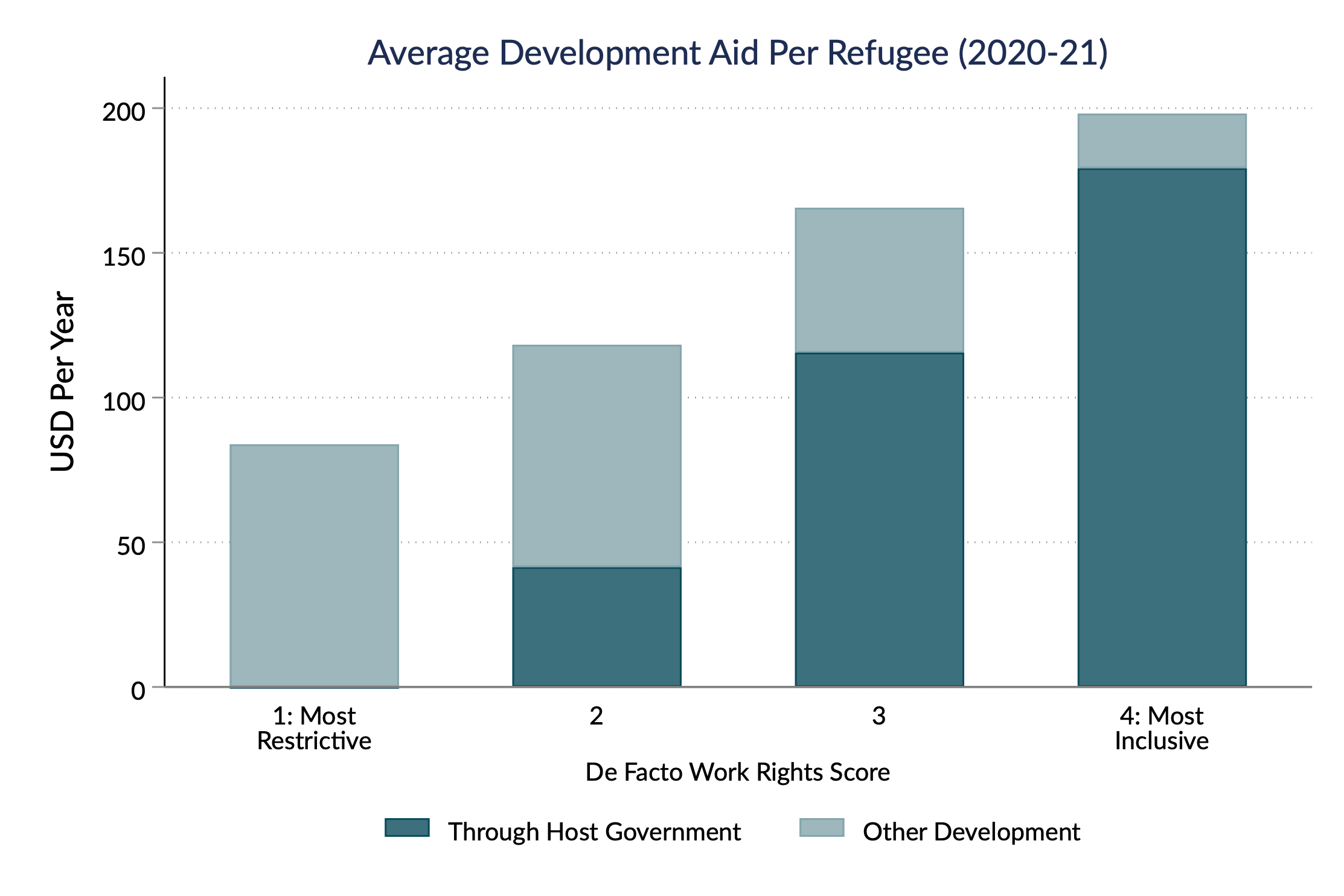
Sources: Data provided from the “Development Finance for Refugee Situations: Volumes and trends, 2020-21” report by the OECD; UNHCR Refugee Data Finder; and the “2022 Refugee Work Rights Report” by CGD, Refugees International, and Asylum Access. Refugee population totals are from UNHCR and include Refugees (including people in refugee-like situations), Asylum-Seekers, Other People in Need of International Protection (Venezuelans Displaced Abroad), and Palestine refugees under UNRWA’s mandate, which is consistent with the financing data.
This pattern must be maintained amidst difficult decisions on aid cuts. We recognize the impossible trade-offs policymakers are currently weighing and that aid is likely to be cut everywhere. In a time of shrinking budgets, maintaining some development spending in the more inclusive countries would, in the short-term, come at the expense of humanitarian needs elsewhere. However, if development spending leads to jobs, this would reduce humanitarian needs now and in the future.
The aid that survives has to be used more effectively, especially to boost refugees’ employment. Too many livelihood programs are poorly designed, uninformed by rigorous evidence, and fail to publicly report meaningful outcomes that others could learn from. Vocational training programs have a mixed track record, worse in sectors like tailoring and hairdressing that implementers often choose (see here, here, and here for discussions). Cash and graduation programs have generally performed better, though more rigorous research is critical. Donors and implementers need to move from frameworks around inputs (i.e. number of people trained) to outcomes (i.e. jobs and wages), using results-based financing in more cases to facilitate this change.
Refugee-serving organizations: support this transition
Well-meaning organizations sometimes let the perfect be the enemy of the good. For instance, one of us witnessed humanitarian organizations arguing against a government’s plans to expand freedom of movement because refugees might accept dangerous jobs. Safe, decent work is obviously an important goal. But where host governments are open to more inclusion—which would free up resources for others in need and allow refugees to decide for themselves what jobs to accept—refugee-serving organizations should not stand in the way.
Similarly, where host governments are amenable to including refugees in national health and education services, higher quality does not justify parallel systems at likely higher costs. That funding should instead be allocated to national systems to provide equitable services for refugees and hosts alike. Host governments should be allowed to lead wherever possible, and responsibility for refugees’ inclusion—as well as development assistance—should sit within line ministries instead of refugee-specific agencies. As refugees gain employment, their contributions to social systems should increase through taxes and direct payments, reducing the need for donor support over time.
The near-term reality is devastating. Let’s plan for a better way forward.
Labor market access is important but not a panacea. Even in the most inclusive countries, many refugees’ basic needs are not met. Further, the savings suggested above are relatively small. Combining humanitarian and development spending, the most inclusive low- and middle-income countries spent about US$80 less per refugee per year than the most restrictive countries. Moving the most restrictive countries to the spending levels of the most inclusive would have saved less than five percent of the overall budget in 2021, nowhere near the anticipated size of the aid cuts.
Our recommendations are therefore just one part of the response. We need a radical step change in how we support refugees in the medium- and long-term. This must include helping refugees move out of camps and integrate into urban or available rural areas, while at the same time transitioning them into national health and education systems. The system was hardly working before—humanitarian appeals have been only partially funded for decades—but these aid cuts must force a faster response.
Here, host governments hold the key. As high-income countries abandon refugees, low- and middle-income countries have an opportunity to make a profound statement and demonstrate compassion for some of the most vulnerable. Supported by donors, they can embrace the radical changes that have been required for a long time.
The authors thank Shona Warren for her contributions to this blog.
Topics
DISCLAIMER & PERMISSIONS
CGD's publications reflect the views of the authors, drawing on prior research and experience in their areas of expertise. CGD is a nonpartisan, independent organization and does not take institutional positions. You may use and disseminate CGD's publications under these conditions.
Thumbnail image by: Adobe Stock Images