Recommended


DATA VISUALIZATION

Violence against children in schools is all too common, and beyond being a violation of children’s basic rights, it adversely affects their learning and life outcomes. We still know too little about how to reduce violence in and around schools, although the evidence base is growing. But certain groups of children are at heightened risk, and we know much less about how to protect those children.
A systematic review of global evidence—published earlier this year by Eldred and others—looked at interventions to prevent school violence against children with disabilities. Here are three key findings.
1. The vast majority of evidence focuses on peer violence
In reviewing the evidence, the authors identified all the evaluations of school-based interventions to combat violence that they can find (Figure 1), regardless of whether those evaluations include children with disabilities. They found nearly 70 studies each on peer-to-peer violence (like bullying and dating violence). They found nearly 30 studies on preventing sexual abuse and just four studies specifically focused on teacher violence. (Most of the interventions on preventing sexual abuse were carried out at school, but they address sexual abuse in any context.) This highlights how much we still have to learn to ensure students are safe in their relationships with authority figures. And while 100+ studies on peer-to-peer violence may seem like a lot, many of these studies lack data on violence outcomes. Instead, many focus on whether the interventions were successful at boosting knowledge or awareness. That’s not a bad start, but it’s far from the knowledge we need to end violence in schools.
Figure 1. Far more studies focus on reducing violence from peers (such as bullying and dating violence) than on violence from teachers
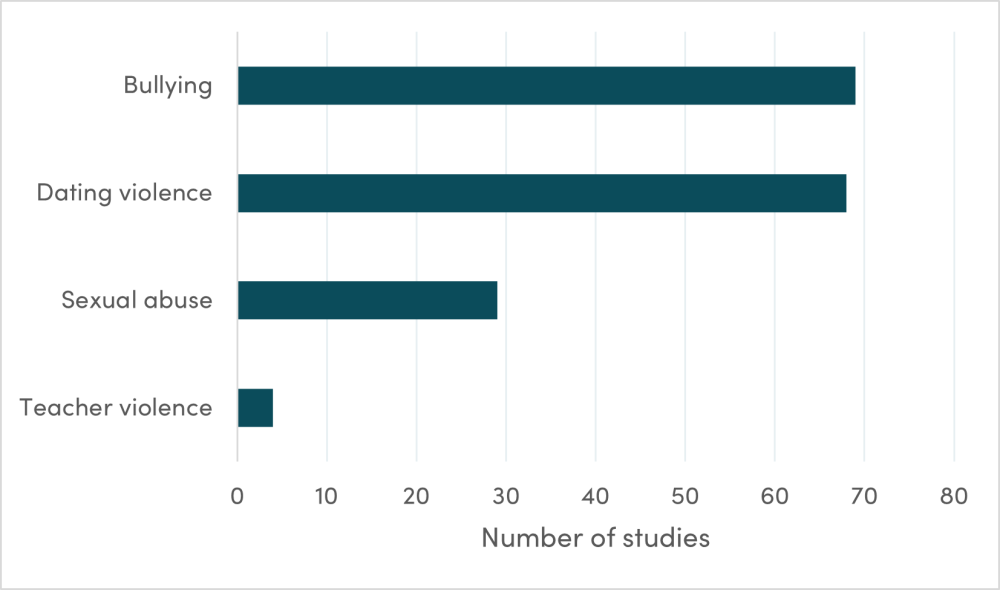
Source: Chart built based on numbers reported in Eldred and others 2025.
2. Children with disabilities are much more likely to experience violence
A global meta-analysis found that children with disabilities were three times more likely to experience physical and sexual violence than children without disabilities. A study in Uganda showed that girls with physical disabilities—mostly sight, hearing, or mobility—were twice as likely to experience sexual violence as non-disabled girls. They were also slightly more likely to experience physical violence. A lot of that violence was taking place at schools. (The differences for boys were not statistically significant.)
3. Almost no studies report results for reducing violence against children with disabilities
Of 160 randomized controlled trials testing the effectiveness of school-based interventions to reduce violence, only three trials report the size of effects for children with disabilities! (The authors of the review include a wide range of disabilities.) Here is what we learn from those three trials:
- In Ugandan primary schools, a trial of the Good Schools Toolkit—which aims to reduce physical violence from teachers to students—reduced violence by just over 70 percent. It also reduced violence against kids with more modest disabilities by 60 percent.
- In China, a training of adolescent girls with mental disabilities increased their understanding of sexual abuse and their knowledge of self-protection.
- In the United States, a training to boost socioemotional skills and reduce bullying among disabled students showed some reductions in bullying (by the disabled kids) and a greater willingness to intervene against bullying.
Only two of the three studies have an actual indicator of violence as a result. This isn’t criticism of the 157 studies that don’t report on children with disabilities. If a study isn’t designed to capture a sizable sample of these children, then the numbers of children will usually be far too small to give a reliable estimate of the impact.
Conclusions
We need to keep building the evidence base on what works to reduce school violence overall. Evaluations of a wider array of interventions give policymakers and school systems a broader menu from which to adapt interventions that will work best in their context.
As we grow the evidence base for all children, we can also make sure we develop evidence for those children who most need our protection, adapting intervention designs and data collection processes to include children with disabilities. Societies have a responsibility to keep their most vulnerable members safe.
Many thanks to Lee Crawfurd, Diana Gutierrez, Thi Le, and Yi Ning Wong for feedback on this blog post. Despite the presence of several m-dashes, generative AI was not used.
Topics
DISCLAIMER & PERMISSIONS
CGD's publications reflect the views of the authors, drawing on prior research and experience in their areas of expertise. CGD is a nonpartisan, independent organization and does not take institutional positions. You may use and disseminate CGD's publications under these conditions.
Thumbnail image by: Hugh Sitton/Stocksy /Adobe Stock