Recommended

Blog Post
A Million Lives at Risk?

Blog Post
US Funding of International Organizations Has Collapsed
The US Administration has made no secret of its intention to considerably reduce America’s engagement with international organizations. It has already announced withdrawal from the World Health Organization and the UN Educational, Scientific, and Cultural Organization (UNESCO) and has declared it will no longer fund the UN Relief and Works Agency or the UN Human Rights Council. A 180-day review of participation in international organizations, originally due in early August, is to suggest more organizations to leave. What the White House and State Department are signaling through obligations, the latest ‘pocket’ rescissions package and their proposed FY26 budget, is that the proposed disengagement from international organizations will be unprecedented in scale.
The State Department’s Contributions to International Organizations (CIO) account covers US membership dues to a large number of UN bodies, affiliated organizations and other treaty organizations, including the United Nations itself, the International Atomic Energy Agency, the World Trade Organization and NATO. (It does not fund core contributions to the multilateral development banks, which come from the US Treasury).
By the end of the third quarter of FY24, the CIO account had obligated and outlayed about $1.4 billion, roughly 90 percent of total FY24 outlays and obligations. In contrast, by the end of the third quarter of this fiscal year, the CIO account had achieved only about a third of last year’s obligations and outlays. Almost all of this year’s obligations and outlays took place in the first quarter of the fiscal year, before the new administration arrived. The chart below shows outlays broken down by calendar year quarter.
International Organizations Account, Outlays by Calendar Year Quarter ($m)
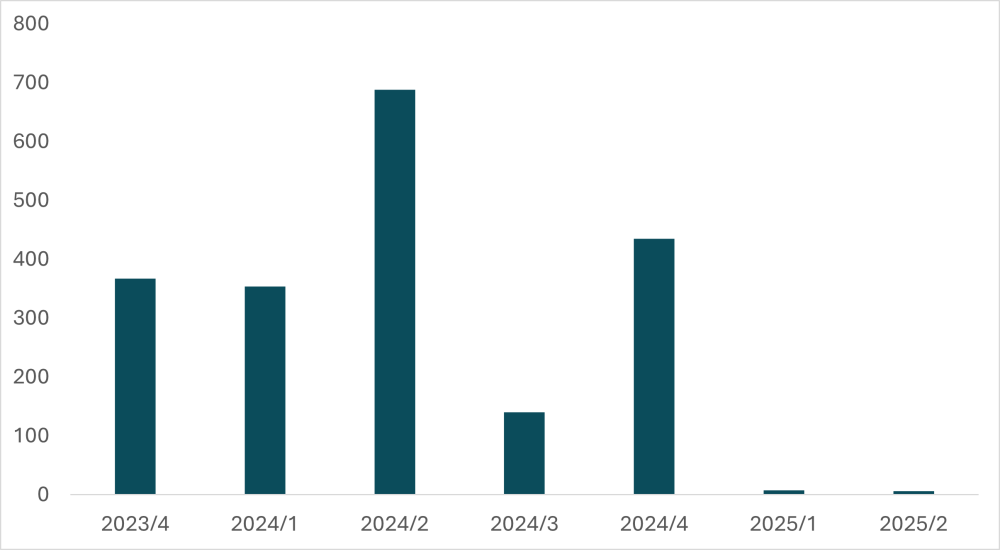
Source: https://www.usaspending.gov/federal_account/019-1126
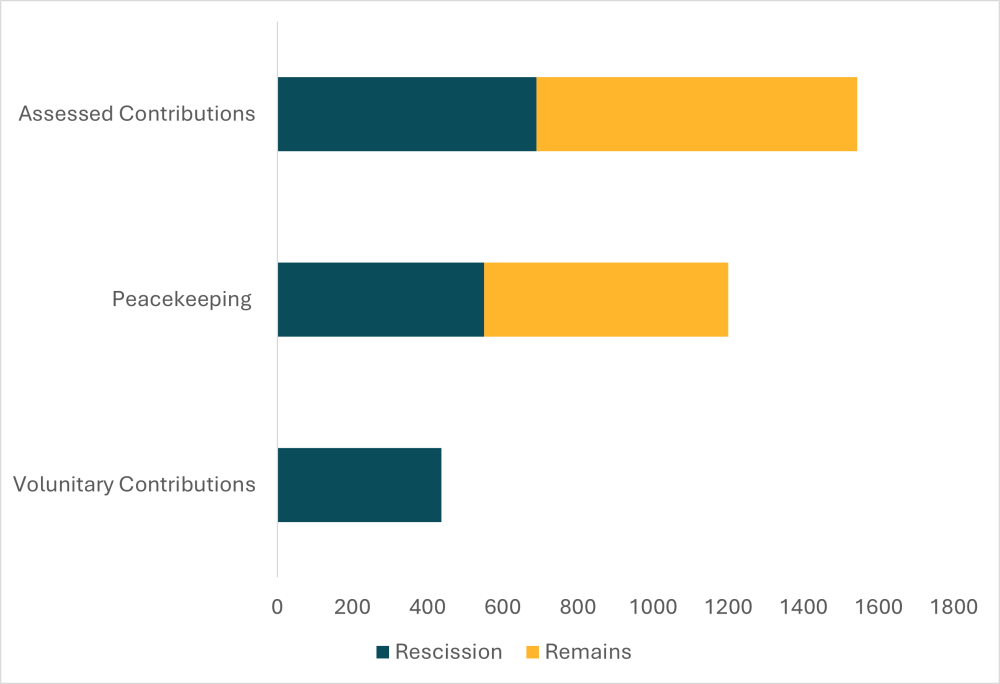
Past and proposed rescissions have cut a total of $723 million from the account in FY24 and FY25 funding. Out of $1,583 million originally available, these rescissions reduced the total to $860 million. Given $491 million has been obligated, that leaves $369 million to be spent. But $369 million is nowhere near enough to fund America’s assessed dues to all of the organizations involved.
Looking at the largest recipients of the main CIO account in FY24, the UN itself has seen FY25 obligations worth less than one half of the FY24 budgeted amount, and that puts it only behind the International Atomic Energy Agency and the International Civil Aviation Organization amongst the 16 largest recipients in terms of FY25 obligations compared to FY24 budget. Nine of those major recipients have not received obligations this year, including the World Health Organization but also the Food and Agriculture Organization, NATO and the OECD.
Funding from State International Organizations Account” to “Funding from State International Organizations Account $000s
| FY24 | FY25 Payments Obligated | Status | |
|---|---|---|---|
| United Nations Regular Budget | 707,048 | 327,002 | |
| World Health Organization | 118,949 | Withdrawn | |
| International Atomic Energy Agency | 112,734 | 83,425 | |
| Food and Agriculture Organization | 109,056 | ||
| International Labor Organization | 98,791 | ||
| UN Educational, Scientific, and Cultural Organization | 75,516 | Withdrawn | |
| North Atlantic Treaty Organization | 74,755 | ||
| Organization for Economic Cooperation and Development | 74,111 | ||
| Pan American Health Organization | 58,965 | 11,109 |
Rescission* |
| Organization of American States | 45,442 | 11,590 | |
| World Trade Organization | 26,708 | ||
| International Civil Aviation Organization | 19,266 | 9,323 | |
| Organization for the Prohibition of Chemical Weapons | 18,269 | ||
| World Meteorological Organization | 17,114 | ||
| Inter-American Institute for Cooperation on Agriculture | 14,687 | 3,672 | |
| International Telecommunication Union | 13,726 | 250 | |
| Note: Other International Organizations | 31,653 | 571 | |
| Total | 1,616,790 | 446,942 | |
| Total Minus US Withdrawn | 1,422,325 | 446,942 | |
| Note: Total Obligations Reported to Account | 490,922 | ||
| Note: Initial FY25 Appropriations | 1,543,452 | ||
| Note: FY25 App Minus Enacted/Proposed Rescissions | 853,452 | ||
| Note: Approximate remaining balance | 362,530 |
Source: State Department Budget, USASpending Note: *specifically called out in recent rescission language.
If the proposed ‘pocket’ rescission goes through, all of the resources left would be insufficient simply to fund the United Nations at its 2024 level, and the choice will be between providing approximately one-third of assessed dues to the 46 organizations covered by the account, or simply zeroing out a considerable number of them, paying nothing of what the US owes.
Rescissions packages have also slashed UN Peacekeeping funding to well below America’s assessed contribution. The first round removed $203 million of the $1.4 billion appropriated in FY24 (essentially all that remained) and $158 million from the $1.2 billion appropriated in FY25. A second proposed cut is for $393 million for FY25, which would leave approximately $683 million of budgetary resources in the account. So far, there have been no obligations or outlays at all in FY25 to UN peacekeeping operations. (It is also worth noting the administration has halted nearly all spending on US direct support to peacekeeping and requested a rescission of $110 million of the $410 million appropriated in FY24 and $326 million of the $410 million appropriated in FY25 for that account).
Beyond assessed contributions, in FY25 there have been no obligations out of the $437 million dollar fund dedicated to voluntary contributions to international organizations from a separate State Department account: International Organizations & Programs. This account was used to back the activities of organizations including UN Development Program and the Montreal Protocol to reduce ozone emissions. In July, the entire amount in the account was rescinded.
FY25 State Department Budget for International Organizations ($m)
Many other parts of the US government also provide funding to international organizations, but much of this support has also been reduced or terminated. UNAIDS received obligations of $106 million in FY24 and a negative $7 million due to a cancelled award with unpaid obligations. So far this fiscal year, UNICEF received obligations of $1.1 billion in FY2024 compared to just $168 million so far this year. The same numbers for the World Food Programme are $4.3 billion and $325 million.
The table below shows the top ten international organizations funded by the US government in 2023, along with obligations from that year, 2024, and so far in FY25. Of these, only the Global Fund to Fight AIDS, Tuberculosis, and Malaria has seen an increase. The World Food Programme’s funding has been cut by more than 90 percent while UNICEF’s support has seen a decline from $1 billion to $168 million. (Note the list includes United Nations affiliated agencies and treaty organizations but excludes institutions such as the Multilateral Development Banks).
| International Organization | Total Contribution Amount ($m) | ||
|---|---|---|---|
| 2023 | 2024 | 2025 | |
| (to date) | |||
| World Food Program | 3800 | 4300 | 325 |
| Office of the United Nations High Commissioner for Refugees | 1600 | 2100 | 818 |
| International Organization for Migration | 1300 | 1700 | 579 |
| United Nations Children's Fund | 1000 | 1100 | 168 |
| United Nations | 874 | 621 | 349 |
| The Global Fund to Fight AIDS, Tuberculosis, and Malaria | 812 | 2300 | 1300 |
| North Atlantic Treaty Organization* | 768 | ||
| International Committee of the Red Cross | 541 | 103 | 0 |
| World Health Organization | 457 | 553 | 133 |
| United Nations Relief and Works Agency for Palestine Refugees | 371 | 119 | 0 |
| Source (for top 10) Report to Congress, (for contributions) USA Spending | |||
| *USASpending does not appear to report DoD contributions, FY23 # from Report to Congress |
Looking at funding volumes and largest recipients overlooks a number of smaller organizations that are vital to US interests, prosperity and safety but (so far) zeroed out by the cuts. These include organizations helping protect US intellectual property rights worldwide, enforcing international agreements on whaling, coordinating rules for the global shipping fleet, tracking criminal payments, enforcing the global nuclear test ban and chemical weapons treaties, and managing activities in the Antarctic.
Funding cuts in the CIO account in particular suggest a widespread assault on US participation in international organizations including many treaty organizations to which the US is a party (all of those listed in the table by name are treaty organizations). The White House budget proposal for the CIO budget in FY26 continues this trend: at $264 million, slashing funding by 83 percent from the initial FY25 budget while only seven out of 46 organizations are budgeted for any funding at all. Zeroed out institutions include the World Trade Organization, the Organization for Economic Cooperation and Development, the Organization of American States, and the World Intellectual Property Organization, while the FY26 proposal also eliminates financing for peacekeeping. That suggests the administration is sidestepping Congressional prerogatives on both funding and treaty participation. Legislators should take note.
Topics
DISCLAIMER & PERMISSIONS
CGD's publications reflect the views of the authors, drawing on prior research and experience in their areas of expertise. CGD is a nonpartisan, independent organization and does not take institutional positions. You may use and disseminate CGD's publications under these conditions.
Thumbnail image by: World Bank Photo Collection/ Flickr