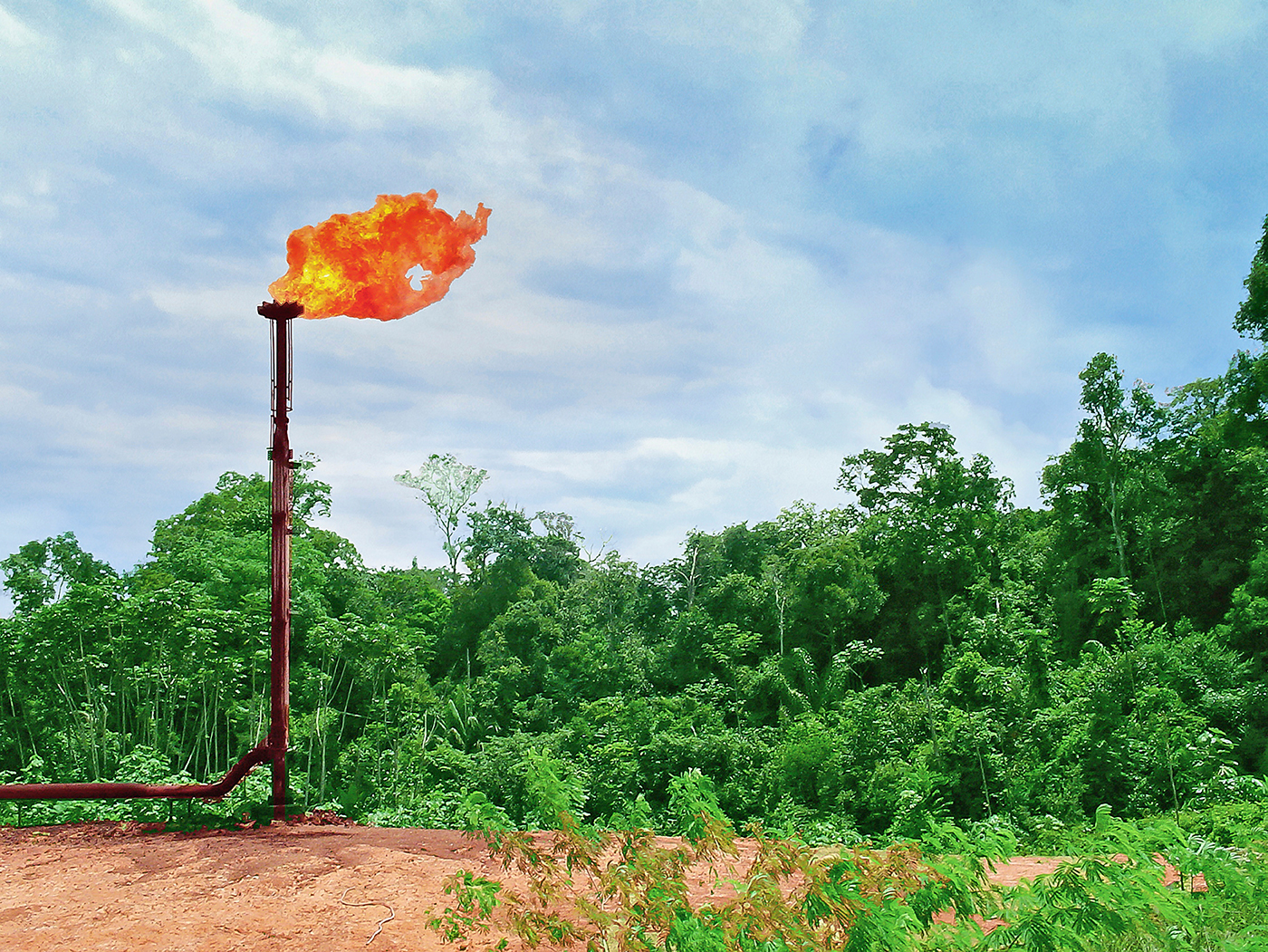
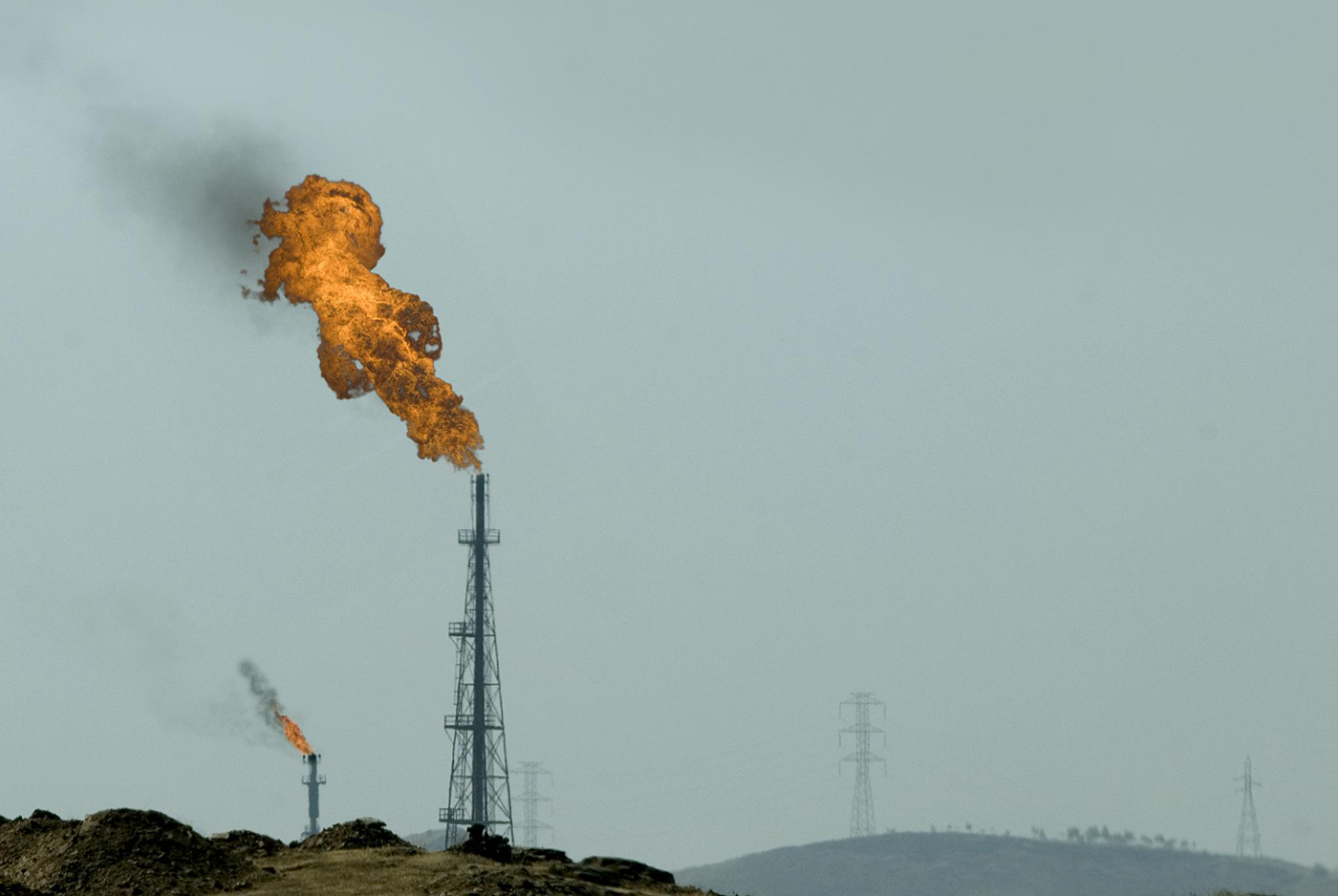
Every year, oil and gas producers burn off or vent into the atmosphere roughly 8 percent of the gas they extract—waste worth more than $100 billion and greater than all the gas consumed annually across Africa. Governments often lack information on the location and volumes of gas being flared and vented. Though satellite technologies help address this issue, oil and gas companies seldom have commercial incentives to capture the gas that they routinely flare and vent to produce oil (except in some highly regulated countries).
Reducing this waste is not an intractable problem. It is a policy failure. And fixing it would deliver a rare combination of benefits: more government revenue, cleaner air, greater energy access, and meaningful progress on climate.
A team from CGD and EnergyCC is working to help countries capture these gains. This blog outlines the four main channels through which flaring reduction pays off. Subsequent posts will develop these and other aspects of our work.
Revenue lost in the air
Governments across the developing world are squeezed for resources. Debt levels are elevated, aid budgets are under pressure, and domestic revenue bases remain thin—a problem that has only deepened since the COVID-19 pandemic and global conflicts. Against that backdrop, the scale of revenue forgone from gas flaring is striking. Our calculations show that in Nigeria alone, the value of wasted gas runs between $1 billion and $2 billion a year. If gas flared in 2021 had been captured and exported as liquefied natural gas, we estimate Nigeria’s exports would have been roughly a quarter higher than they were. Under a well-designed tax regime, some of that value would flow to public coffers.
Yet voluntary commitments have not delivered. For example, the World Bank’s global public-private initiatives since 2002 to reduce flaring and venting have not realized their potential. At the global level, flaring is rising, not falling. The experience of countries like Brazil and Nigeria shows that progress is possible, but it requires more than pledges.
The most promising lever is a well-designed methane tax that penalizes emissions and creates incentives to capture and monetize gas rather than waste it. Norway has demonstrated that effective regulation, combined with a methane tax and support for small-scale gas utilization, can dramatically reduce emissions. Most developing countries lack Norway's institutional capacity, but they don't need to reinvent the wheel: workable templates already exist and can be adapted to country circumstances with targeted technical assistance.
But how can this be brought about? Some impetus to collective action is needed. One idea is for the International Monetary Fund (IMF) to use its well-established processes to provide policy advice and technical assistance to nudge the adoption of a performance-based tax system. With its unique global reach, the IMF can offer standards for good practice, help countries access needed technical support, and provide a forum for cross-country sharing of experience. The IMF comments annually on each country’s macroeconomic policies, including taxation, and thus has a ready-made tool to raise flaring and venting taxation on the policy agenda. Developing a handbook and template for coordinated action is one of the goals of the CGD-EnergyCC project.
A public health emergency hiding in plain sight
The health costs of gas flaring are severe and largely invisible in policy discussions. Flaring produces a toxic mix of particulates, carcinogens, and ozone precursors. Studies have linked proximity to flare sites to elevated cancer rates and higher rates of disease among children. Oil and gas are one important source of methane; the emissions from all sources covered by the Global Methane Pledge—if reduced by 30 percent by 2030—are projected to prevent 5.6 million deaths through 2050 from ozone exposure alone.
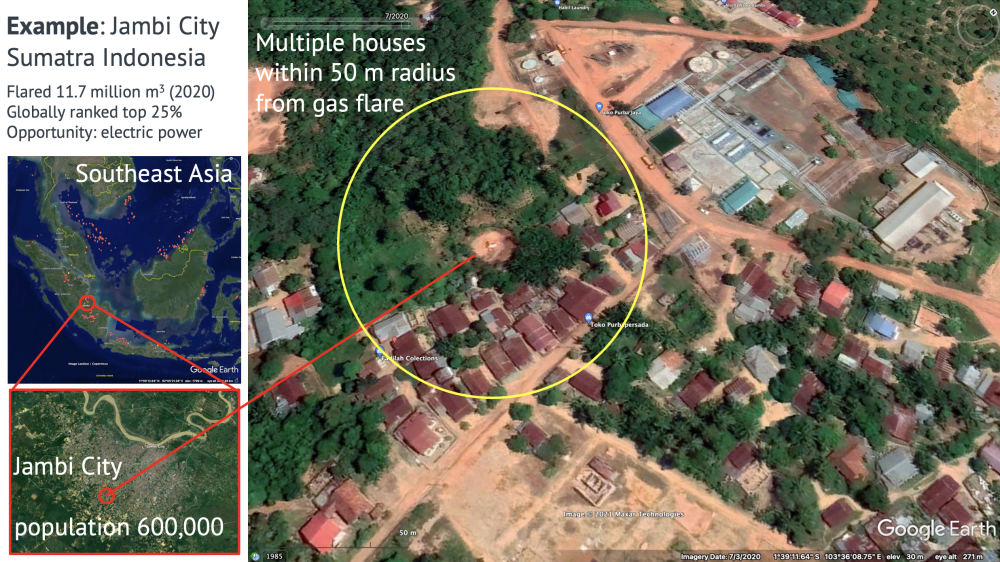
The problem is not abstract. One of Indonesia's 200 active flares sits in the middle of Jambi City, where it has burned continuously since 1948 (Figure 1). Satellite imagery shows homes and food storage facilities within close range of the flare. This has been tolerated for more than 75 years. Better data linking flaring to local health outcomes would make the human cost impossible to ignore. Strengthening that evidence base is a core part of the CGD-EnergyCC research agenda.
Figure 1.
Energy wasted next door to energy poverty
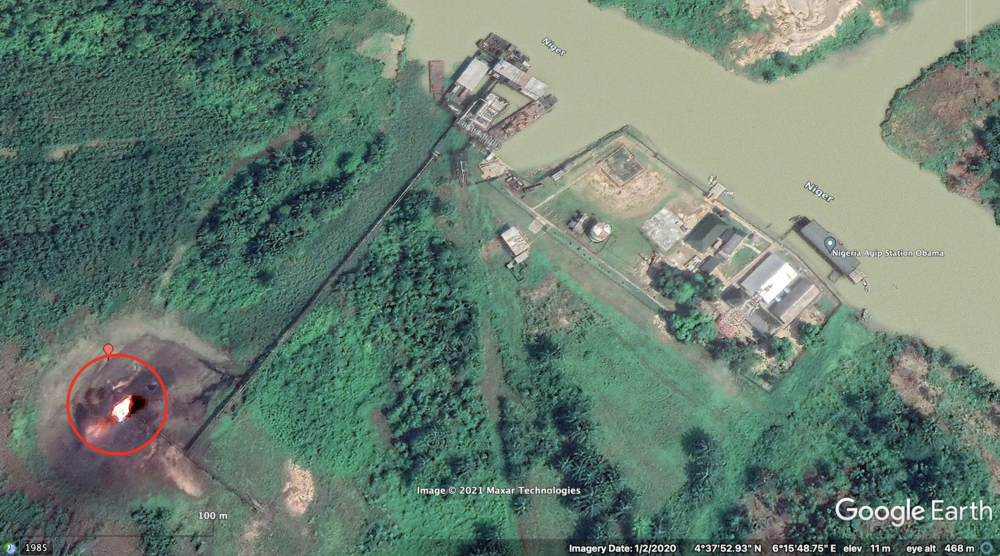
More than 500 million people in Africa lack access to electricity. Much of the gas being flared and vented on the continent could, with the right infrastructure, power homes and businesses instead. The economics depend on flare and vent volume and proximity to potential users, but the opportunities are sometimes strikingly direct. In one Nigerian example (Figure 2), a major flare sits immediately adjacent to a marine fuel station—a site where captured gas could be converted to compressed natural gas on the spot.
Figure 2. Repurposing flare gas: potential compressed natural gas fuel opportunity in Nigeria utilising already existing infrastructure
The same logic applies beyond Africa. The Jambi City flare in Indonesia has been burning for over 75 years in a city that is short of electricity. The cumulative value of the gas wasted there is substantial—and technologies exist today that can monetize the wasted flare and vent gas and connect it to the local grid. Precisely because these flares last so long, gas monetization can meet commercial thresholds. Identifying and prioritizing these opportunities is another strand of the project's work.
Flaring/venting reduction and climate commitments
Reducing gas flaring and venting is one of the quickest and most effective contributions producer countries can make toward their climate goals. Some have included flaring and methane reductions in their Nationally Determined Contributions (NDCs), and the sector falls squarely within the scope of the Global Methane Pledge now endorsed by over 150 countries—to cut methane emissions by 30 percent by 2030 and thereby shave an estimated 0.2°C off global warming by 2050.
Nigeria has pioneered formalizing its commitment: its 2021 NDC included explicit methane targets for the oil and gas sector, and its 2023 Gas Flaring, Venting and Methane Emissions Regulations were the first such regulations in Africa. Brazil’s 2024 NDC to reduce greenhouse gas emissions did not include specific methane targets for the oil and gas sector, though new regulatory frameworks are being introduced and the National Energy Policy Council (CNPE) adopted guidelines that call for zero routine flaring and explicit measures to curb methane leaks across upstream operations.
The case for international cooperation
Action at the national level unambiguously yields local benefits, while contributing to the global good. At the global level, it would make sense to focus on the top 300 super-emitter flares—responsible for around 42 percent of global flaring emissions—that are spread across 26 countries, nearly all of them developing economies. But for all oil and gas producers, policy strategies and shared technical know-how, including on a structured template for taxation, need to be put in place. The role of international institutions, including the IMF, will be key. The global effort will be helped by greater understanding of the health effects and the opportunities for energy use.
The demand is there. At the New Producers Group's 2024 Annual Meeting in Suriname, governments from across the developing world—including many in Africa—pressed for help managing the tension between resource development, emissions control, and mounting debt. The CGD-EnergyCC project is designed to respond to exactly that need: building the analytical foundation, the policy templates, and the international cooperation required to turn a $100 billion waste problem into a source of revenue, health, and energy for the countries that can least afford to keep squandering it.
Note: This blog post was updated to clarify the reference to World Bank public-private initiatives to reduce flaring and venting.
Topics
DISCLAIMER & PERMISSIONS
CGD's publications reflect the views of the authors, drawing on prior research and experience in their areas of expertise. CGD is a nonpartisan, independent organization and does not take institutional positions. You may use and disseminate CGD's publications under these conditions.
Thumbnail image by: Google Earth