Recommended

Blog Post
When Is a Country Too Rich for Aid?
Blog Post
Assessing the UK’s International Development Reset
Blog Post
How the UK Should Focus Its Aid in 2026

How much aid is actually spent abroad? That’s an important question, and we think we need a clear way to measure and talk about it. But Official Development Assistance (ODA) is no longer a good measure of overseas or international aid or development. To that end, we have coordinated with UK development watchers to establish a new measure, called “International Assistance.” International Assistance is the subset of Official Development Assistance (ODA) which is actually spent abroad.
This measure will enable organisations to refer to a government’s aid spend in a way that excludes the significant and fluctuating amounts spent domestically. This is of particular interest to those monitoring the UK’s ever-dwindling aid budget, as our analysis shows over £20 billion of ODA has been spent within the UK since 2020.
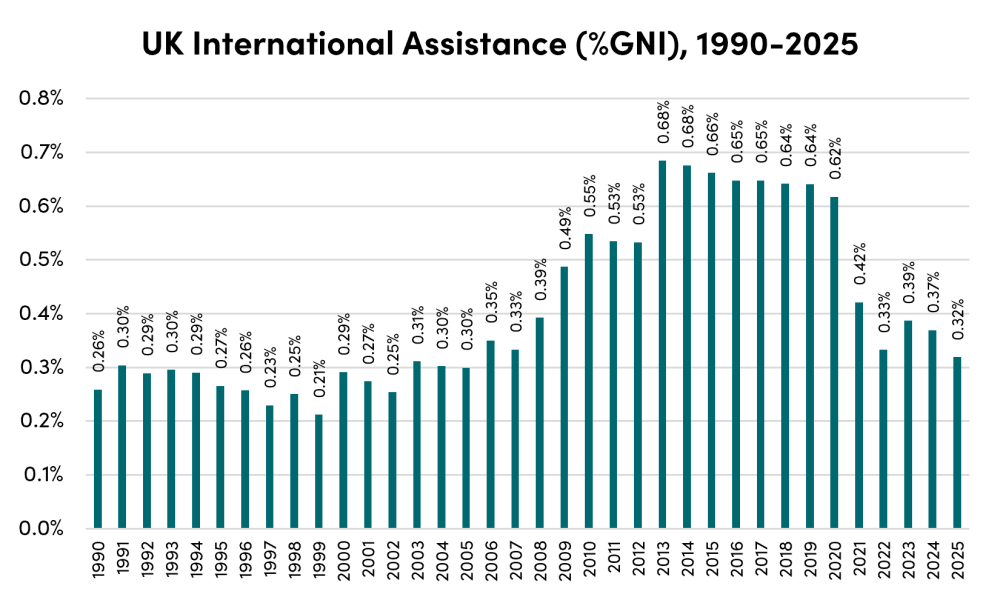
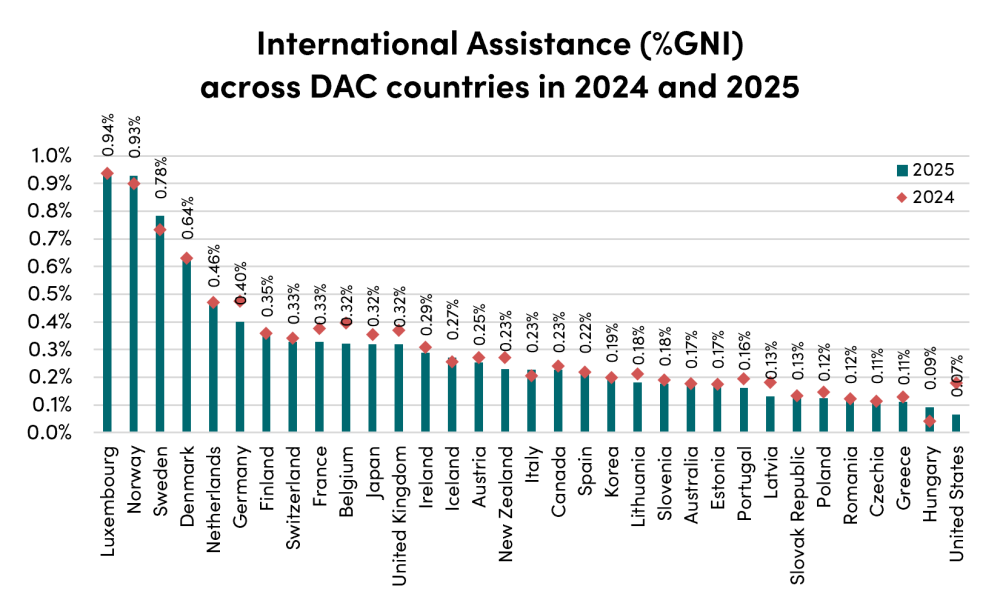
Following the publication of preliminary ODA data in 2025, we calculated the amount spent on true International Assistance, explored the historic trend, and drew comparisons with other providers. We find that the UK’s International Assistance was at 0.32 percent of national income in 2025. Even before the government’s cuts to aid take full effect, this is the lowest level since 2005; and below that of France, Germany, Japan and Switzerland. We intend that partners can calculate and use this measure and put a sharper focus on genuine international development spend.
What is International Assistance?
International Assistance is a grant equivalent measure of cross-border, concessional finance publicly provided for humanitarian or development objectives. It includes support to international organisations like the UN and World Bank, as well as the amounts provided directly to developing countries. It excludes spending on refugees and asylum seekers living within the donor country, support for international students, and administrative costs, as well as debt relief provided to domestic entities (all of which are counted as ODA).
The UK is among the highest spenders of ODA within its borders. Since 2020, when the UK began to cut its aid from its pre-pandemic peak, it has spent over £20 billion, a quarter of its ODA budget, on these areas. Domestic costs have risen substantially over time, apart from debt relief (which is lumpy and concentrated in 2005 and 2006). Excluding debt relief, they were well-under £1 billion in the 1990s, £2.4 billion in the 2000s, £6.9 billion in the 2010s and have already reached £19.8 billion in the 2020s. Put another way, these costs had never more than a tenth of ODA before 2020, but jumped to over a third in 2022 and 2023 and remain around a quarter.
How much does the UK provide?
The UK provided £9.6 billion of International Assistance in 2025. Over a quarter of ODA did not qualify as International Assistance, with 74 percent of ODA qualifying in 2025, unchanged from 2024. £9.6 billion of International Assistance in 2025 is equivalent to 0.32 percent of the UK’s Gross National Income (GNI), down from 0.37 percent in 2024. This represents a real terms cut of 11 percent, down by £1.2 billion (in 2025 prices).
The following table lays out these latest figures in comparison to ODA:
Table 1. Latest Figures on UK International Assistance
| UK International Assistance | UK ODA | |||||
|---|---|---|---|---|---|---|
| Unit | 2024 | 2025 | Change | 2024 | 2025 | Change |
| £m, current prices | 10,424 | 9,633 | -8% (-£790m) | 14,082 | 13,036 | -7% (-£1,046m) |
| £m, constant 2025 prices | 10,809 | 9,633 | -11% (-£1,175m) | 14,603 | 13,036 | -11% (-£1,567m) |
| %GNI | 0.37% | 0.32% | -0.05 pp | 0.50% | 0.43% | -0.07 pp |
| ODA qualifying as IA (%) | 74% | 74% | 0 pp | N/A | N/A | N/A |
Source: CGD calculations using data from the OECD’s DAC1 dataset (updated 29/04/2026) and the UK’s Office for National Statistics (via HM Treasury)
How does UK International Assistance compare historically and with partners?
Looking across a longer timeframe shows that the International Assistance provided by the UK in 2025 fell to its lowest share of GNI since 2005.
Figure 1.
Source: CGD calculations using data from the OECD’s DAC1 dataset (updated 29/04/2026) and the UK’s Office for National Statistics (via HM Treasury)
Note: Net ODA is used before 2018, as grant equivalent data was not yet available.
Across the 33 countries in the Development Assistance Committee (DAC), the UK was the twelfth largest provider of International Assistance as a share of GNI in 2025, falling from its rank of ninth place in 2024.
Figure 2.
Source: CGD calculations using data from the OECD’s DAC1 dataset (updated 29/04/2026)
The UK’s historic low in overseas spend
The UK is also on track spend its lowest share of GNI as International Assistance in 2027-28 since at least 1990. The Government’s spending review set out Departmental ODA spending plans—most cuts are still to come with ODA set to fall by £3.8bn from 2025 to the 2027-28 fiscal year. Departmental plans exclude in-donor refugee costs (the largest component of the UK’s domestic ODA spending). If we (conservatively) assume that administrative costs fall in line with the overall ODA budget (i.e. remain the same in proportional terms), that in-donor student costs remain the same in nominal terms, and that no debt relief is provided, then UK International Assistance would fall to £6.7 billion in 2027-28, equivalent to 0.208 percent of GNI (based on OBR projections from March) – this would be the lowest level since at least 1990 (the previous low was 0.212 percent in 1999).
Why do we need a narrower measure?
Everyone from the Prime Minister, to parliamentarians and the public refers to overseas aid when they talk about international development. The UK parliament’s 2021 vote to reduce aid spending to 0.5 percent of GNI referred to “overseas aid” and “international aid”. The government’s announcement last year of the further reduction referred to “Overseas Development Assistance” falling to 0.3 percent of GNI by 2027 and the Prime Minister regularly referred to “overseas development” in his statement to parliament. When the public are surveyed on their support for ODA, the question they are asked actually refers to “overseas aid”. This reflects a clear intuition that aid is the amount spent internationally.
But ODA is no longer a good measure of overseas or international aid or development. Ostensibly ODA must be “administered with the promotion of the economic development and welfare of developing countries as its main objective” but in reality it includes spend which is barely relevant to this objective: most obviously the significant elements spent within the provider’s own borders.
Domestic spending on refugees and asylum seekers currently comprise almost a fifth of the UK ODA budget, and government spending plans show they are expected to remain at this level until 2027-28 (despite plans to reduce asylum costs).
But UK aid is also spent domestically on administration, hosting international students, and debt relief that goes to UK entities. These areas of spend are important; but are distinct from international aid.
The share of UK ODA spent domestically has risen dramatically in recent years, the government has ignored repeated pleas to report these costs conservatively in line with OECD requirements, and the UK is an outlier among its G7 peers.
How does this compare to other measures?
A number of aid measures excluding non-cross-border flows have already been developed and used as alternatives to ODA. These include Country Programmable Aid (OECD), Real Aid (by ActionAid), Real ODA (by Eurodad), non-inflated ODA (by CONDORD) and our own Finance for International Development (which we use to compare G20 and OECD countries). The below table provides a summary of these measures. Each excludes or discounts a different selection of domestic flows; and most go further in also excluding additional cross-border flows.
Table 2. Summary of Alternative Aid Measures and the Flows they Exclude from ODA
| Flows Excluded from ODA | International Assistance | CPA (OECD) | Real Aid (ActionAid) | Real ODA (Eurodad) | Non-Inflated ODA (CONCORD) | FID (CGD) |
|---|---|---|---|---|---|---|
Domestic flows excluded | ||||||
| Refugees | X | X | X | X | X | X |
| Admin | X | X | X* | X | ||
| Students | X | X | X | X | X | X |
| Development awareness | X | X | ||||
| Research | X | |||||
| Debt relief | X | X | X | X | X | X |
Cross-border flows excluded | ||||||
| Humanitarian | X | |||||
| Core support to NGOs | X | |||||
| Equity investments | X | |||||
| Unallocated by sector or recipient | X | |||||
| Middle-Income Country recipients | X* | |||||
| Technical Assistance | X* | |||||
| Tied Aid | X* | |||||
| Coordination costs | X | |||||
| Covid-19 vaccines | X | |||||
| Ukraine | X | |||||
| Private Sector Instruments | X | |||||
| ODA loans | X* |
*Partially discounted rather than completely excluded.
Although these measures have been worthwhile and impactful, few were used by more than one organisation in part due to differing advocacy goals. International Assistance focuses on a single objective principle—whether spending crosses borders. Consultations across the UK development sector since October 2025 have helped build consensus around this approach and the flows that should be included within it. We intend International Assistance to provide a common measure of how much UK aid is spent overseas which can be easily understood.
How can I use International Assistance?
Further statistics on International Assistance are available via the linked spreadsheet. This contains a “UK Timeseries” sheet covering the period 1990 to 2025, and a “DAC Cross-section” sheet for comparison across countries in 2025 and 2024. Statistics on International Assistance are provided in nominal and real terms, as a share of GNI, and as a share of ODA. We also intend that organisations can calculate it themselves and details on how to do so are contained in the linked spreadsheet.
If you would like to receive future statistics on International Assistance, please contact: [email protected]
We hope this will be useful measure of true international aid and that it will help focus the attention of policy-makers and commentators on the value that matters.
Topics
DISCLAIMER & PERMISSIONS
CGD's publications reflect the views of the authors, drawing on prior research and experience in their areas of expertise. CGD is a nonpartisan, independent organization and does not take institutional positions. You may use and disseminate CGD's publications under these conditions.
Thumbnail image by: DFID/ Flickr