Recommended
POLICY PAPER
China in the Multilateral Development System

Event
China’s International Climate Finance: A Blind Spot in Global Discussion
VIRTUAL
November 07, 2024 9:00—10:30 AM ET | 2:00—3:30 PM GMT
POLICY PAPER
China as a Provider of International Climate Finance
A decade ago, China helped launch two new multilateral development banks, the Asian Infrastructure Investment Bank (AIIB) and the New Development Bank (NDB). With Washington lobbying allies to stay out of the AIIB, many read this as the start of a parallel multilateral development system, built by a country frustrated at its limited voice in the Bretton Woods institutions. In 2016, China appeared to be emerging not just as a major bilateral creditor—having just launched its Belt and Road Initiative three years earlier—but also as a multilateral power.
Ten years on, our new paper, published today, asks what kind of multilateralist China has become. Our colleagues’ 2021 analysis found China was already an unusual multilateral actor: at once shareholder, donor, borrower, and institutional entrepreneur. We update that picture in 2026 across the major multilateral development banks (MDBs), vertical funds, and development-oriented UN bodies. For the first time, we also estimate how much multilateral climate finance can be attributed to China under the accounting framework for the new $300 billion climate goal and compare this to its global fair share.
In this blog, we highlight five of the key findings.
1. China’s financial contributions: continued growth at a slowing pace
China has not stepped back from the traditional development banks nor from the UN system since 2016; in fact, it is putting more money into them than ever. Its funding to development-focused multilaterals has doubled since 2016, to $3 billion in 2024, and risen more than tenfold since 2010 (Figure 1).
Figure 1. China’s contributions to development-oriented multilaterals, 2011–2024
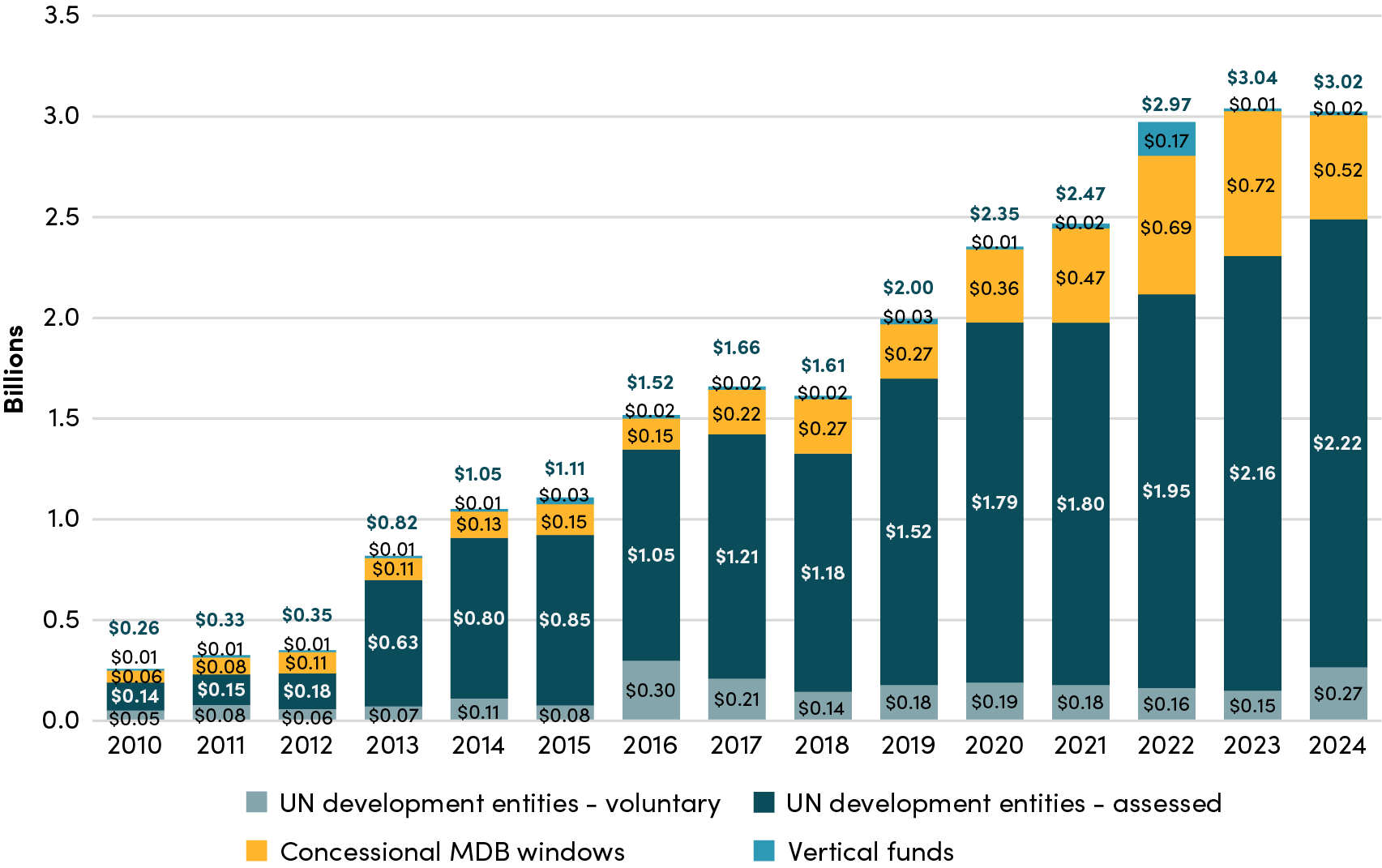
Growth in contributions to “traditional” development multilaterals has continued even as the newer multilateral institutions China helped set up have matured. The AIIB has nearly doubled its membership to 111 and approved $67 billion in financing since 2016, and the NDB has also expanded beyond the five original BRICS founders. But the pace has slowed since the early 2010s, and China appears more selective about the multilaterals it focusses on today.
2. China has solidified its role in traditional multilateral development banks
In the past five years, China’s contributions to MDB concessional windows have grown fastest (up 92 percent since 2019), driven primarily by the World Bank’s most concessional window supporting low-income countries, the International Development Association (IDA). China’s $1.5 billion pledge to IDA21 makes it the 5th largest contributor, up from 6th under the previous IDA20 replenishment, and 28th in 2010. Its increased contributions come in the context of wider donor retrenchment, with total donor pledges of $23.7 billion to IDA21 essentially flat against the previous round’s $23.5 billion in nominal terms (which represent a cut in real terms due to inflation). Its contributions to the ADB’s Asian Development Fund and the AfDB’s African Development Fund have also increased, but much more modestly.
Figure 2: China’s Rising Donor Rank Across Concessional MDB Windows, 2010–2026
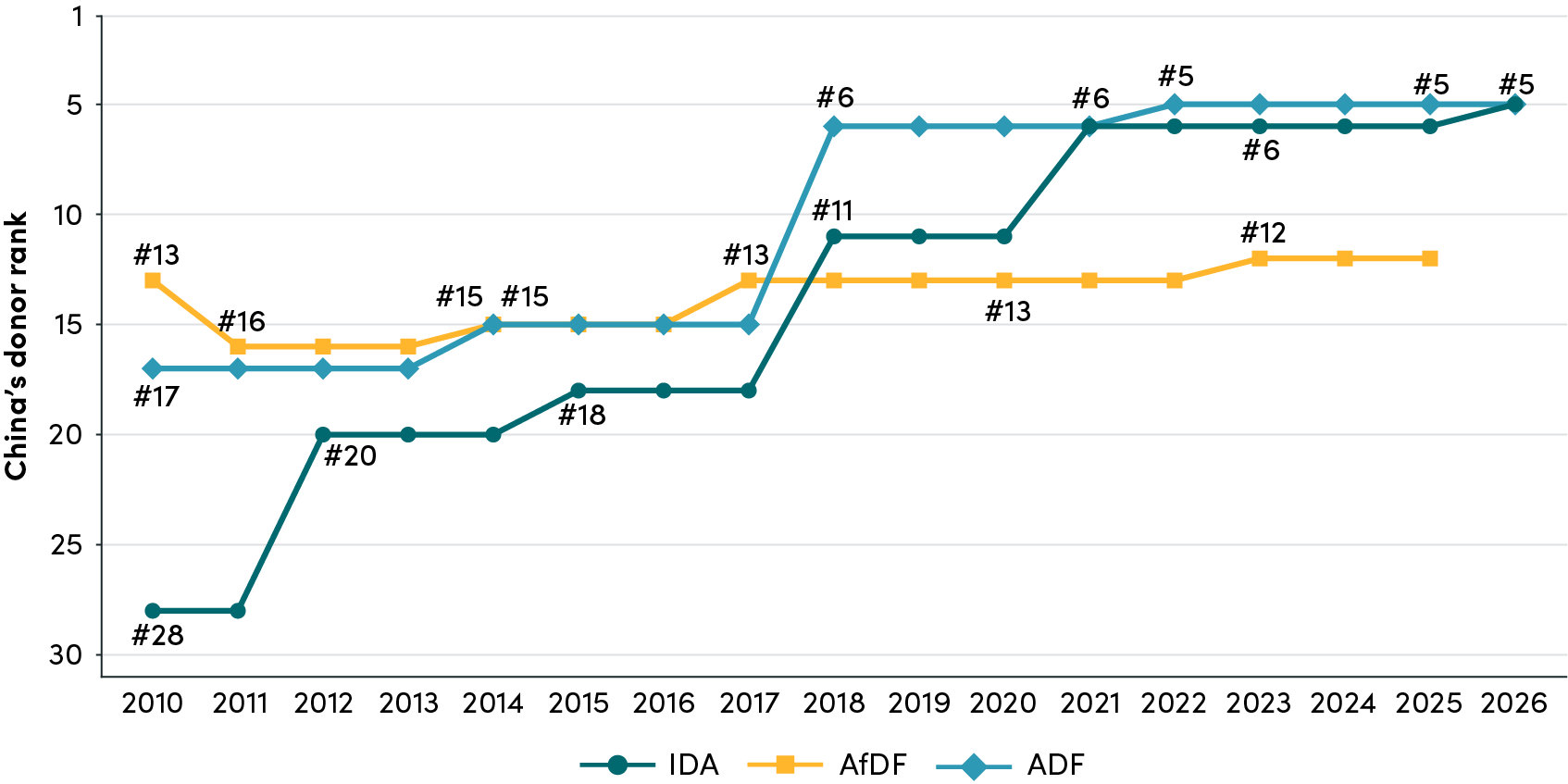
Sources: Finance for International Development workbooks—based on IDA, AfDF, and AsDF replenishment documents from 2010 through 2025.
Note: Ranks reflect annualised contributions, rather than pledges in the year they were made. IDA contributions in 2022 and 2023 reflect the overlap of the 19th and 20th replenishments. AfDF documentation makes it possible to calculate ranks only until 2025.
By way of contrast, China’s contributions to the UN have risen at half the pace, and finance for vertical funds has remained small and uneven, although it made larger, one-off contributions to the Pandemic Fund and Gavi’s COVAX in 2021.
A side effect of China’s wider contributions to the MDBs is the growth of its climate finance. China's attributable multilateral climate finance reached $5.25 billion in 2025 (up from $600 million in 2017). At 5.4 percent of total MDB climate finance outflows, contributions through this channel now approach the lower end of China’s global fair-share range.
3. China’s borrowing has almost halved in three years
China’s domestic situation has also changed, and it now sits on the cusp of graduating to high-income status according to the World Bank. China’s borrowing from the MDBs had already been declining from a peak of $8.1 billion in 2021 down to $4.7 billion in 2024, and some banks are now phasing out lending to China altogether. The World Bank’s main lending arm of middle-income countries, the IBRD, announced this summer that it plans to phase out all lending to China after 2031. This continues an ongoing trend, where China had already fallen from being the IBRD’s largest client in 2017 to its 18th largest in 2025.
China is a net contributor to the multilateral system. Although the face value of finance China received from the MDBs looks larger than its 2024 contributions (Figure 1), these are all repayable loans, as opposed to contributions which are equivalent to grants. China’s borrowing is also generally on market or near-market terms whose grant element is only a fraction of the loan amount, as it has long graduated out of the most concessional windows, like IDA. At the UN, it contributes nearly 18 times more than it receives.
4. The size of China’s economy implies its role at the World Bank should double
China's growing contributions have not necessarily translated into a matching voice, with statements such as its June 2026 White Paper on global governance pressing for reform. China holds about 6 percent of IBRD shares, roughly half the 12 percent the World Bank's own formula implied at its last published benchmark, and the gap has likely widened since. But the 2025 shareholding review has closed without change, leaving developing countries and China with no more voice than before, and no opportunities for realignment until the next review in 2030.
5. China’s assessed funding at the UN puts it second highest, but its role in senior governance has shrunk
Also at the UN General Assembly last month, China called for a stronger UN, with a greater voice for the Global South.
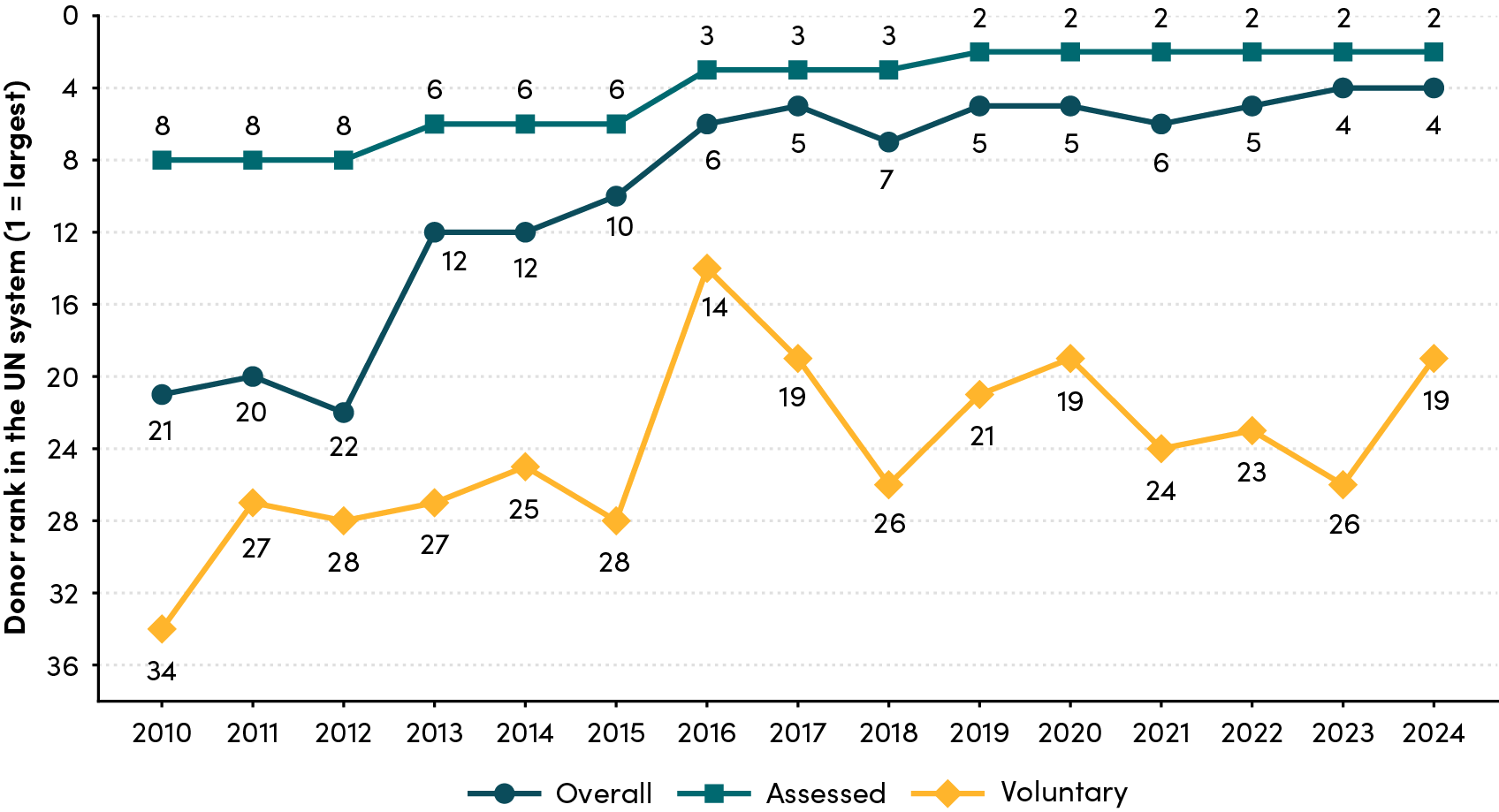
Figure 3: China’s Rank as a UN Government Donor, 2010–2024, Overall vs. Only Assessed vs. Only Voluntary Contributions
Source: UN CEB
China’s funding to UN entities has grown by 47 percent, rising at roughly the same pace for both assessed and voluntary contributions. China’s assessed contributions—based on UN formulas reflecting the size of its economy—are now the second largest within the UN, but its voluntary contributions—which more clearly demonstrate Beijing’s policy priorities—rank only 19th, and include agencies like IFAD and UNDP, where Chinese nationals held senior positions in 2024. In 2025, China also pledged an “additional” $500 million for the WHO, which would make it the WHO's largest government donor in the years ahead, and be a roughly 40-fold increase on its previous voluntary funding, contributing to filling the roughly $350 million a year gap that US departure left behind.
Yet China's own presence at the top of the UN system has declined. Chinese nationals head two of the 56 UN bodies we track (FAO and UN DESA), and hold senior positions at four more (UNDP, UNESCO, UNIDO, and IAEA). This is a net loss since 2020, after China gave up top or senior posts at the WHO, ITU and WMO. Its leadership presence is somewhat below its 5.3 percent share of UN funding, and far below its 17 percent share of the world's population. Its wider staff presence is lower still: Chinese nationals make up just 1.3 percent of UN personnel.
China’s future role as a multilateral actor will have profound global implications
As finance ministers meet in Bangkok for the IMF-World Bank Annual Meetings next week, and just weeks after the UN General Assembly, the multilateral system is under strain. A decade ago, the debate centred on how to govern an expanding multilateral system, with the Paris Agreement and the Sustainable Development Goals having just been agreed and two new development banks opening their doors. Today, it is about how to sustain what is most vital and how multilateralism works in a more contested global environment.
It’s already clear that China is not stepping in to compensate for the US withdrawal from dozens of international bodies. But while China’s international role has grown, its multilateral contributions are still a very small share of its economy and low relative to other providers: our wider benchmarking suggests its multilateral contributions were just 0.01 percent of its economy (GNI) in 2023, less than a tenth of the average 0.14 percent share across OECD members, for example. This is understandable for a middle-income country. But as China reaches and grows through high-income status, it could comfortably increase its role in many different ways: building on its support to the MDB concessional funds; creating or expanding China-led multilaterals; supporting vertical funds on climate or health; or providing meaningful voluntary resources to the UN. These decisions will be crucial to the pace and shape of development around the world in the coming decades.
Topics
DISCLAIMER & PERMISSIONS
CGD's publications reflect the views of the authors, drawing on prior research and experience in their areas of expertise. CGD is a nonpartisan, independent organization and does not take institutional positions. You may use and disseminate CGD's publications under these conditions.