Recommended
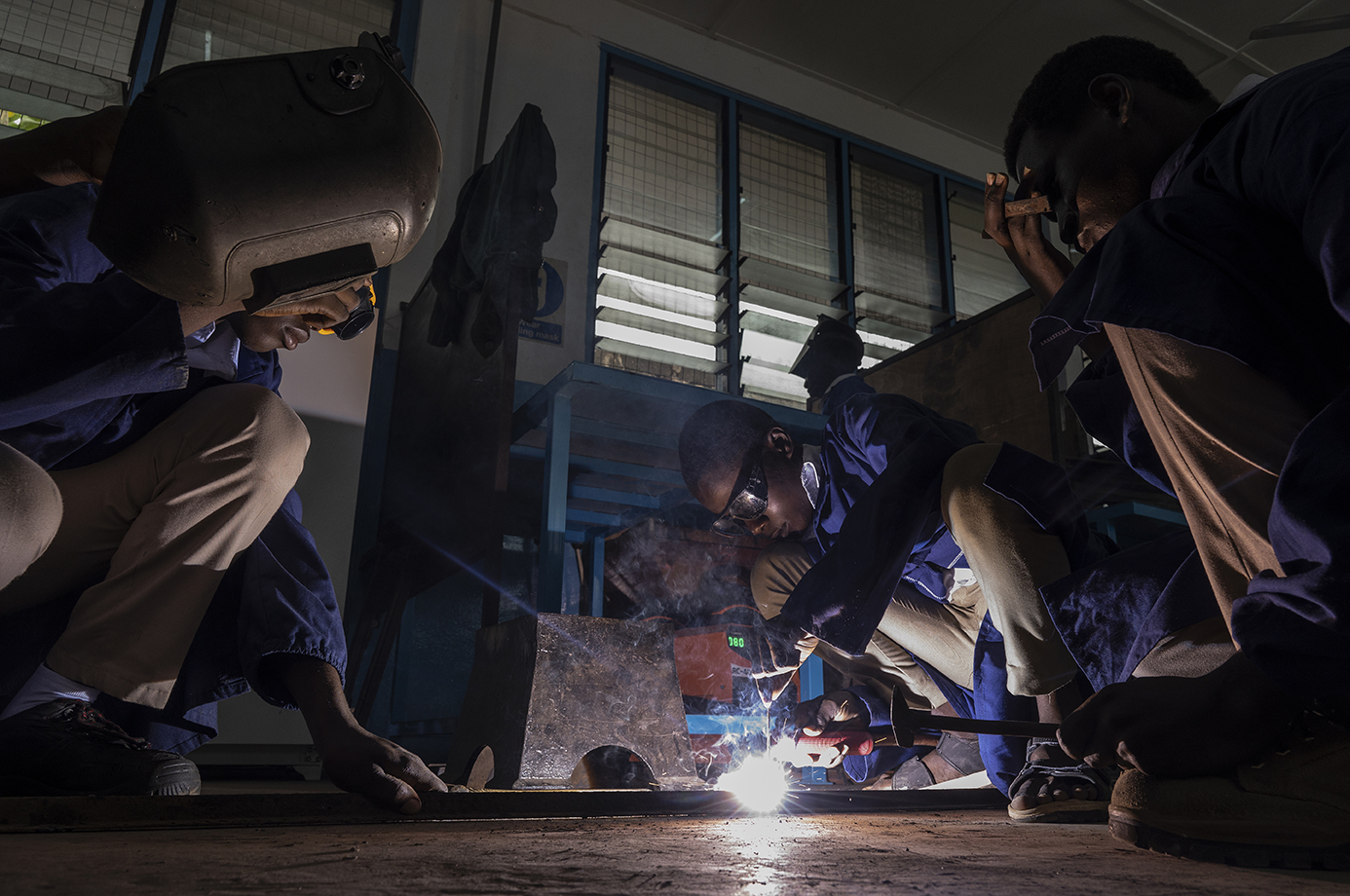
POLICY PAPER
A Landscape Analysis of Green Skills TVET Providers

Blog Post
Kenya’s Small-Business Crackdown Risks a Hammer Blow to Refugees

African countries have increasingly moved from concerns around “brain drain” to seeing labour mobility as a strategic option to reduce unemployment, build partnerships, and promote economic growth. In August in Nairobi, the CGD team saw this shift first-hand. We collaborated with Jacob’s Ladder Africa to deliver the #GreenWorks4Africa Forum, and convened a roundtable on regional mobility with the African Non-State Actor Platform on Migration and Development.
These events explored how embracing labour mobility can crowd in investment, promoting green skills and jobs across the continent. This blog draws out three key themes from the Forum, roundtable discussion, and 12 bilateral meetings.
1. Mobility is now accepted as part of Kenya’s economic development strategy
There was a striking shift in the overall tone of discussions. Reticence has turned to strategy: Kazi Majuu (which means work abroad) is more than just a slogan for Kenya’s labour mobility programme. There was general agreement across the board—from government stakeholders, employers, trade unions, and civil society—that outgoing labour mobility needs to be part of Kenya’s job creation strategy. The conversation focused on mobility as an economic opportunity and a means to leverage the country’s human capital. President Ruto has explicitly included the “export of labour” as a way to create opportunities for Kenya’s young people, alongside other investment areas including industrialisation, digital jobs, and market development.
This is largely driven by the reality of Kenya’s youth bulge. Each year, one million young Kenyans enter the job market, but there are only 200,000 formal jobs available. Mobility (within the continent as well as to OECD countries and the Gulf) is already happening. We heard of 17 pending bilateral labour agreements (BLAs), but this mobility could be much better managed. The country requires stronger systems and infrastructure to implement these programmes ethically and sustainably.
Figure 1. Employment growth in Kenya compared with job seekers, 2022-2025
Source: Derived from Table 3.1, p. 51, Economic Survey 2026, Kenya Bureau of Statistics and UN Resident Coordinator Estimate.
Note: “Job seekers” is estimated at 1,000,000 per year, based on the UN Resident Coordinator Estimate.
2. How mobility is managed is a key concern
The question is therefore not if labour mobility happens, but how its impact on economic development can be strengthened. While BLAs can serve as a useful framework, they don’t guarantee job placement, decent work, or protection mechanisms. Nor do they necessarily support sustainable return and reintegration. Civil society stakeholders also stressed that existing BLAs fail to take account of the perspectives of migrants, trade unions, and civil society actors, leaving Kenyan migrant workers without the necessary protection, support and safeguards when working in countries of destination.
Across our conversations, we heard concerns about the management of outward labour mobility. Last year, the New York Times documented exploitation in the Gulf-Kenya corridor, finding that at least 274 Kenyan workers (mostly women in domestic work) had died in Saudi Arabia over the last five years. Civil society partners working on OECD pathways state that families left behind (due to visa restrictions), protection issues, job mismatch, and racial discrimination are among critical concerns raised by migrants.
Against this backdrop, President Ruto’s comments have been met with ire. Many Kenyans see domestic jobs and economic growth as the priority, and do not think promoting mobility should supersede that; rather, it should complement it. There are attempts to address these concerns; the Labour Migration Management Bill, currently before Parliament, is looking to consolidate the laws relating to labour mobility. The bill will tighten regulation of migrant recruitment agencies, and seeks to protect the rights and welfare of Kenyans seeking work abroad, covering pre-departure training, fair recruitment, support when working abroad, and support to return.
Our position is that labour mobility should contribute to and strengthen domestic training and skill building, thereby contributing to “brain gain.” At the Forum, we organised a side event focused on how this can be done. Speakers from the International Organisation for Migration (IOM) and the East African Institute of Welding stressed the importance of ensuring migrants can move with the right skills and can return with improved skills and income, contributing to the Kenyan economic growth and development priorities. There were also calls to strengthen mobility across the region, facilitating mobility between neighbours to drive regional growth. Free movement protocols within Regional Economic Communities (e.g., the East African Community) offer opportunities, and a push towards the ratification of the African Union Free Movement Protocol (FMP) remains critical for the sustainability of mobility of skills.
Figure 2. CGD’s side event at the #GreenWorks4Africa Forum
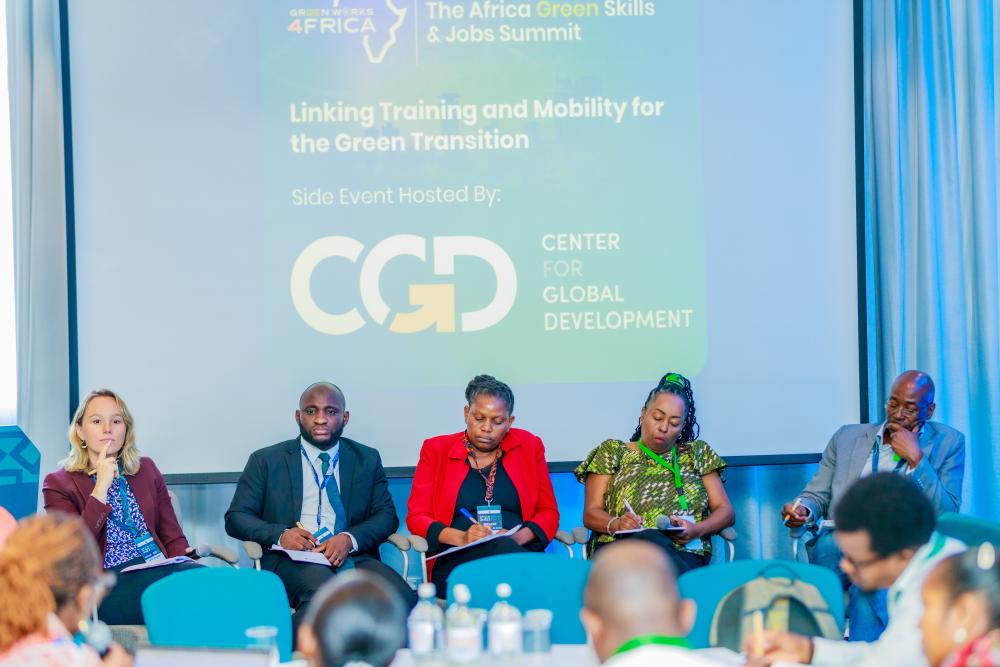
Source: Jacob’s Ladder Africa.
3. The policy architecture is in place, but investment is needed
In both our roundtable and the Forum, training and skill development came up repeatedly. Less than one percent of climate finance goes to skills development; our recent research highlighted the fact that less than two percent of all aid and only 0.2 percent of GDP in low- and middle-income countries goes toward technical and vocational education and training (TVET). If Kenya is to meet its green transition targets, it must prioritise skills development to deliver the necessary climate infrastructure.
In Kenya, this is not due to a lack of effort. Repeatedly, speakers highlighted that the policy environment is strong. There are strategies and frameworks covering technical training (curriculum, delivery, industrial training, national standards, and recognition of prior learning), as well as for labour mobility, diaspora, and the recently launched national strategy on Green Skills and Jobs. Calls were not for more policy architecture, but rather a focus on financial investment and delivery. At the Forum and its pre-convenings, six priority areas to take forward to next year's COP negotiations were examined: renewable energy and productive use of energy; circularity, industry and waste systems; e-mobility and green infrastructure; natural capital and nature-based enterprises; and industrial decarbonisation and green manufacturing.
At the Forum, CGD presented our research (coauthored with IREX) on high-performing TVET providers in Africa. We demonstrated how pairing mobility and TVET could crowd in international investment, improving equipment, infrastructure, trainer quality, as well as the overall prestige and profile of a TVET provider. Stakeholders called for stronger partnerships with TVET institutions overseas, as well as engaging private corporations for investment, and creating job pipelines for graduates. This focus on skills and jobs continued with the launch of The Africa Green Skills and Jobs Tool Kit, a practical framework for how investment in green sectors can be connected to skills and employment outcomes.
We heard of TVET providers already applying this model and having great success. The East African Institute of Welding is offering courses aligned to Kenya’s National TVET Curriculum Development, Assessment and Certification Council, and has been accredited by the Canadian Welding Bureau for International Certification. Its graduates are already migrating across the continent, with refugee populations now included in cohorts as well.
What’s next?
In just under a year, Kenya heads to the polls for a general election. Given demographic challenges, it is unlikely the broad approach to labour mobility will shift, but priority destination markets, skills, and the balance between such mobility and domestic skills and jobs investment may change. CGD has joined the Alliance for Greening Skills and Opportunities, making the case for skills and jobs to be on the agenda at COP32, to be held next year in Addis Ababa. Together with the African Non-state Actors Platform on Migration and Development, we hope to bring the pertinent perspectives of diaspora actors, trade unions, the private sector, and civil society.
In the meantime, we look forward to continuing these discussions and diving deeper into the world of migrant financing at the Global Workforce Xchange, held in Nairobi in early December. We hope to see many of you there!
Topics
DISCLAIMER & PERMISSIONS
CGD's publications reflect the views of the authors, drawing on prior research and experience in their areas of expertise. CGD is a nonpartisan, independent organization and does not take institutional positions. You may use and disseminate CGD's publications under these conditions.
Thumbnail image by: Author