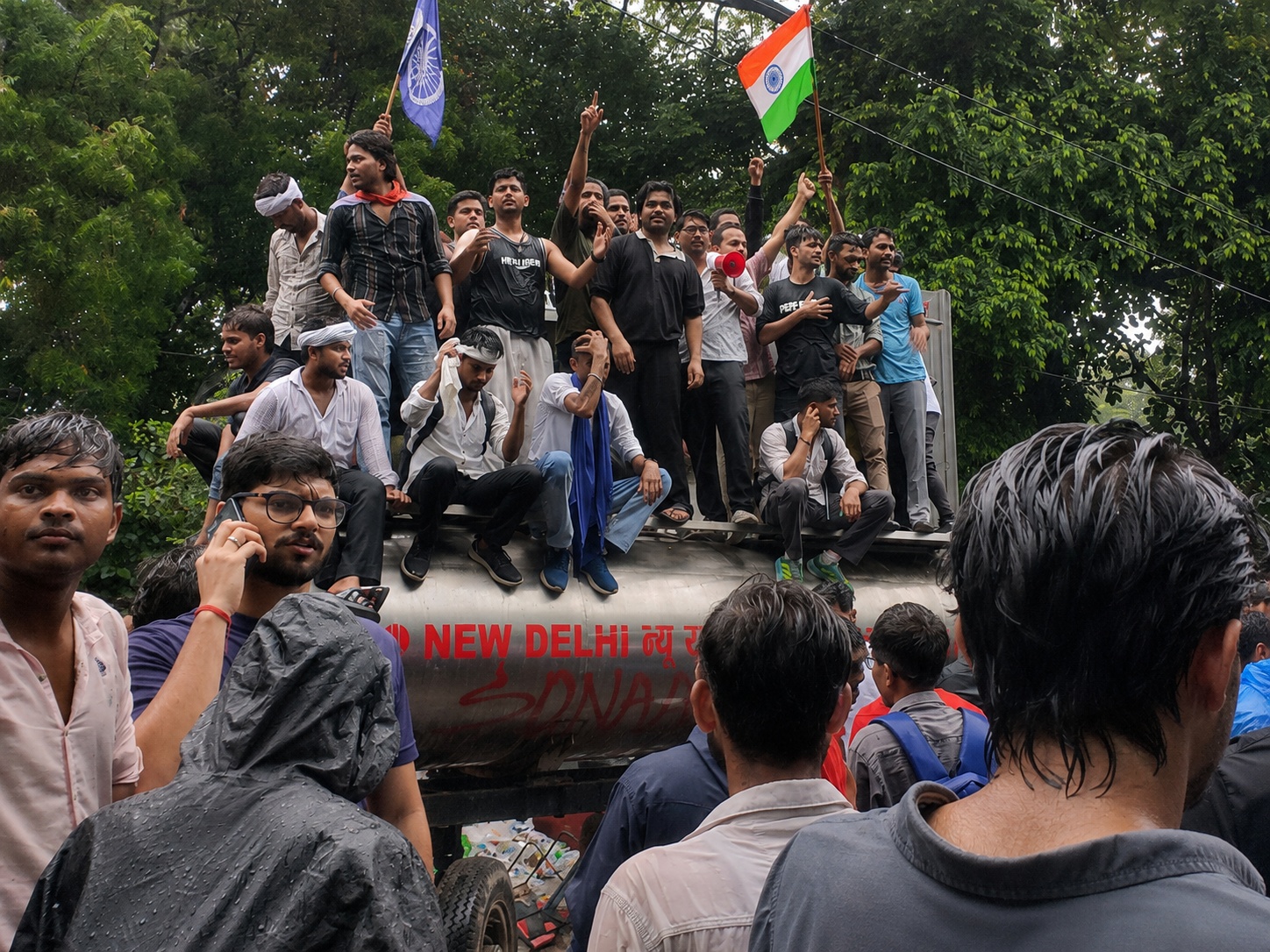
A little over a week ago, a 17-year-old girl reported being gang-raped by three men in Aastha Kunj Park in South Delhi, a short distance from Lady Shri Ram College for Women (LSR), one of India’s leading women's colleges. Shortly afterward, police shot one of the accused in the leg. LSR responded by moving its classes online for two days. In response, hundreds of students from LSR and other Delhi University women's colleges marched through the neighborhood chanting “Azadi.” Freedom. Many said they had reported harassment in the area before, without much coming of it.
That same week, a video from Jamui, a small town in Bihar, circulated widely. In it, a group of men is seen stopping a schoolgirl and a boy walking with her, and molesting the girl. Asked about it, a Bihar minister called it a sporadic incident. “Ghatna hote rehti hai,” he said—these things keep happening.
He is right that sexual assault “keeps happening” to women in India. As renewed scrutiny of sexual assault at Cornell University reminds us, there is nothing uniquely Indian about this: Cornell’s own recent task force describes persistently high rates of sexual assault on its campus.
In July, I argued that India's competitive entrance exams have long been one of its few channels of intergenerational mobility—rules-based, standardized, the same for everyone—and that this summer's exam leaks threatened even that. Shortly before, I wrote about how social norms treat a woman's body as everyone's business but her own. The LSR and Jamui assaults bring those two arguments together—because what difference does it make whether exams or admissions are perfectly fair and meritocratic when a girl cannot safely walk to college. And, it turns out, that threat alone may be enough to keep her from attending the college she earned a place at.
Women pay the price even before anything happens
Some of the most compelling evidence on the costs of sexual violence comes from Delhi University itself. Girija Borker surveyed around 4,000 Delhi University students, mapped their possible bus routes to every college in their choice set, and paired those routes with crowdsourced safety data.
Borker finds that in Delhi, where 95 percent of women aged 16–49 report feeling unsafe in public spaces, women are willing to choose colleges roughly 8.5 ranks lower than ones they are eligible for in exchange for a bus route that feels safer. Men with comparable options don't face this tradeoff. Borker estimates that women's willingness to pay for safety amounts to about a 17 percent decline in the present discounted value of their post-college earnings.
That estimate—17 percent—isn't the cost to women who are harassed or assaulted. It's the cost of anticipating harassment and planning one's education around it. The meritocratic pathway I wrote about in July is, for half of all Indian college applicants, a discounted one.
The importance of getting to school safely is hardly confined to Delhi. In rural Bihar, Karthik Muralidharan and Nishith Prakash found that providing bicycles to girls entering secondary school increased their enrollment by 32 percent, with the largest gains in villages further from schools. The authors attribute this pattern in part to reduced travel and safety costs. Even something as simple as a bicycle can expand girls' educational opportunities considerably.
Women's safety is a precondition for growth
The same threat follows women into the labor force. India's female labor force participation has risen in recent years, reaching 41.7 percent in 2023–24. But nearly all of that gain is rural, where participation is 47.6 percent. Urban female labor force participation remains at 28 percent, compared to 76 percent for urban men—among the lowest urban rates in the world. The persistence of low urban participation, even as women's education and household incomes have risen, has puzzled economists for over a decade.
Safety is part of the answer, alongside norms, marriage, and childrearing. New research by Lori Beaman, Seema Jayachandran, and Anisha Sharma surveyed more than 4,000 women at bus stops, metro stations, and markets in Delhi and Bengaluru. In the preceding year, 65 percent of women in Delhi and 29 percent in Bengaluru had experienced public harassment; 41 percent in Delhi had been groped, stalked, or sexually assaulted. In both cities, roughly 70 percent of women who weren't students said fear of harassment mattered for whether they worked at all. Among women who worked or had worked outside the home, 87 percent in Delhi and 84 percent in Bengaluru said it mattered in deciding where to work.
The ambient threat appears to matter considerably: the reported influence of harassment on work decisions is remarkably similar across the two cities, even though its prevalence is more than twice as high in Delhi. And the fear isn't always women's own: about half the women surveyed said it was primarily their family's fear that shaped where they worked.
I've complained before that we seem able to talk about women's welfare only in terms of the jobs they can hold. Fine. But a woman who can't safely get to college or to the office isn't going to hold a job either.
Policing and blaming women
There's a familiar—and maddening—reflex after incidents of sexual violence where the costs of crimes committed by men are thrust upon the women around them. Curfews, hostel restrictions, parents who decide that the better college across town or the job in the city isn't worth the risk, colleges that move classes online. To say nothing of the staggering victim-blaming. Why was she out at 7 am? Why was she out at 7 pm? What was she wearing? Why was she alone? Why was she with a man? What else did she expect?
Delhi University's women students have been organizing against exactly this for more than a decade. The Pinjra Tod ("break the cage") movement began in 2015 over hostel curfews that applied to women but not men.
Restrictions on women's movement aren’t even particularly well targeted to when harassment actually occurs. Curfews assume the danger is at certain times. But Beaman, Jayachandran, and Sharma find that more than 75 percent of harassment incidents happen between 5 am and 8 pm, usually with bystanders present. Keeping women indoors “early in the morning” or “late at night” mostly just keeps them indoors.
What would help?
Street lighting, reliable last-mile transport, and police who act on reports of harassment before a more serious crime occurs could all help to keep women safer. The students marching outside LSR were asking for precisely these sorts of protections.
In Hyderabad, a randomized trial (by Borker, Prakash, and co-authors) of one of the world's largest police patrol programs targeting street harassment found that visible, uniformed patrols reduced severe harassment—such as groping—by 27 percent. Women also became less likely to avoid those streets. Undercover patrolling had no detectable effect.
Visible patrolling, however, had no effect on less severe forms of harassment—staring, catcalls, and lewd comments, all of which still have corrosive effects on women’s sense of safety. The researchers' work with the officers themselves offers a possible explanation: police were more tolerant of these behaviors and less willing to sanction them. Milder forms of harassment declined only where assigned officers held less tolerant views of harassment.
The ubiquity of these supposedly lesser forms of harassment can itself be hard to see. Just last week, walking away from a business meeting in downtown Washington, DC, in the middle of the afternoon, I was subjected to unsolicited “commentary” on my body. It made me angry, but it was commonplace enough in my experience that it didn't surprise me. What has surprised me is how often male friends and colleagues—including men I know to be allies to women—are startled to hear how ordinary such experiences are.
But, needless to say, women don't necessarily experience offenses that the law treats as less serious as less threatening. Beaman, Jayachandran, and Sharma find that flashing—which Indian law treats as a lesser offense—makes women in Delhi as anxious as the prospect of sexual assault.
Changing these attitudes is no straightforward matter, either. In another recent experiment with police officers in the Indian state of Madhya Pradesh, Borker, Prakash, and co-authors find that confronting officers with evidence of their biased handling of a gender-based violence complaint produced strikingly different responses by the officer’s gender, with women officers more likely to prioritize the victim’s account and male officers prioritizing the alleged offender’s. Of course, the police don't hold these attitudes in a vacuum. The pervasive victim blaming after sexual violence shows this quite clearly.
Institutions have a role to play in making reporting worthwhile, too. My colleague Gabriela Smarrelli has found that training school leaders to manage violence in Peru increased reporting by 15 percentage points and reduced school switching by two percentage points. And in India, Lakshmi Iyer and coauthors have shown that greater representation of women in local government increased reported crimes against women, with no evidence of an increase in underlying crime. Both seem particularly relevant when LSR students say they had repeatedly reported harassment without much coming of it.
“If I didn’t create a ruckus, he would do this to me every day”
I grew up in northern India and came to the US for college. On my first visit home, I caught up with a high school friend who was attending Delhi University. She told me that a man had groped her on her very first ride on the university's "student special" bus. She said to me, "As soon as I felt his hand, I screamed as hard as I could and pushed him with all my might because I knew that if I didn't create a ruckus then, he would do this to me every day." I will never forget the rage and desperation in her voice as she said those words. Twenty-five years later, the women marching outside LSR are still demanding the right to attend college without first having to fight to get there safely.
With thanks to Nishith Prakash, Emily Schabacker, and Gabriela Smarrelli for helpful discussions.