Recommended



Blog Post
Reimagining Official Development Assistance

In an era of budget constraints and growing populist challenges to traditional development narratives, it is more important than ever that agencies are effective and that resources are used wisely. With governments and taxpayers increasingly scrutinizing spending, agencies are under pressure to prove that their work is not just well-intentioned but also impactful. These pressures are amplified by shifting development needs, including calls to respond to global challenges, urging many to re-examine what effectiveness looks like in today’s context.
In this blog, we share emerging findings from our ongoing research series on how development agencies are thinking about their effectiveness. Based on 44 interviews with officials from the development agencies of four countries—France, New Zealand, Norway, and South Korea—we find that agencies most often understand their effectiveness in terms of adaptability and flexibility, followed by considerations related to effective resource allocation and improved organisational structures. However, our findings also reveal that there is no clear global guidance on what effective action entails today, making it difficult for agencies to align their approaches.
What is agency effectiveness?
We define agency effectiveness as the internal capabilities—processes, structures, and management practices—that enable a development agency to achieve its goals. How well an agency functions is part of what determines overall development effectiveness—and the actual outcomes achieved.
In previous work for this series, we identified five “dimensions” that have shaped thinking around how agencies can improve their effectiveness over the past two decades. These interviews show how agencies are adapting and prioritising these dimensions today (Figure 1). These dimensions are:
- Allocation: How choices made about where and on what agencies distribute resources affect outcomes.
- Compliance with global effectiveness norms: Whether provider processes align with international “best practice” as outlined in the Paris Declaration and Busan principles.
- Cost-efficiency: Strengthening the relationship between money spent and results achieved.
- Organisational design (including strategic coherence): How agency structure enables or hinders effective and coordinated action.
- Adaptive management: The ability to quickly adjust and respond to uncertainty and change.
What dimensions resonate with how agencies operate in today’s landscape?
As part of the interviews, we asked agency staff how the five dimensions were currently prioritised and applied by their agencies (Figure 1). The answers revealed a few general patterns.
Figure 1. Answers to “which agency effectiveness dimensions resonate most”?
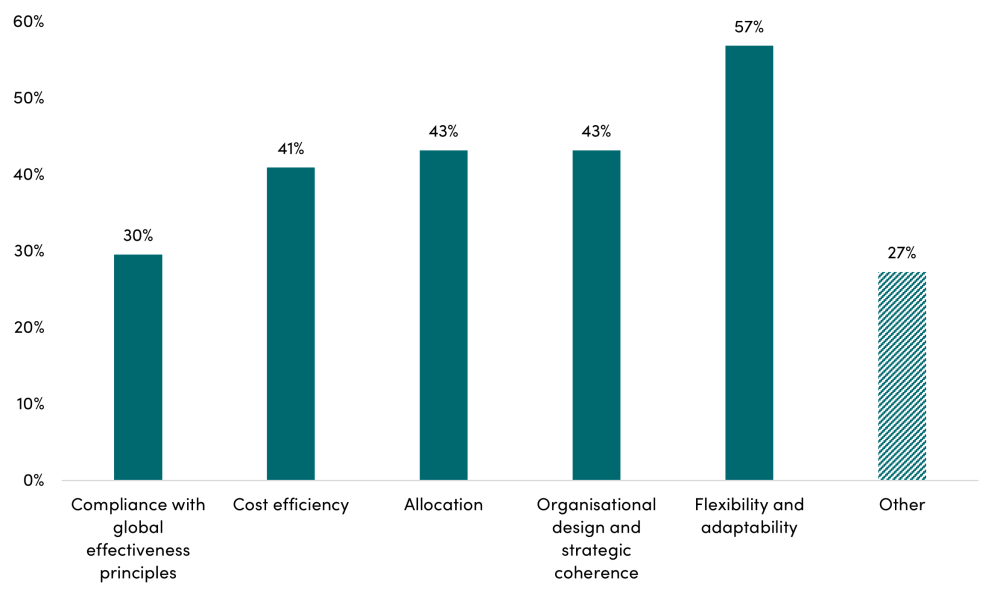
Note: Chart is based on preliminary findings from 44 interviews. “Other” than five dimensions includes institutional capacity for foresight, alignment with other development guidance, such as the OECD’s Evaluation Criteria or the SDGs, and the ability to build trust in credible and long-term partnerships, among others. We aim to explore these other aspects of agency effectiveness more in future work.
First, we find that adaptability and flexibility are the dimensions most strongly associated with development agency effectiveness in today’s context. Alongside growing uncertainty in the development landscape, staff described the need to adjust timelines, budgets, or even redesign interventions as realities shift on the ground—going beyond project-level tweaks to call for institutional flexibility. This includes having the right tools, such as contingency funds or flexible financing instruments, to respond quickly to unexpected shocks. However, many interviewees also cautioned that staying nimble must not come at the expense of predictability or a long-term strategic vision for development cooperation.
Second, we find agencies place emphasis on organisational design and strategic coherence as they adapt to increasing demands. Most interviewees noted that their agencies had recently restructured—merging units, changing their field presence, relocating responsibilities, or rethinking how their geographic and thematic teams can coordinate more effectively. These changes often aim to create more flexible and coherent structures, reflecting demands for agencies to tackle both global and local challenges simultaneously, and navigate the interconnected nature of today’s development goals. This requires greater synergies and communication across teams. However, several interviewees warned that “constant” reorganisations, even when motivated by effectiveness, have disrupted their day-to-day workflows and reduced bureaucratic efficiency, for instance, by harming established lines of communication.
Third, while allocation was often cited as a key dimension of effectiveness, staff noted that the priorities driving allocations were shifting. Given ongoing budget cuts, agencies are being forced to make difficult choices about where they allocate scarce concessional finance and decide the optimal balance in the types of sectors, partner countries, and instruments they support. Increasingly, these pressures are encouraging agencies to allocate in line with their “comparative advantage” to improve efficiency, or to support the “mutual interest” in response to shifting political demands. These shifting narratives move beyond the allocation criteria often associated with development effectiveness—such as targeting the poorest—and raise questions about what it means for agencies to allocate effectively in the current context.
Fourth, cost-efficiency is seen as important, but is often met with scepticism about how it’s applied. Interviewees discussed it in two ways: first, through a value-for-money lens, and secondly, in terms of managing overhead costs. While some interviewees welcomed the increased scrutiny for projects to maximise value-for-money and appreciated the need to “do more with less,” many agreed that cost-efficiency metrics only make sense when grounded in a broader development offer and framework which accounts for less tangible, long-term development gains. Indeed, the challenge is not about whether to pursue cost-efficiency, but how to do so without reducing effectiveness to narrow inputs and outputs—aligning with previous critiques of a ”value for money” approach.
Fifth, effectiveness as defined by alignment with the international effectiveness principles—currently, those agreed during the 4th High-level Effectiveness Forum in Busan—was the least mentioned dimension overall. This finding underscores the challenge of finding consensus amid a diversity of perspectives on what effectiveness is. While the global effectiveness principles should, in theory, provide some such universal guidance for all agencies, interviewees rarely brought these up without being prompted. When asked directly, most interviewees were unfamiliar or only vaguely aware of these principles (Figure 2). When aware, “ownership” and “localisation” were the most cited principles, alongside earlier frameworks like the Paris Declaration and harmonisation. We heard two explanations for this: first, waning political momentum and growing fatigue with new global frameworks, and, secondly and perhaps more encouragingly, the sense that these principles are now so ingrained in daily operations that they rarely need explicit mention.
Figure 2. Answers to “how familiar are you with the GPEDC principles,” total
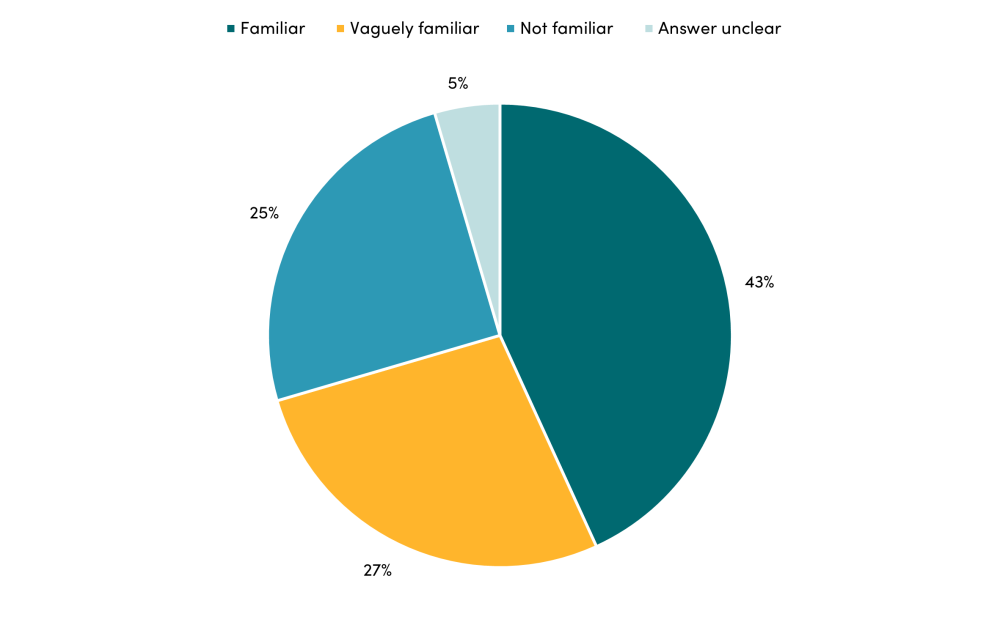
Note: based on preliminary findings from 44 interviews
Agency effectiveness in flux
Our findings show that agency effectiveness is often understood as a complex beast, with different pillars likely to become more or less relevant over time. In the current context, the prioritization of adaptability is perhaps unsurprising, with growing uncertainty demanding that agencies can adequately respond and course correct as new crises require attention. At the same time, the relatively lower prioritization of cost-efficiency stands out against a backdrop of declining budgets. Might this pillar of effectiveness grow in agency consciousness in the years ahead?
The current diversity of views on what “effectiveness” means risks it becoming a moving target, with agencies unclear on what aspects to prioritise most. Without a shared vision, it may be more difficult for agencies to build a common language around effectiveness across the organisation.
Our research shows that agencies’ understanding of their own effectiveness is a dynamic concept, shaped by both domestic and international pressures. In this shifting environment, it will be important for agencies to be clear about what effectiveness means for them, not only to build a shared culture of effectiveness among staff, but to meaningfully ensure that their strategic choices are designed to enable effective action.
Topics
DISCLAIMER & PERMISSIONS
CGD's publications reflect the views of the authors, drawing on prior research and experience in their areas of expertise. CGD is a nonpartisan, independent organization and does not take institutional positions. You may use and disseminate CGD's publications under these conditions.
Thumbnail image by: Sushanta/ Adobe Stock