Recommended
Executive summary: How to deprioritise
BMZ (Germany's Federal Ministry for Economic Cooperation and Development or Bundesministerium für wirtschaftliche Zusammenarbeit und Entwicklung) is consulting on how to implement a material reduction in its official development assistance (ODA) budget.
In this paper, we review where remaining funds would have the greatest impact, and propose a series of reforms accordingly. We recommend:
- Focussed thematic allocation: Germany’s development projects have been substantially diluted over the last decade. We find that BMZ projects have progressively targeted a broader range of Sustainable Development Goals (SDGs). The number of projects that target more than four goals, for example has risen almost nine-fold from 72 to over 600 in the last ten years. Evidence suggests that less complex measures would have been more efficient and effective. We suggest focussing on 4-5 SDGs that align with the Government’s priorities and BMZ’s expertise render overall ODA allocation more effective.
- Strategic country allocations: BMZ currently funds projects in a 110 of the 141 ODA-eligible countries in total. It seems clear this will need to be reduced. Providing development finance makes the biggest difference to those in greatest need, so we undertake an analysis to ascertain the level of ODA that each of these recipients receives from other countries, expressed in terms of ODA per person in extreme poverty. We identify 31 BMZ partner countries that are under-prioritised—of which 13 are significantly under-prioritised. In contrast, we find 48 countries that are over-prioritised by other providers. We urge BMZ to fully protect budgets in the 31 under-prioritised countries, and concentrate reductions in the 48 over-prioritised. This enhances the impact of BMZ funding overall and enables German funding to represent a larger and more influential share of recipients’ economies.
- Sharpening instruments: Over the last five years, funding for the “Multilateral and European development cooperation” federal budget instrument has been cut by 34 percent, while there has been 20 percent cuts in bilateral efforts. Germany is below average in the share of its international finance that is allocated multilaterally. We argue this split should be reversed. First, multilateral organisations are assessed as highly effective by independent assessments, and surveys of the German public also suggest they garner a high level of trust. But there is an additional compelling geopolitical case for allocating funding multilaterally. Following the abrupt withdrawal of the United States from a number of organisations, the international system is more vulnerable than ever. It is difficult envisage a future where Germany is secure and prosperous if the multilateral system fails to endure. We urge the German government to shield its multilateral contributions in from these cuts, refocus earmarked multilateral spend towards core funding, and increase its core multilateral share to at least 40 percent in the next two years. Regarding the remaining bilateral share, we propose that Germany reconsider its current approach to the volume and tendering of technical assistance.
Introduction
The German cabinet has decided to reduce the development budget by about 8 percent from 2024 to 2025. The remaining funds will therefore have to be used more efficiently and effectively. The most important components of such a reorientation are (1) a stronger thematic focus, (2) a targeted list of countries, and (3) a streamlined selection of instruments. Of course, various attempts to prioritize certain aspects have been made over the years, mostly unsuccessfully. The main bottleneck so far has been a lack of consistent deprioritisation.
In this paper we set out the context for deprioritisation and then consider its application in three sections on themes, countries and instruments.
Why deprioritisation?
Over recent decades, the number of thematic objectives pursued in service of development has increased dramatically. The 17 Sustainable Development Goals (SDGs), adopted in 2015, along with 169 sub-goals, have contributed to this trend. It has been argued that many of these goals may be too broad and complex, and therefore lead to conflicting objectives. At the same time, domestic interests have moved to the forefront of policy discussions in donor countries, adding to the range of goals and priorities pursued. German bilateral development cooperation mirrors this global trend. Figure 1 shows that between 2013 and 2023, the number of German projects reporting on four or more SDGs increased almost ninefold. Evaluations of projects with a large number of goals often note that a focus on fewer and concrete measures would have been more efficient and effective.
Figure 1. Number of BMZ-funded projects reporting on four or more SDGs
Source: Own representation based on the BMZ Transparency Portal (2025).
Pursuing several development goals at the same time can have hidden costs. For example, an ongoing German project to protect an ecosystem in India and Bangladesh with a volume of €5 million aims to train forestry officials, protect tigers and river dolphins, and improve the income and environmental awareness of local communities, especially women and young people. According to the transparency portal tracking German aid projects, it thus contributes to eight different SDGs. Such complexity renders implementation considerably more challenging. Responsible project managers would therefore need to possess a deep understanding of different thematic sectors. Projects with a multitude of objectives also tend to perform less well in evaluations. Going forward, fewer but more effective projects with high economies of scale, a larger volume and lower overheads are needed. A focus in this direction will enable politicians and the general public to better understand how development funds are spent. Even if domestic interests, such as promoting Germany’s own economy, continue to dominate policy debates, prioritisation will remain inevitable for improving effectiveness. In the long term, this may even increase public support for development policy.
Germany should focus its bilateral development cooperation in three ways: 1) themes, 2) countries and 3) instruments. We have adopted this structure as it encompasses the main strategic decisions with which the Federal Ministry for Economic Cooperation and Development (BMZ) is mandated to make. Each step can be viewed individually, and the chosen methods of deprioritisation primarily serve an illustrative purpose to assist decision-makers.
Selecting themes where BMZ can make a difference
Reducing the number of thematic priorities and simultaneously increasing the volume allocated to each priority would create greater focus within the existing development cooperation portfolio. Current commitments generated by past allocation decisions can only be altered over time. Therefore, concentrating funds on topics where Germany already has expertise emerges as a sensible starting point. In order to identify the thematic focus of German ODA, we map Germany’s ODA allocation across all 17 SDGs, using OECD data from 2019 to 2023.
The SDGs provide a good proxy for sectoral prioritisation because they reflect actual political targets of donor country decisionmakers, as opposed to alternative indicators that match operational activities to sectoral themes (OECD CRS data) or perception-based analysis of themes in recipient countries (surveys of country-level views on donors). Increasingly, political leaders like the ministers of development cooperation in Germany formulate their goals in line with SDGs—and there is a direct link between their stated priorities and the actual allocation patterns.
Figure 2 shows that Germany’s current allocation is dispersed widely, with no specific goals receiving more than 15 percent of the ODA budget. In comparison, other donors often allocate 20-30 percent of their budget to main priorities.
Figure 2. Sum of German ODA allocation per SDG in percent (2019-2023)
Note: Own representation based on OECD CRS (2025). ODA allocations between 2019-2023 are clustered by SDG. If several SDGs are reported per project, the commitment per project is split equally across the reported SDGs.
In addition to considering Germany’s ODA allocation per SDG, we compare Germany’s portfolio with the allocations of all other donors per SDG (Figure 3). The overview highlights that Germany is responsible for 12 percent of all global ODA allocated to SDG-4 on Quality Education. For context, Germany’s share of global ODA is only 6 percent.
Figure 3. Share of German ODA allocation per SDG compared to global ODA (2019-2023)
Note: Own representation based on OECD CRS (2025). German ODA allocations between 2019-2023 are clustered by SDG. OECD CRS data contain information on project-level contributions to specific SDGs. If several SDGs are reported per project, the commitment per project is split equally across the reported SDGs.
When both figures (Figure 2 and Figure 3) are viewed together, it is clear that four of the top five SDGs overlap: SDG 4 (Quality Education), SDG 10 (Reduced Inequalities), SDG 11 (Sustainable Cities and Communities) and SDG 1 (No Poverty). These goals could therefore be the starting point for thematic prioritisation.
The SDGs currently being prioritised only partly align with BMZ’s stated priorities: “the global realisation of human rights, the fight against hunger and poverty, the protection of the climate and biodiversity, health and education, gender equality, fair supply chains, the use of digitalisation and technology transfer, and the strengthening of private investment to promote sustainable development worldwide”. In fact, our data reveal a significant discrepancy between the actual allocation and the official goals of BMZ. In addition, the current thematic allocation pattern also only partly matches with the development minister’s newly announced four priorities: 1) combating hunger, poverty and inequality; 2) creating security and stability by defusing existing crises; 3) expanding economic cooperation; and 4) promoting strategic alliances. This mismatch further supports the argument for a focus on a limited number of SDGs to render overall ODA allocation more effective.
Selecting countries where BMZ can have the greatest impact
BMZ currently funds projects in a relatively large number of countries—110 of 141 ODA-eligible countries in total. It seems clear this will need to be reduced, and there is also an argument that funding in any country should be material in the context of that economy.
How, then, should BMZ prioritize countries? It is widely understood that one euro of support is much more valuable to those living in extreme poverty than to a typical citizen in a developing country. The Federal Minister for Economic Cooperation and Development, Reem Alabali Radovan, has said that the first of her four major priorities is to “combat hunger, poverty, and inequality.” This is backed by the German public where the top argument for aid is “doing a lot of good in poor countries with few resources”. When asked which goals German development cooperation should contribute to, the German public rank water and sanitation, education, and health the highest. Advances in these social sectors are closely correlated with fighting extreme poverty. Finally, the German public has a clear preference for allocating aid to countries characterised by extreme levels of poverty.
In the following section, we consider where BMZ finance can have the greatest impact and suggest a more strategic approach by taking account of allocations by other provider countries.
There are multiple ways to approach the issue of country allocations and poverty. Here we propose a concise and intuitive approach focussed on a country’s extreme poverty levels that also responds to the allocations of other providers, including the recent USAID cuts. A similar approach was used by CGD authors to inform the UK Foreign, Commonwealth and Development Office’s country allocations during its recently planned aid cuts. Detailed explanations of this method and our data sources can be found in the original CGD publication and its linked spreadsheet.[1] Below, we replicate this prior analysis for BMZ.
Our approach is to ask: considering the cuts to USAID allocations, which BMZ partner countries are currently under-prioritised by other providers, relative to their levels of poverty? To identify these countries, we calculate the ratio between each recipient country’s actual aid allocation (from all non-German providers and after subtracting confirmed USAID cuts) and the amount they would have received if aid were allocated equally between each person living in extreme poverty. Ratios below one hundred percent indicate that a country is under-prioritised by non-German providers relative to their levels of extreme poverty, and ratios above one hundred percent indicate that it is over-prioritised.
To illustrate this metric: were aid from all non-German providers distributed equally per person living in extreme poverty in ODA-eligible countries, each of these persons would receive $225 per year. If a country only received the equivalent to $75 per person living in extreme poverty, then relative to this $225 benchmark its ratio would be 33 percent. Conversely, if it actually received $450 per person living in extreme poverty, its ratio would be 200 percent.
An alternative way to understand this metric is that it reflects the ratio between the actual share of global aid a country receives and its share of global extreme poverty. For instance, if 4 percent of the extreme poor live within a country, but it only received 1 percent of global aid, this country would score 25 percent whereas it would score 150 percent if it received 6 percent of global aid.
BMZ lists 65 countries (including Bilateral Partners, Global Partners, and Nexus and Peace Partners), but it also disbursed ODA to an additional 45 countries in 2023. Disbursements to most of these 45 countries were relatively small (but exceeded $10 million per year for 14 of these 45). To avoid excluding relevant BMZ recipient countries from this analysis, we therefore investigate disbursements to all 65 listed partner countries plus the 14 additional recipient countries that received at least $10 million from BMZ in 2023. Henceforth, “BMZ de facto partner countries” shall be used to refer to this aggregate group of 79. Table 1 summarises the number of BMZ partner countries in different groupings, and whether those countries received $10m or more in ODA in 2023. The shaded cells represent the 79 de facto partner countries we analyse below.
Table 1. BMZ partner countries
| BMZ partner countries | Receiving <$10m ODA in 2023 | Receiving ≥$10m ODA in 2023 | Total |
|---|---|---|---|
| Bilateral Partners | 2* | 45 | 47 |
| Global Partners | 1** | 7 | 8 |
| Nexus and Peace Partners | 0 | 10 | 10 |
| Other ODA recipients in 2023 | 31 | 14*** | 45 |
| Total | 34 | 76 | 110 |
Source: Country list for the BMZ’s bilateral official development cooperation & OECD CRS database
Notes: Shaded cells identify the 79 BMZ de factor partner countries we analyse. *Armenia, Bosnia and Herzegovina.**China.***Burundi, Central African Republic, Guinea, Haiti, Liberia, Myanmar, Honduras, Kyrgyzstan, The Philippines, Sri Lanka, Tajikistan, Zimbabwe, Guatemala, Turkey.
Figure 4 provides an overview of BMZ’s de facto 79 partner countries, plotting the ratio we calculate to identify the extent to which recipient countries are either under- or over-prioritised by non-German providers relative to their levels of poverty against BMZ’s 2023 allocations of bilateral ODA gross disbursements.[2]
Figure 4. BMZ de facto partner countries under- and over-prioritised by other providers
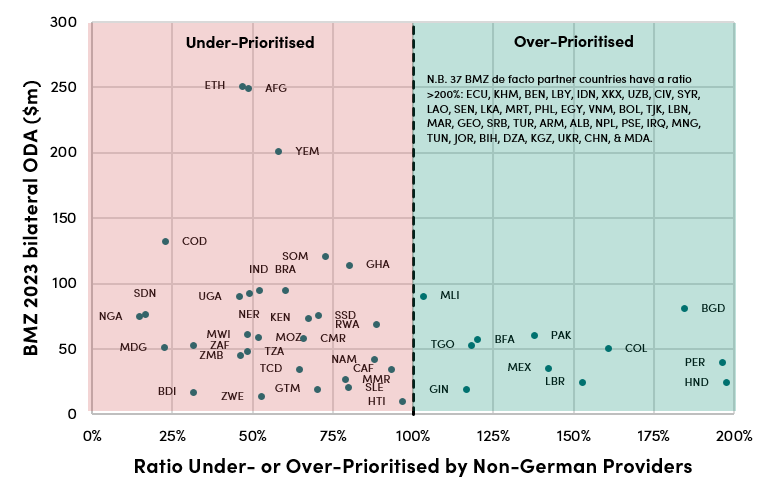
Of BMZ’s 79 de facto partner countries, 48 are over-prioritised by other providers relative to their levels of poverty. 37 of these 48 countries received more than twice the benchmark of $225 per person living in extreme poverty. In total, over-prioritised countries received almost $3 billion of ODA from BMZ in 2023, 55 percent of its country-allocable total.
This allocation compares to 31 BMZ partner countries under-prioritised by other providers. Collectively, BMZ allocated $2.4 billion to these counties in 2023, 45 percent of its country-allocable total. 13 of these are significantly under-prioritised relative to their levels of poverty—that is, receiving less than half the aid from other providers than their poverty levels would imply.
Table 2. Summary of BMZ 2023 ODA allocations to its de facto partner countries under- and over-prioritised by other providers
| Ratio under- or over- prioritised by non-German providers | Number of BMZ de facto partner countries | BMZ 2023 ODA ($m) | Share of BMZ 2023 country-allocable ODA* |
|---|---|---|---|
| Significantly under-prioritised (ratio: <50%) | 13 | 1,244 | 23.0% |
| Under-prioritised (ratio: 50%-100%) | 18 | 1,166 | 21.5% |
| Over-prioritised (ratio: >100%) | 48 | 2,957 | 54.6% |
*Note that shares do not sum to 100 percent as the analysis excludes 31 countries which received under $10 million ODA from BMZ in 2023, yet which are not listed as BMZ partner countries (see Table 1).
Given the planned decrease in the German aid budget over the next year, BMZ should urgently reconsider current country allocations. In the first instance, future reductions can be undertaken in countries that are over-prioritised, concentrating BMZ’s resources where needs are greater. Over a longer timeframe, BMZ should also reduce its list of partner countries, starting with the 48 that are over-prioritised by other providers and thus safeguarding the budgets for those that are under-prioritised by other providers. As a result, budget cuts become an impetus to improve BMZ’s impact in those countries where development cooperation can make the largest difference.
Choosing the most effective instruments
The final section provides a brief overview of instruments and, on this basis, argues that BMZ should reform its budgeting processes and prioritise its multilateral efforts both on the grounds of effectiveness and to bolster the international system during a time of global crisis. Notably, the term “instruments” is defined differently in German development cooperation than in international contexts. Internationally, instruments in foreign aid refer to cooperation modalities, including approaches such as budget support, basket funds, and project-type interventions. In the German context, however, the term is used primarily in relation to individual line items in the federal budget, with the differentiation between financial and technical cooperation mirroring Germany’s organisational architecture for development aid implementation.
Table 3. BMZ budget for major “instruments” in billions of Euros (federal budget section 23)
| 2021 | 2022 | 2023 | 2024 | 2025 | |
|---|---|---|---|---|---|
| Bilateral development cooperation | 6.0 | 6.2 | 5.6 | 5.2 | 4.8 |
| Incl. financial cooperation | 3.0 | 2.7 | 2.4 | 2.2 | 2.0 |
| Incl. technical cooperation | 1.8 | 2.0 | 1.9 | 1.8 | 1.9 |
Multilateral and European development cooperation | 4.4 | 4.3 | 3.6 | 3.4 | 2.9 |
Civil society, local and economic engagement | 1.4 | 1.3 | 1.4 | 1.3 | 1.3 |
| Special initiatives | 1.3 | 1.7 | 1.1 | 1.0 | 0.9 |
| Administration costs | 0.2 | 0.2 | 0.2 | 0.2 | 0.2 |
| Total budget | 13.4 | 13.8 | 12.1 | 11.2 | 10.3 |
Source: Own compilation based on German Federal Court of Audit’s analyses for 2023, 2024 and 2025. Figures are based on actual expenditure except for 2024 and 2025, which are based on projection. Financial cooperation figures are based on expenditures listed in chapter 2301, title group 01, which is divided into title 866 11 items (loans) and title 896 11 items (grants). Technical cooperation figures are based on expenditures listed in chapter 2301, title 896 03 items, “Bilateral Technical Cooperation”, and chapter 2301, title 896 06 items, “International Cooperation with Regions for Sustainable Development”. Values may not add up to the total budget due to rounding.
Table 3 shows the main components of BMZ’s annual budget over the past five years. These instruments are negotiated in parliamentary budget committees in advance of implementation. For example, these committees decide how much German aid is spent either bilaterally or multilaterally. Consequently, major strategic decisions are often made before specific thematic or country-related aspects can be considered.
Over the last five years, funding for the “Bilateral development cooperation” instrument has been cut by 20 percent, and funding for the “Multilateral and European development cooperation” instrument has been cut by 34 percent. We argue that such decisions should be carefully considered based on the advantages and disadvantages of specific multilateral, bilateral, financial and technical interventions, as well as overall portfolios. Therefore, making German aid budgeting more flexible throughout the budget cycle and bringing more substantive expertise into the budget committee are two promising ways forward. In particular, the budget committee could make more effective use of its ability to grant experts the right to speak in parliament, including but not limited to sector experts at the German Federal Court of Audit.
At a strategic level, we see a strong case for protecting multilateral spending and increasing its share beyond 40 percent of all international finance. There are two main arguments in support of this proposition. First, the best multilaterals are a highly effective way to provide development assistance. In CGD’s Quality of ODA (QuODA), which assesses agencies on prioritisation, ownership, transparency and evaluation, multilaterals take the top five positions in the ranking. These multilaterals prioritise countries that truly need finance, operate at scale, avoid fragmentation, use grant resources sparingly, are transparent in their operations, and use open procurement to deliver. In addition, when surveyed, the German public trust international organisations more than they do the government, NGOs, charities or businesses.
Aside from arguments regarding effectiveness, there is also a compelling geopolitical case for supporting multilateralism. Following the abrupt withdrawal of the United States from a number of organisations, the international system is more vulnerable than ever. Germany is now the largest bilateral funder of international development, yet as the table above shows, it has reduced its core multilateral contributions. Most recently, these accounted for merely 35 percent of its finance for international development, well-below the cross-country mean of 46 percent. Meanwhile, Germany provides a sizable volume of “multi-bi” funds, which are earmarked for particular objectives. Such funding is considerably less valuable to multilaterals. Moreover, much of Germany’s multilateral core ODA is provided through the EU; whilst this channel plays an important institutional role, it is increasingly focussed on the European arena. Germany has emerged as the G20 leader on development, despite recent budget cuts.
Germany’s stability and prosperity ultimately depend on a functioning, resilient multilateral system—one that risks erosion without stronger German support. We urge the German government to shield its multilateral contributions from these cuts, refocus earmarked multilateral spend towards core funding, and increase its core multilateral share to at least 40 percent in the next two years.
Finally, BMZ should consider the reallocation of funds to financial and away from technical cooperation. The majority of Germany’s allocation for these instruments is currently channelled through two major official implementing organisations: the KfW Development Bank and the Deutsche Gesellschaft für Internationale Zusammenarbeit (GIZ), the German corporation for international cooperation. The question of how BMZ should steer financial and technical cooperation needs to be considered as an additional area of reform.
We note that Germany provides unparalleled resources for technical cooperation. In fact, its funding accounts for more than half of all globally reported free-standing technical assistance projects by OECD donors. While this practice is valuable to GIZ, German development cooperation could realise important gains in both efficiency and effectiveness by increasing the competition through open tendering processes, as called for in the current government’s coalition treaty. Such competition should not be geared towards benefitting German companies but rather allowing aid recipients a greater say in the mix of financial and technical assistance that they deem most beneficial.
Conclusion
Decisions on which themes, countries and instruments German development cooperation focuses on and which one it deprioritises are ultimately political. But to achieve maximum effectiveness and maintain public legitimacy, it is advisable to base such decisions on evidence rather than on past practice.
Deprioritisation processes inevitably trigger conflicts of interest and political resistance. Prior political decisions, individual career incentives, leadership changes and global agendas create a complex incentive system that has so far hindered necessary reforms. These mechanisms can be observed in many organisations; they require that leadership commits to reforms over a much longer period and prioritises global impact over domestic politics.
Overall, we recommend focussing on a maximum of five thematic areas in which German bilateral cooperation can play a decisive role, supporting countries that are currently underfunded, introducing more expertise into the parliamentary budgeting process, and markedly prioritising core funding for multilateral institutions. This four-pronged reform would foster much-needed effectiveness, is in line with public support, and would also enable more credible communication of Germany’s contribution to global development.
Annex. BMZ de facto partner countries to prioritise and deprioritise in future allocations
| Extreme Poverty, 2025 | Non-German support | ||||
|---|---|---|---|---|---|
| Country | BMZ 2023 ODA ($m) | Million people | Rate | $ per person in extreme poverty | Ratio under- or over-prioritised |
| Significantly under-prioritised | |||||
| Nigeria | 75 | 113.9 | 50% | 33 | 15% |
| Sudan | 76 | 34.6 | 69% | 37 | 17% |
| Madagascar | 52 | 24.8 | 80% | 50 | 22% |
| DRC | 132 | 76.7 | 73% | 51 | 23% |
| South Africa | 53 | 14.2 | 23% | 71 | 31% |
| Burundi | 17 | 8.6 | 63% | 71 | 32% |
| Uganda | 90 | 19.8 | 41% | 103 | 46% |
| Zambia | 45 | 12.9 | 62% | 104 | 46% |
| Ethiopia | 251 | 48.0 | 37% | 105 | 47% |
| Malawi | 61 | 15.0 | 71% | 109 | 48% |
| Tanzania | 48 | 28.2 | 42% | 109 | 48% |
| Afghanistan | 249 | 24.2 | 58% | 110 | 49% |
| Niger | 93 | 10.6 | 41% | 110 | 49% |
| Under-prioritised | |||||
| Mozambique | 59 | 25.3 | 75% | 117 | 52% |
| India | 95 | 43.1 | 3% | 117 | 52% |
| Zimbabwe | 14 | 5.9 | 36% | 118 | 53% |
| Yemen | 201 | 28.9 | 73% | 131 | 58% |
| Brazil | 95 | 5.5 | 3% | 136 | 60% |
| Chad | 35 | 7.8 | 40% | 145 | 65% |
| Cameroon | 58 | 6.5 | 23% | 148 | 66% |
| Kenya | 74 | 18.8 | 34% | 151 | 67% |
| Guatemala | 20 | 2.2 | 12% | 158 | 70% |
| South Sudan | 76 | 10.4 | 91% | 158 | 70% |
| Somalia | 121 | 13.6 | 74% | 164 | 73% |
| Myanmar | 27 | 7.0 | 13% | 177 | 79% |
| Sierra Leone | 21 | 3.0 | 35% | 180 | 80% |
| Ghana | 114 | 9.0 | 27% | 180 | 80% |
| Namibia | 42 | 0.6 | 20% | 198 | 88% |
| Rwanda | 69 | 6.5 | 47% | 199 | 89% |
| Central African Republic | 35 | 3.4 | 65% | 210 | 93% |
| Haiti | 10 | 4.4 | 38% | 218 | 97% |
| Over-prioritised | |||||
| Mali | 91 | 4.9 | 21% | 232 | 103% |
| Guinea | 20 | 2.0 | 14% | 262 | 116% |
| Togo | 53 | 2.2 | 23% | 266 | 118% |
| Burkina Faso | 58 | 5.4 | 24% | 270 | 120% |
| Pakistan | 61 | 17.6 | 7% | 310 | 138% |
| Mexico | 36 | 1.4 | 1% | 320 | 142% |
| Liberia | 25 | 1.4 | 25% | 343 | 153% |
| Colombia | 51 | 2.4 | 5% | 362 | 161% |
| Bangladesh | 81 | 15.9 | 9% | 415 | 184% |
| Peru | 40 | 0.9 | 3% | 442 | 196% |
| Honduras | 25 | 1.2 | 12% | 444 | 197% |
| Ecuador | 20 | 1.0 | 6% | 548 | 243% |
| Cambodia | 26 | 2.3 | 13% | 717 | 319% |
| Benin | 54 | 1.3 | 10% | 758 | 337% |
| Libya | 25 | 0.4 | 5% | 803 | 357% |
| Indonesia | 108 | 2.8 | 1% | 822 | 365% |
| Kosovo | 23 | 0.4 | 22% | 872 | 387% |
| Uzbekistan | 21 | 1.3 | 4% | >1000 | >400% |
| Côte d'Ivoire | 116 | 2.2 | 7% | >1000 | >400% |
| Syria | 91 | 7.7 | 33% | >1000 | >400% |
| Laos | 26 | 0.5 | 6% | >1000 | >400% |
| Senegal | 138 | 1.4 | 8% | >1000 | >400% |
| Sri Lanka | 32 | 0.9 | 4% | >1000 | >400% |
| Mauritania | 31 | 0.3 | 7% | >1000 | >400% |
| Philippines | 18 | 1.4 | 1% | >1000 | >400% |
| Egypt | 95 | 1.1 | 1% | >1000 | >400% |
| Viet Nam | 34 | 0.9 | 1% | >1000 | >400% |
| Bolivia | 33 | 0.3 | 2% | >1000 | >400% |
| Tajikistan | 27 | 0.2 | 2% | >1000 | >400% |
| Lebanon | 188 | 0.4 | 7% | >1000 | >400% |
| Morocco | 41 | 0.3 | 1% | >1000 | >400% |
| Georgia | 11 | 0.1 | 1% | >1000 | >400% |
| Serbia | 29 | 0.1 | 1% | >1000 | >400% |
| Türkiye | 56 | 0.2 | 0% | >1000 | >400% |
| Armenia | 6 | 0.0 | 1% | >1000 | >400% |
| Albania | 19 | 0.0 | 1% | >1000 | >400% |
| Nepal | 30 | 0.1 | 0% | >1000 | >400% |
| West Bank & Gaza Strip | 95 | 0.1 | 2% | >1000 | >400% |
| Iraq | 197 | 0.0 | 0% | >1000 | >400% |
| Mongolia | 15 | 0.0 | 0% | >1000 | >400% |
| Tunisia | 85 | 0.0 | 0% | >1000 | >400% |
| Jordan | 148 | 0.0 | 0% | >1000 | >400% |
| Bosnia & Herzegovina | 8 | 0.0 | 0% | >1000 | >400% |
| Algeria | 18 | 0.0 | 0% | >1000 | >400% |
| Kyrgyzstan | 21 | 0.0 | 0% | >1000 | >400% |
| Ukraine | 502 | 0.0 | 0% | >1000 | >400% |
| China | 7 | 0.0 | 0% | >1000 | >400% |
| Moldova | 22 | 0.0 | 0% | >1000 | >400% |
[1] At the time of the original CGD analysis, the World Bank assigned the regional average poverty rate to countries with no survey data. As countries with missing survey data tend to also have relatively low levels of GNI per capita, this approach was deemed problematic for the country-level CGD analysis. Afghanistan, for instance, had been assigned an extreme poverty rate of just 7 percent in 2025. In such cases, the CGD authors instead estimated the extreme poverty rate based on levels of GNI per capita (yielding 58 percent for Afghanistan). However, since then, the World Bank has adopted a new approach for countries with missing survey data, estimating poverty rates based upon levels of GDP per capita, child mortality, life expectancy, and rural population. CGD’s original estimates of extreme poverty based on GNI per capita have continued to be used in the analysis here for BMZ. But for the sake of transparency, listed here are the World Bank’s new poverty estimates for four relevant BMZ partner countries which lack survey data (and CGD’s estimates are given in brackets): Afghanistan, 48 percent (58 percent); Cambodia, 9 percent (13 percent); Libya, 2 percent (5 percent); Somalia, 64 percent (74 percent). (Country-level poverty data based on the new imputation model is not available from the Poverty and Inequality Platform website. Rather, this data was accessed on 07/10/2025 via the PIP Stata command using the fillgaps option.)
[2] A more detailed breakdown of the data is provided in Table 4 in the Annex, which also includes the 37 BMZ de facto partner countries whose level of over-prioritisation exceeded 200 percent and so could not be plotted in Figure 4.
Topics
CITATION
Hughes, Sam, Heiner Janus, Ian Mitchell, and Tim Röthel. 2025. How to Deprioritise? Selecting Themes, Countries and Instruments for German Development Policy . Center for Global Development.DISCLAIMER & PERMISSIONS
CGD's publications reflect the views of the authors, drawing on prior research and experience in their areas of expertise. CGD is a nonpartisan, independent organization and does not take institutional positions. You may use and disseminate CGD's publications under these conditions.
Thumbnail image by: Salahaldeen Nadir / World Bank