Recommended
ESSAY
Foundational Investments for Gender Equality
Blog Post
We Can Spend $50 Billion a Year Effectively
In case you missed it, Nan Ransohoff’s article on the anticipated increase in philanthropic capital from impending AI IPOs sparked a lively discussion on AI philanthropy and effective spending. The ensuing flurry of public commentary coincided with a wave of pan-African feminist organizing in Namibia. Over several days in early August, the African Women’s Development and Communication Network (FEMNET), Akina Mama wa Afrika, and Nawi convened a Weavers Forum, and the African Women’s Development Fund hosted the fifth African Feminist Forum. Despite the many miles between them, these two developments were connected in important ways.
On the surface, AI philanthropists in Silicon Valley and pan-African feminists in Windhoek seem worlds apart, both physically and ideologically. Digging deeper though, common threads emerge: a wariness of AI risks, and a commitment to human flourishing. As Nan writes on the first belief underpinning AI philanthropists’ worldview: “Flourishing here is broader than the usual short list. It’s longevity and economic abundance, yes—but it also extends into aesthetics, civic life, moral imagination, relationships, and the cultural infrastructure that gives life meaning.” Most discussion on spending AI wealth has focused on the other two tenets Nan mentions—moving with speed and eschewing traditional philanthropy. However, that first belief about human flourishing echoes values central to African feminist praxis, and was evident in the Weavers Forum, which gathered African feminist political economy thinkers, practitioners, economists, scholars, artists, healers, and movement builders to weave together economic alternatives to the status quo. Embracing the multidimensionality of human flourishing, and countering a global economic system that privileges productivity over holistic wellbeing, are key motivations for the pursuit of gender equality.
As I headed to Windhoek for the Weavers Forum, I’d been thinking about how to build a stronger bridge between conversations about gender equality and AI philanthropy. I was inspired by Florence /Khaxas, founder and executive director of Y-FEM (the Young Feminists Movement Trust), who led a breakout session at the forum that completely shifted my perspective. She opened the session with an expression from the San people:
“You might have lost a lot but hold on to what you have and heal yourself.”
This stayed with me as a constructive lens through which to view everything currently happening in the global development ecosystem. For now, I’ll focus on how it applies to funding for gender equality and discuss (1) what’s been lost, (2) what remains to hold on to, and (3) how investing in movements for gender equality and AI accountability can facilitate self-healing.
1. You might have lost a lot
Much has been written about how challenging the last 18 months have been for progress towards gender equality. So, it’s important to acknowledge what’s been lost. There are the direct losses from reduced service delivery—UN Women estimates that up to one million women and girls have lost access to critical support since January 2025, primarily due to funding cuts in humanitarian settings. Additionally, the demise of USAID initiatives like PEPFAR’s Determined, Resilient, Empowered, AIDS-free, Mentored, and Safe (DREAMS) program has especially compromised global investment in the health and wellbeing of girls and young women. Beyond these reductions in access to vital services, and the associated loss of life, there have been losses in rights and freedoms, with rising militarization and anti-gender backlash curtailing women’s autonomy. There’s also been a loss of funding for what my colleagues Kelsey Harris and Eeshani Kandpal have described as foundational investments—the structures and policies underpinning the success of broader efforts to address inequality. Cuts to funding for public goods such as data from the Demographic and Health Surveys have been particularly devastating on a systemic level, by weakening the measurement infrastructure used to identify gaps and facilitate interventions to close them. Finally, there’s the multifaceted loss from depleted resources for women-led and women’s rights organizations, along with the seasoned personnel and contextual knowledge lost with them. These organizations often didn’t just provide services; they also strategized and held the line against opposing forces. While substantial losses are already palpable, many resulting impacts won’t be fully realized for some time.
2. Hold on to what you have
That said, there’s a lot left to hold on to. The dynamism at the Weavers Forum and African Feminist Forum was a testament to what remains. Hundreds of pan-African feminists gathered over two weeks in Windhoek to affirm their resistance to exclusion and inequality, demonstrating their resilience in this season of loss. The knowledge and evidence exchanged, combined with the creativity, artistry, energy, and social capital of alliances woven across sectors and space, spoke volumes. There remain active, organized masses of people across the world dedicated to ensuring everyone has opportunities to thrive.
At the Weavers Forum, I repeatedly heard the headline statistic from AWID’s Where Is the Money report: the median annual budget for feminist and women’s rights organizations was $22,000 in 2023. Even before the recent upheaval, these organizations did not have a lot of institutional funding to draw on. Their work was often sustained by contributions they mobilized to top up their grant income, including financial and non-financial resources— from mutual aid, community fundraising, and membership fees to unpaid time and other in-kind contributions. This autonomous resourcing continues.
Additionally, there is still external financing. Despite the latest cuts, official development assistance (ODA) from philanthropists, bilateral, and multilateral donors continues to flow to this work. Some governments have held their bilateral ODA levels stable and others have retained their share of gender-marked allocations as overall funding levels dropped. Several multilateral institutions have reaffirmed commitment to their gender strategies or action plans. Some philanthropic foundations have stepped up their support, to offset the impact of decreasing ODA from other sources. Similarly, countries like Nigeria and South Africa have increased domestic financing for essential services. Several countries have also funded national gender policies and strengthened protections for human rights. The global gender equality movement remains vibrant, with persistent determination and momentum.
3. Heal yourself
This was the real turning point for me. I took a step back from reviewing evidence on scalable, cost-effective strategies to speedily close gender gaps and shifted my focus to thinking about self-healing— “acting or serving to heal or repair oneself.” This concept calls for belief in an organism’s ability to direct its own recovery from injury or damage. What does self-healing mean for AI philanthropy and gender equality?
It means investing in two sets of things:
- Gender equality movements and civil society. I’d encourage all funders to approach this moment with a goal of supporting self-healing. This may sound like an oxymoron, but while there’s a primary role for the organism directing self-healing, there’s also space for external support of this process. A strong ecosystem already exists with this objective in mind, along with well-established models grounded in principles of feminist philanthropy. Until recent cuts, the Netherlands provided over 50 percent of ODA to women’s rights and gender equality organizations in the Global South, offering a blueprint for bilateral donors on how to directly fund frontline organizations. For philanthropists, windfall giving from people like MacKenzie Scott and Melinda French Gates models the kind of trust-based unrestricted support that facilitates self-healing. Additionally, a growing number of feminist funds serve as intermediaries for funders unsure of which specific organizations to resource. (More to come on investing in people below.)
- Initiatives for equitable and accountable AI. Women technologists and researchers of African descent like Joy Buolamwini, Timnit Gebru, and Safiya Noble have long been at the forefront of the ethical AI movement. Consensus is steadily growing about the need for concerted action to curb AI risks, with Bill Gates chiming in. Yet, there are some nuanced differences: while feminists primarily warn about harm from AI bias and the economic, political, and social implications of this disruption to human civilization as we know it, the AI mainstream tends to emphasize loss of control and threats to global security from enhanced criminal activity. The most effective change could come from leaders within the AI world engaging with the full scope of warnings and earnestly acting to self-repair. Here again, there’s an established ecosystem working to assess and mitigate harm, and equipping technologists, policymakers, and advocates with the tools to plan and respond accordingly. Organizations like the AI Accountability Lab, Algorithmic Justice League, and Distributed AI Research Institute are examples of initiatives to transform the trajectory of the AI transition towards a future with equity and accountability.
Altogether, the current conversation on AI philanthropy is an opportunity for everyone in the global development community, not just those with AI money, to think about how to more effectively channel resources to heal from the losses of the past 18 months.
Simplification and scale
I’ll close with some broader thoughts on how self-healing connects with simplification and scale. Two developments in global financing are intensifying the urgency to allocate resources efficiently. First, the drastic shrinkage of ODA means that every remaining dollar needs to do more. Second, the AI windfall is driving a push to find entities capable of absorbing large sums quickly. Both developments call for a basic set of principles to let governments and philanthropists maximize impact, on the most people, in the shortest time—fueling interest in simplification (simplifying spending guidance) and scale (reaching many people).
There are at least two ways to approach simplification and scale: investing in effective things or investing in effective people. The distinction comes down to a question of picking what versus picking whom.
Picking things
This approach identifies evidence-based “smart buys” and channels funding to a limited set of proven interventions, giving governments and philanthropies a simple list to work with. Consolidating investments this way also enables scale, since a small number of high-capacity implementers can deliver vetted solutions to many people quickly.
While this radical simplification is efficient, it risks excluding promising interventions that haven’t been comprehensively evaluated yet or can’t be delivered at scale. It’s also top-down—applying a global evidence base across widely differing contexts, which makes a people-centered approach a useful complement.
Picking people
This approach identifies people capable of directing funding to contextually appropriate interventions—effectively delegating the question of “what” to trusted partners (individuals, groups, or institutions). The core premise is that there’s no universal set of effective interventions, only a diverse set of effective people who understand specific issues or contexts. Evidence still plays a role, with trust extended to people who have demonstrated insight and efficacy. Resourcing these people lets them fund the highest-impact interventions within their sphere of influence. Scale here could mean funding many different people to do different things in different places. It’s a decentralized approach, rooted in the notion that many small pieces can make up one big whole. (Although, as my colleague Pete Baker explains, it can also mean picking governments for large sector-specific investments, like country health partnerships.)
Rather than an evidence-based intervention roadmap, this approach relies on a trust-based commitment to a process—resourcing frontline actors to find locally optimal solutions. Instead of narrowing the interventions and scaling the number of people served by each, it broadens the people resourced and the resulting interventions and reach.
Finding balance
There’s immense value in curating an evidence-based set of scalable, cost-effective interventions, but not everything is known or measurable, and investing in things need not come at the expense of investing in people. Shifting future funding from a predominantly things-centered approach to a more people-centered one could be especially effective in resourcing an equitable AI transition focused on fostering meaningful lives for all.
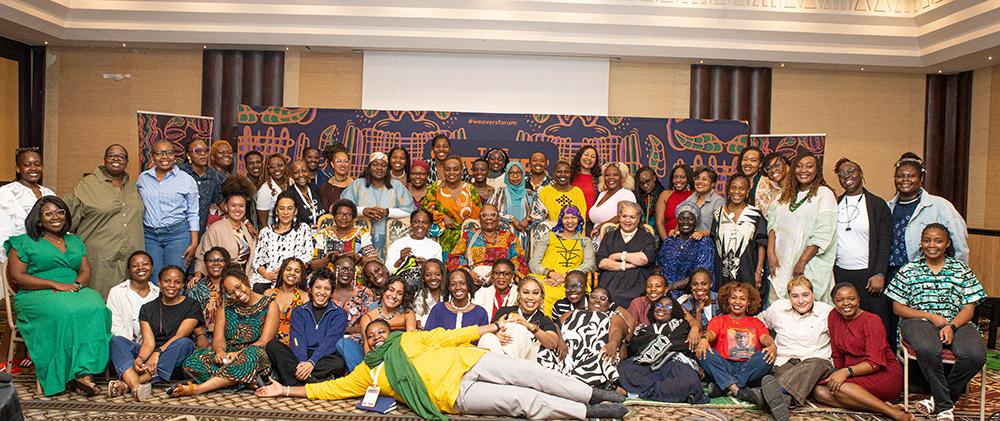
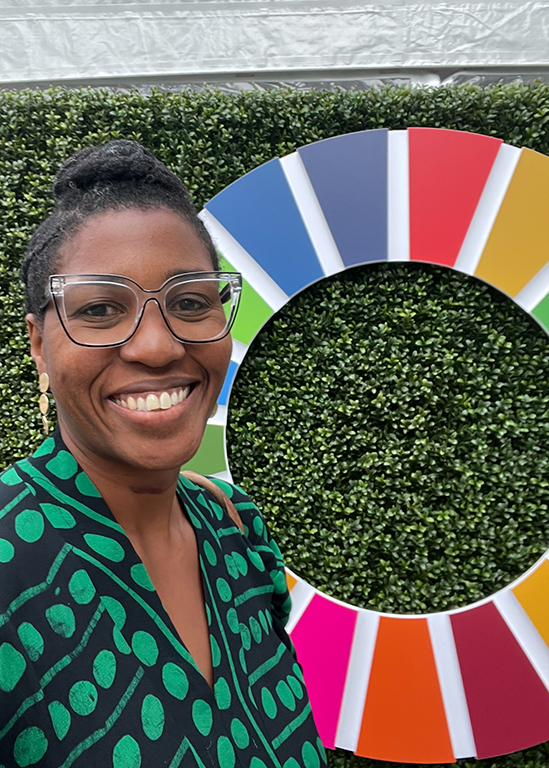
Weavers Forum participants, Windhoek, Namibia
Thanks to Weavers Forum and African Feminist Forum participants for inspiration, to Jessica Horn and L. Muthoni Wanyeki for useful discussions, and to Taiwo Ajayi, Toyin Ajayi, Eeshani Kandpal, and Leah Rosenzweig for feedback.
Topics
CITATION
Ajayi, Kehinde. 2026. AI, Gender Equality, and Self-Healing. Center for Global Development.DISCLAIMER & PERMISSIONS
CGD's publications reflect the views of the authors, drawing on prior research and experience in their areas of expertise. CGD is a nonpartisan, independent organization and does not take institutional positions. You may use and disseminate CGD's publications under these conditions.
Thumbnail image by: Jonathan Torgovnik/Getty Images/Images of Empowerment