Recommended

BRIEF
A Clearer Case for Aid

Development agencies across donor countries face political pressure to demonstrate that cooperation delivers benefits for domestic constituents as well as partner countries. There is a risk that while scrambling to meet this demand, they neglect to ensure they can actually deliver—and then credibly verify—such benefits. This could undermine the case for spending public money on development cooperation, rather than bolstering support.
For mutual benefit to build rather than erode support for development, providers may need to adjust their practice. Research shows that mutual benefit is possible, but not every claim is equally credible. We argue that two questions matter most for the legitimacy of mutual benefit projects: can the claimed benefits be verified on both sides, and do they align with or undermine development outcomes? Using these questions, we build a simple framework for assessing claims of mutual benefit and apply it to four common rationales identified across DAC country strategies, highlighting challenges. We end with reflections on what is needed to strengthen trust in cooperation rather than hollowing it out.
What should agencies consider when setting up mutual benefit partnerships?
Our two key questions have different operational implications. The first, on the y-axis in Figure 1, is the degree of alignment with development outcomes. “Win-win” has become a widely used term, but is this possible in practice? As Owen Barder has argued, it can be—but only under certain conditions. According to the OECD’s Development Assistance Committee (DAC) definition, official development assistance (ODA) must target “the economic development and welfare of developing countries as its main objective.” This implies donor-side benefits must be secondary, if they feature at all. Some forms of cooperation can, at least in theory, generate genuinely shared gains (e.g., strengthening local health systems also helps to reduce global pandemic risk; trade facilitation builds export capacity and improves market access). Others can create tensions: tied aid can increase procurement costs and weaken local firms and supply chains. Synergy is possible in theory, but the degree to which this works in practice needs to be tested.
The second question, on the x-axis in Figure 1, is the ability to measure mutual benefit claims. Measurability itself depends on several factors: the quality of evidence, the time horizon over which benefits—to donor or partner—are expected to accrue, the complexity of the causal chain, and the degree to which specific effects can be attributed to specific interventions. For instance, claims that programmes focussed solely on increasing incomes in poorer countries will reduce irregular migration are not backed by the existing evidence.
Figure 1. Examples of mutual benefit types across two dimensions
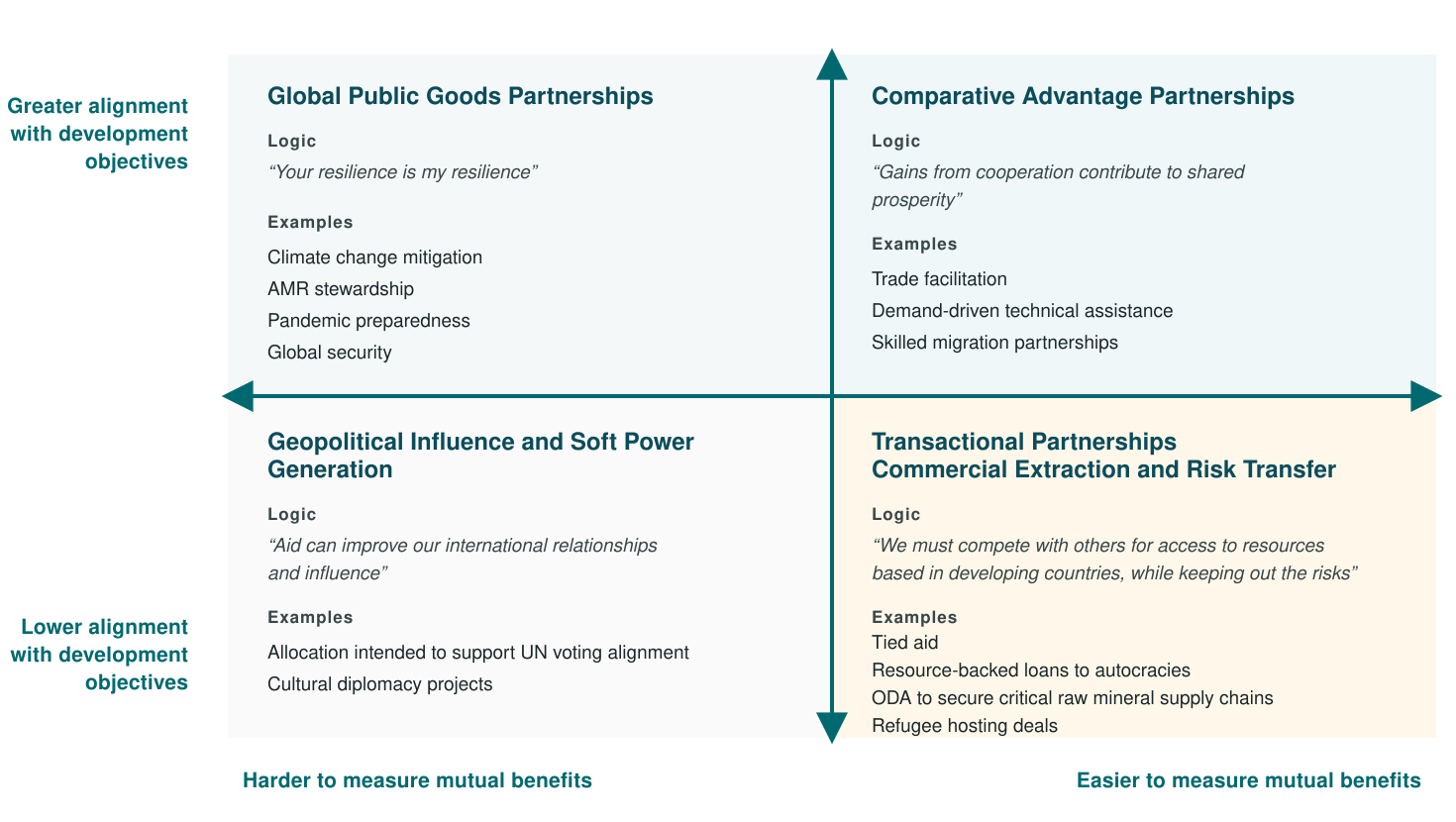
Plotting these against each other gives a framework for identifying different types of mutual benefit partnerships and their risks (Figure 1). The point is not that top-right (high verifiability, high degree of synergies) is “good” and bottom-left “bad,” but that the risks posed by each quadrant may demand different types of evidence, safeguards, or financing streams (beyond ODA).
What types of partnerships can bring mutual benefits, and what are the risks?
Having briefly reviewed DAC country strategies, we identified four recurring logics, which we mapped onto the four quadrants of the framework above, serving as examples. These are not mutually exclusive, as a single donor may deploy several logics across its portfolio, and one programme may invoke more than one.
First, a global public goods logic, based on the idea that global risks such as pandemics, climate change or antimicrobial resistance create shared interests between partner and donor. Australia’s DFAT, for example, frames climate change as the “greatest shared threat to all countries.” As the benefits of global public goods are diffuse and non-excludable—and projects aim to avert complex or one-off global public "bads," like a pandemic or war that never happens—attribution and measurement of each donor's contribution is a key challenge. Synergies between development and donor interest are high in theory, but global priorities set in donor capitals can crowd out local ownership, and the synergies between development and other global aims—such as climate change mitigation—may be overstated, especially when they are funded from the same limited ODA budgets.
Second, a comparative advantage logic that justifies cooperation where donors’ technical expertise or domestic industries can support partner country development. The Netherlands’ “Doing What the Netherlands is Good At” strategy, for example, focuses on water management, food security and health while providing “opportunities for Dutch companies” with a proven track record in these sectors. The returns here are more specific to a set of countries and sectors and therefore easier to verify, but risks remain. One is supply-driven capture: a donor’s sense of what it is “good at” can determine what the partner is said to “need.” Another is one-sided measurement: a Dutch government review of over 50 aid-and-trade instruments showed that evaluations assessed either donor-side gains or development gains, but rarely both together.
Third, a transactional logic, where aid functions as a payment for a specific donor benefit. The underlying mechanism here may be commercial—focused on securing trade deals, markets, supply chains, access to strategic resources—or about transferring risks beyond the donor’s borders. Examples of the former include the rise of tied aid or the EU Global Gateway-branded critical-minerals partnerships signed with the DRC and Zambia. The latter is exemplified by refugee-hosting deals such as the EU–Türkiye agreement or the UK's previously proposed Rwanda scheme. While the nature of these partnerships makes provider benefits easier to verify—contracts and trade deals can be counted, as can refugee arrivals—trade-offs with development are also higher. They can reduce cost-effectiveness and equity. Research shows that tied aid raises the cost of goods and services by 15–30 percent on average, and gains from extractive or commercially conditional partnerships can accrue to narrow elites. In refugee deals, the development benefit for the host is uncertain at best—a zero-sum exchange where the “mutual” benefit claim is under strain.
Lastly, we identify a geopolitical influence logic, framing aid as part of broader diplomatic effort to increase donors’ international influence and image, exemplified by allocations intended to support UN voting alignment or cultural diplomacy programmes. The mutual benefit claim here is not inherently illegitimate, as concessional resources still flow to partner countries, but the verifiability is low. Evidence that donor-side benefits materialise is mixed. Studies find aid can shift UN votes through some channels (such as untied grants) but not others, while gains in improving a donor’s image may fade or vanish once other factors are controlled for. What’s more, donor benefits here stem less from what the aid accomplishes than from the act of giving it, which weakens incentives to care about development results, tempts programme design around recipient elites, and—as CGD analysis of tying US aid to UN votes found—may skew allocation away from poorer and more democratic countries.
What can agencies do to increase the legitimacy of mutual benefit narratives?
Programmes which could, according to our framework, have true mutual benefits should be rigorously evaluated. Claims of domestic benefits in the provider country should be held to concrete standards. For example, a programme that promises to boost employment at home should name a figure for the number of new jobs created, and be judged against it as rigorously as against its development impact. At the same time, performance on a donor-side indicator should not crowd out the measurement of primary development benefits.
Where development benefits are hard to attribute, as with many projects focused on global public goods, accountability depends on individual reporting of inputs against collectively owned outcomes. Climate mitigation is a case in point: no donor can credibly say how many fractions of a degree of warming its funding averted, or how many extreme-weather events it spared a partner country; but it can report the greenhouse gas emissions its contribution avoided—which few still do. Providers should be credited for their fair share of a global input, not for the ultimate effect. Still, these programmes also need safeguards to ensure global priorities do not come at the expense of local ones. For instance, green-hydrogen projects that use African solar power to supply green ammonia for European industry (at high conversion losses) are absorbing scarce renewable capacity from countries that still face large domestic energy deficits.
Where alignment with development aims is weakest or most contested, the burden of proof that development remains the primary objective should be highest, and the safeguards strongest. The label of mutually beneficial development cooperation should be reserved for cooperation that can credibly demonstrate development impact; where development cannot be shown to be the main objective, a programme should not be funded by or reported as ODA. Japan’s Official Security Assistance window is one model to draw on here: rather than stretching the ODA definition to cover strategic objectives, Japan accounts for them through a distinct budget line—keeping the development budget's primary purpose intact and making each set of claims separate.
Finally, agencies should recognise that the same donor-side objective can often be pursued through different routes, and which one is taken matters. Take reducing irregular migration: a donor can pay a third country to host refugees (verifiable donor-side benefits, but zero-sum for development outcomes); address economic and social push factors as “root causes of migration” (higher development synergies, with some promising evidence especially for improved social service provision reducing outbound migration); fund conflict prevention (with security as a global public good—high potential development synergies, but with benefits hard to attribute); or build legal migration pathways by linking vocational training in partner countries to labour mobility. The framework’s point is that these are not interchangeable, and routes that prioritise partner-country ownership are more likely to sustain both the benefit and the legitimacy of claiming it.
Beyond the rhetoric of “mutual benefit”
Ultimately, the risk here is not just conceptual, but also political. When everything from pandemic preparedness to tied procurement to migration deals is framed as “mutually beneficial,” the term can lose its meaning. It becomes unclear whose interests are served, whether development is still the goal, and whether the benefits can be shown at all, undermining public trust. A framing meant to shore up support for development ends up eroding it, at home and with partners alike.
The notion of mutual benefit is understandably appealing: the promise that development cooperation could serve everyone in one stroke provides a tidy solution when budgets are tight. But unless it is grounded in evidence, that promise becomes empty. In forthcoming work, we’ll go a step further and examine how agencies measure and evaluate mutual benefit partnerships in practice.
Topics
DISCLAIMER & PERMISSIONS
CGD's publications reflect the views of the authors, drawing on prior research and experience in their areas of expertise. CGD is a nonpartisan, independent organization and does not take institutional positions. You may use and disseminate CGD's publications under these conditions.
Thumbnail image by: Adobe Stock Images