Recommended

Event
Sustainable Financing for Education
HYBRID
April 15, 2026 1:00—2:15 PM ET | 6:00—7:15 PM BSTThe Global Partnership for Education (GPE) is the largest global pooled fund focused on education. This week at UNGA, GPE will ask donors to contribute to its fifth replenishment, seeking to raise at least $5 billion for its core fund. That’s probably a good investment.
Global education finance is entering one of its most vulnerable periods in decades
The past two years have marked a watershed for foreign aid. Total official development assistance (ODA) fell for a second consecutive year in 2025, declining by 23 percent—the largest annual contraction on record. Aid to education was relatively stable since 2021, when the last GPE replenishment took place, but that stability ended with the wider aid shock. Our 2025 estimates, extrapolating from overall cuts by the Development Assistance Committee (DAC) countries and accounting for their respective shares of education aid, suggest aid to education may have fallen by around 15 percent, while aid to basic education could have declined by as much as 26 percent (Figure 1). The much sharper decline in basic education was driven by the dramatic fall in US aid, which accounted for 46 percent of DAC bilateral aid to basic education in 2024.
Figure 1. Basic education aid was falling before the 2025 cuts
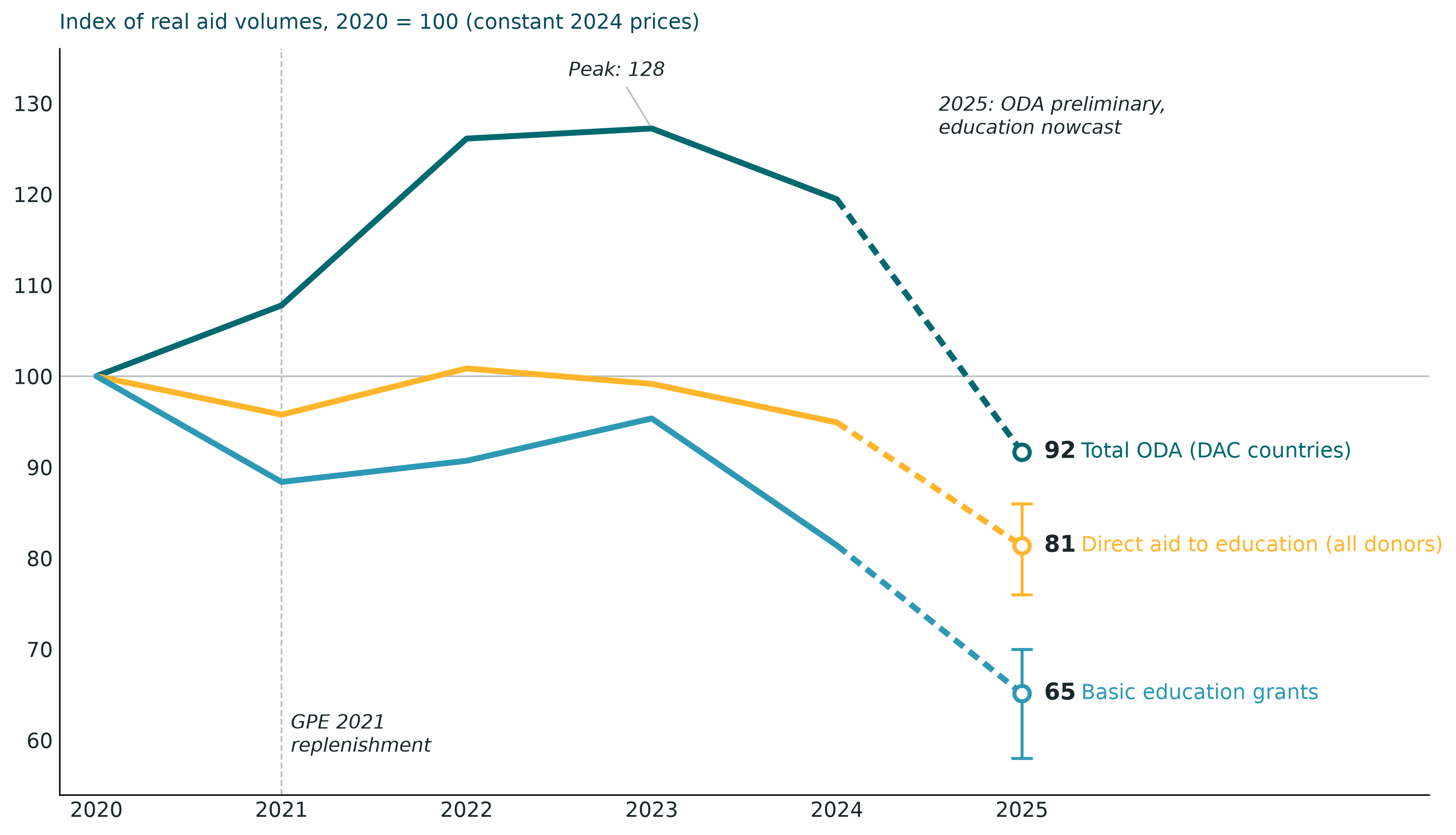
Note: Each series is indexed to its 2020 value 2020=100), in constant 2024 prices. Dashed segments and hollow markers denote 2025 values, which are OECD preliminary figures for ODA and a donor-weighted nowcast for education; whiskers show the mild-to-severe scenario range. Sources: OECD DAC preliminary 2025 ODA (grant-equivalent basis); OECD Creditor Reporting System gross disbursements for education (sector 110) and basic education (sector 112).
These cuts hit a subsector that was already particularly exposed. The share of education aid going to primary and lower-secondary education fell from around one-third in 2013 to one-quarter in 2023, while basic education became increasingly reliant on a small group of donors. This concentration means that retrenchment by one or two large bilateral donors can have outsized effects.
Our estimates also assume that multilateral education financing remains constant. This implies an expectation held by many that, as bilateral aid retreats, institutions such as the International Development Association (IDA) and GPE can serve as stabilising sources of finance for basic education. IDA alone now accounts for around one-quarter of global aid to basic education.
That cuts to basic education are disproportionately large by donors and have been compounded by weak responses from recipient governments. Health featured prominently in both budgetary and policy responses by African governments to aid cuts in 2025, while education barely registered in either rhetoric or action. This is understandable to some extent, given that disruptions to health services are immediate and potentially life-threatening, whereas the consequences of education cuts emerge more slowly. But it also means that basic education risks being squeezed from both sides, losing external financing while receiving relatively little protection from domestic policy responses.
How GPE performs on four key criteria for prioritising education funding
Last year we laid out four criteria for prioritising education funds: (1) use of cost-effective interventions, (2) focus on foundational skills, (3) poverty focus, and (4) maximising leverage. GPE has always performed well on leverage and poverty focus, and its focus on cost-effective approaches to foundational skills is also improving.
Criteria 1 and 2: Cost-effective interventions focused on foundational skills
GPE has increased its focus on basic education and on what it defines as foundational learning (Figure 2). Further, GPE is a key funder of teacher development, textbooks and technological inputs into education quality, school construction, gender equality inputs, and school feeding programmes.
Figure 2. GPE’s grant portfolio is shifting towards foundational learning
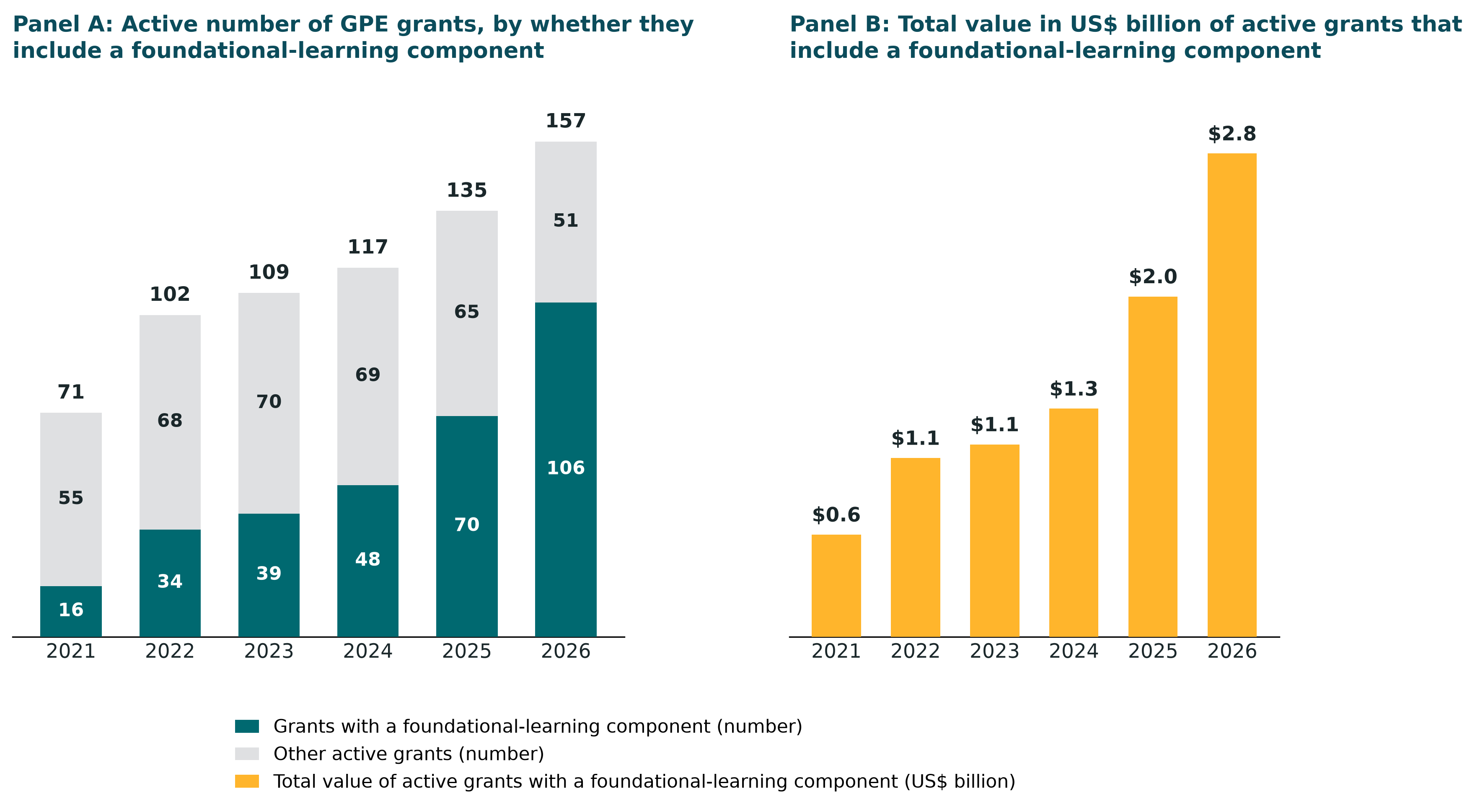
Source: GPE provided data, September 2026, based on its project database. Foundational learning skills are defined in GPE’s coding framework as "skills that make learning possible. They typically include basic literacy and numeracy skills commonly covered in the curricula of the first years of primary education."
GPE’s most recent results report does not capture detailed data on project components that can be linked to the Global Education Evidence Advisory Panel (GEEAP)’s best buys for education. However, a rapid scan of GPE project documents conducted by the authors finds that two leading approaches recommended by GEEAP—structured pedagogy and targeted instruction—seem to be steadily increasing. GPE’s focus on best buys is catching up with the FCDO and the World Bank (Figure 3).
Figure 3. GPE tracks other major funders in mentioning cost-effective approaches
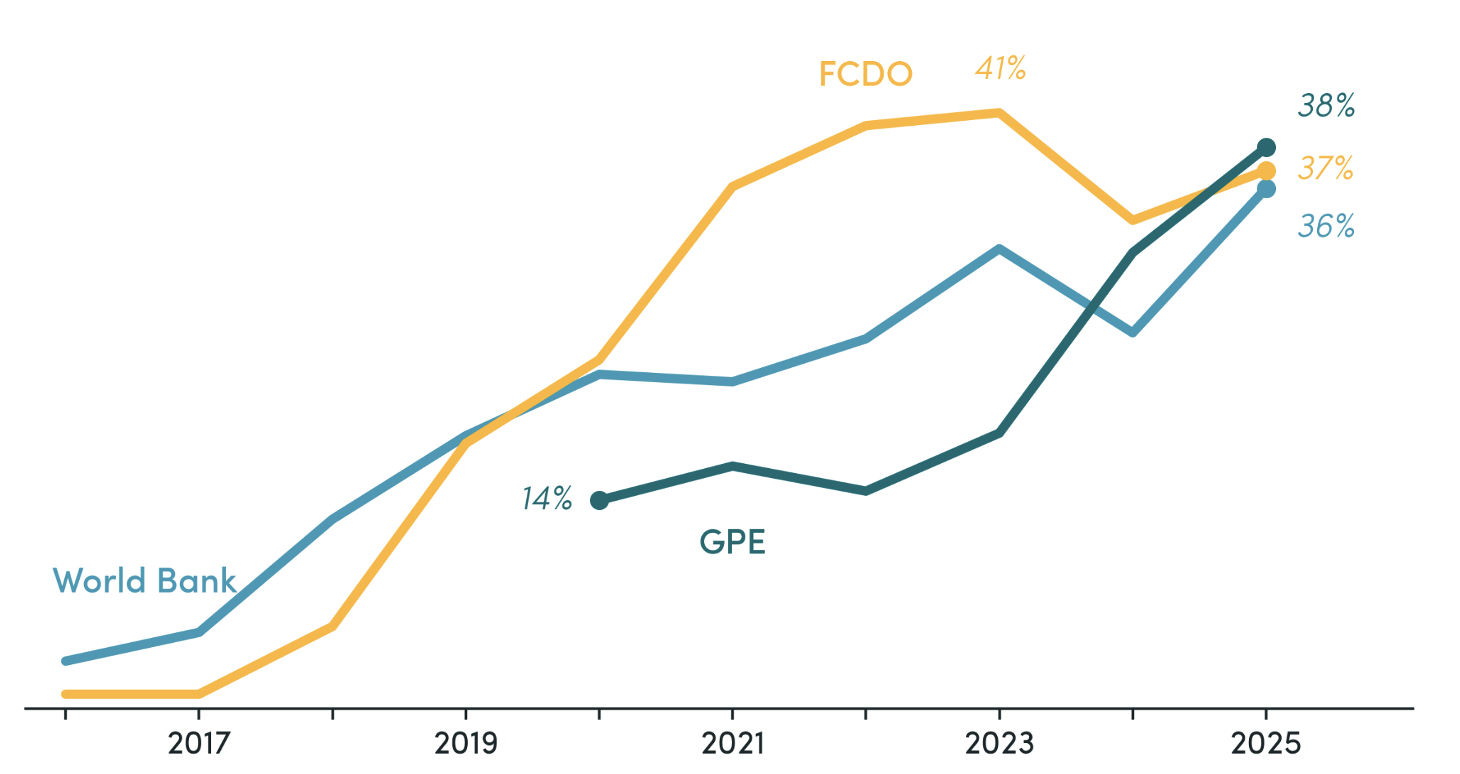
Note: The analysis of World Bank (237 project appraisal documents) and FCDO (72 business cases) is from Angrist, Bedasso, Crawfurd, Hameed, and Ritchie. The GPE analysis scans 257 grant programme documents searched for the same terms. A mention is not a measure of spending: from 2023 to 2025, about one-third of World Bank and GPE documents name at least one of these approaches, but only around one in seven is tied to a funded component.
Beyond specific pedagogical approaches, good data on learning outcomes is central to any effort to improve education systems. From 2020 to 2023, GPE reported that only 40 of 90 countries reported any type of learning achievement data that met global reporting criteria. In an important shift for 2026, 98 implementation grants across 66 countries or federal regions supported learning assessments or learning assessment systems. GPE’s latest results framework introduces standardised measurement of the beneficiary-level impact of grants and co-financing, including the number of children with improved learning outcomes and the number of countries with a portion of their allocation (a "top-up") linked to SDG4.1.1a reporting.
Criterion 3: Poverty Focus
GPE compares favourably to other multilateral organisations and bilateral aid programmes in its focus on low-income countries and countries with high numbers of out-of-school children.
GPE funds are highly concentrated in low-income countries, including those affected by fragility and conflict. Its eligibility framework for the next five years indicates that most funding delivered through its system transformation grants is reserved for low-income countries (and island states eligible for IDA funding). Even the multiplier grant, originally developed to support middle-income countries, now protects allocations for low-income countries with high numbers of school-age children. The organisation’s new strategy promises to continue spending at least 50 percent of grant funds in low-income countries (Figure 4).
Figure 4. Most GPE funding still goes to low-income and fragile countries, though less so than in the previous replenishment cycle
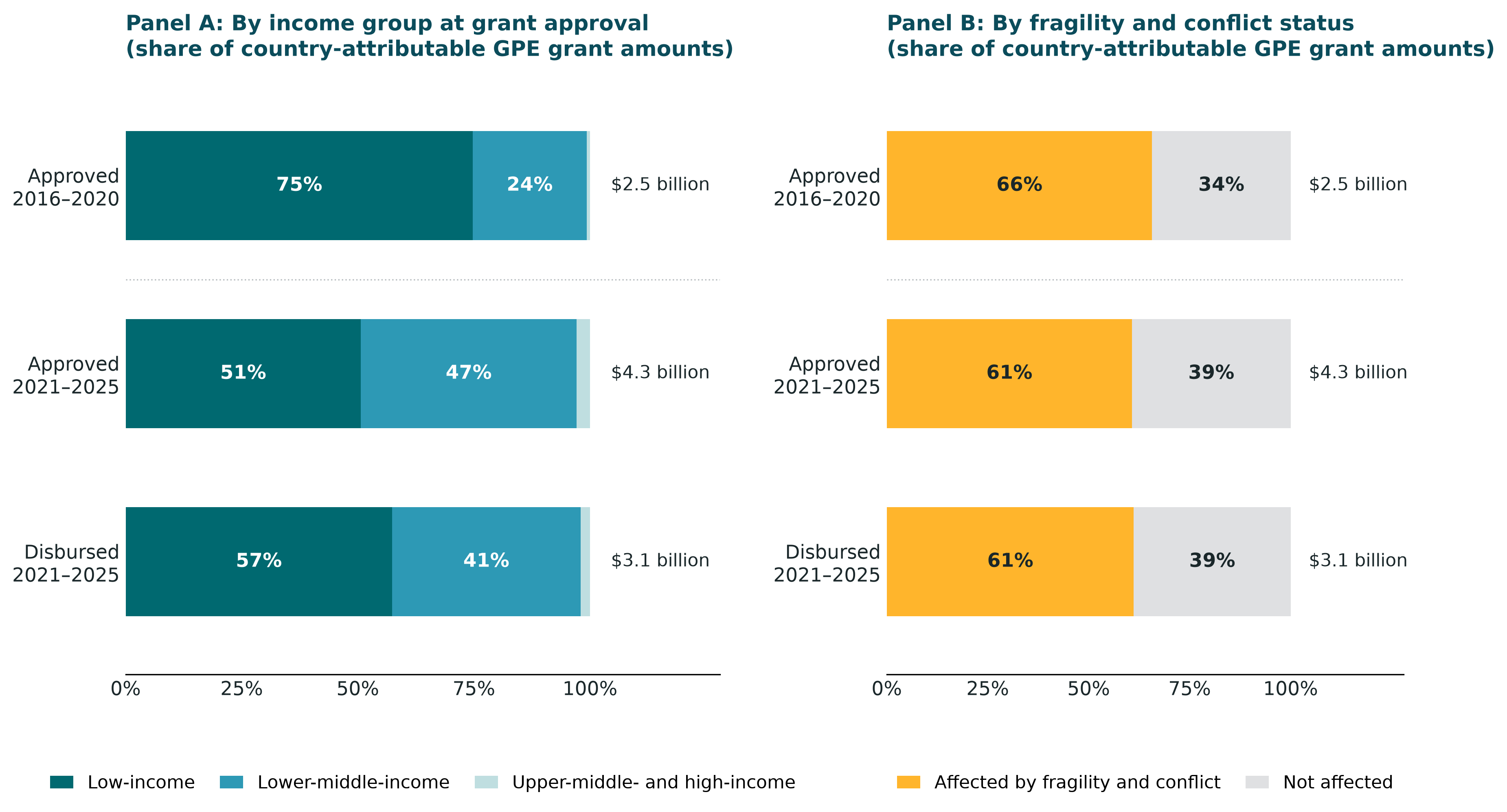
Note: Approval and disbursement figures for 2021–2025 were obtained from GPE (personal communication). The 2016–2020 approval figures are from the authors’ calculations based on GPE’s grant portfolio data. Disbursements are amounts paid out during 2021–2025, from grants beginning in any year.
One larger change proposed in the new allocation formula bears careful scrutiny. GPE plans to increase the funding share offered through its multiplier grant, while also excluding middle-income countries (apart from island states) from its traditional grant window. This change is expected to support the current distribution of GPE resources, but could also reinforce co-financing flows to lower-middle and middle-income countries at a time when grant funding for low-income and recently graduated lower-middle-income countries, particularly in Africa, is falling.
Criterion 4: Maximising financial and policy leverage
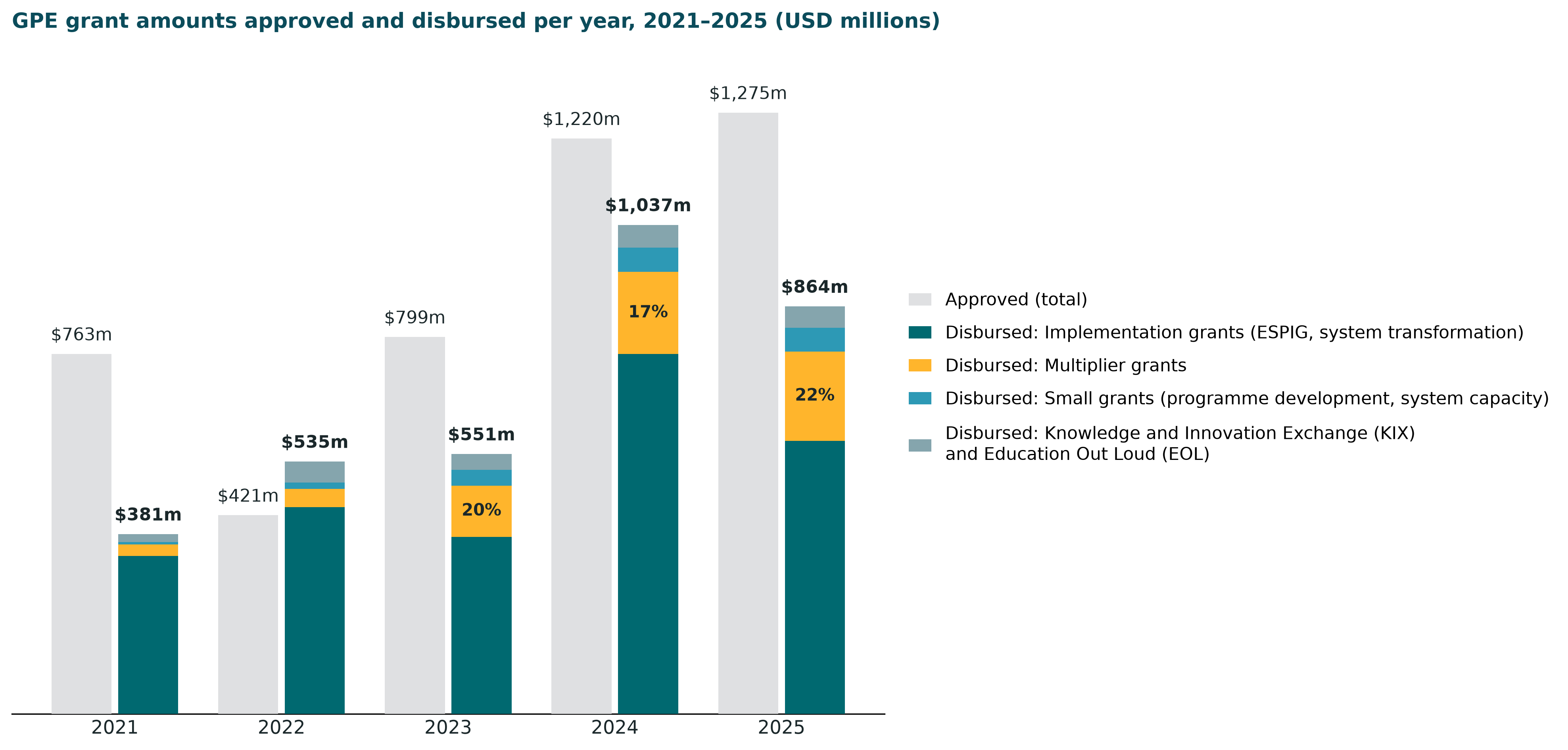
GPE moves about $1 billion annually. Moving funds has not always been a GPE strength, partly because of the complexity of its requirements and its use of intermediaries to design and implement grants.
Volume increases have been matched by improvements in project outcomes. In 2025, 76 percent of implementation grants met their objectives, compared to 61 percent in 2024. And GPE now has a mechanism to leverage improvements in domestic financing by providing top-up grant incentives to improve, for example, budget execution rates or the inclusion of newly recruited teachers in the national payroll.
GPE has also expanded efforts to create new co-financing and innovative finance for the education sector (Figure 5). Its multiplier grant has onboarded 66 co-financing partners for country programmes since 2021. A small but growing part of this co-financing–$236 million–has come from private sector and civil society organisations.
Figure 5. GPE disbursements have more than doubled since 2021
Multiplier grants have allowed governments to co-finance through debt swaps in Côte d’Ivoire, receive co-financing from the Green Climate Fund to support school resilience in South Sudan, and secure co-financing with philanthropy and the private sector cacao industry to support basic education in Ghana. In Ukraine, the multiplier grant brought on board Google and Microsoft to support educational technology.
While these new co-financing arrangements carry risks, they have helped bring in new partners and support national coordination, according to a 2023 evaluation.
GPE plays an outsized role in supporting governments to plan and manage their national education systems, while other donors have moved towards more projectised approaches (increasingly concentrated on subsectors such as TVET and secondary education). GPE’s system capacity grants allow governments to engage in holistic, system-wide planning, which is critical for prioritisation and costing in low-resource contexts.
GPE also brings policy leverage through two other mechanisms. The Knowledge and Innovation Exchange (KIX) fund was recently evaluated positively for its effectiveness in fostering capacity for better management, planning, and evidence use. Education Out Loud supports national civil society actors in holding governments accountable for outcomes.
Room for improvement
No fund is perfect. GPE’s overhead costs and the complexities of its model should remain a concern. It should do more to encourage governments to monitor outcomes, especially at the primary level, and to test and learn from innovations.
GPE has also grown into a more complex organisation with different types of grants and top-ups. It is probably due for an overall independent evaluation to take stock of its impact and comparative advantage across these new mechanisms.
That said, GPE measures up well against our four criteria: (1) increasing use of the most cost-effective approaches; (2) focusing on basic education, and increasingly targeting foundational learning; (3) it is poverty-oriented and protects financing for low-income countries; and (4) it has made major strides in co-financing, now moving approximately $1 billion a year. It has strengthened its support for local technical capacity and data, as well as civil society voice and social accountability.
The word on the street is that GPE will not achieve its bid for a $5 billion replenishment. This is reflected in the Board’s consideration of scenarios that dip below $3 billion.
At levels below $3 billion, GPE’s ambitions come into question, and GPE will need to make difficult decisions about the balance of allocations to middle-income countries and between foundational learning and other levels of education. GPE’s role in the overall architecture—and specifically its relationships with Education Cannot Wait and the International Facility for Financing Education—will also come under scrutiny.
Whatever the resourcing scenario, GPE should continue to focus on foundational learning and protect its financing of the poorest countries with the greatest educational needs, given the wider pullback of education aid.
Topics
DISCLAIMER & PERMISSIONS
CGD's publications reflect the views of the authors, drawing on prior research and experience in their areas of expertise. CGD is a nonpartisan, independent organization and does not take institutional positions. You may use and disseminate CGD's publications under these conditions.