This week in New York, foundations that work in global development are busy discussing their role in a changed world. I think they have a critical role, but it is a role that acknowledges, advertises and responds to their limits. They can and should help directly save some of the lives and services at risk from cuts. Equally important, however, is that they collectively communicate how much they can’t replace government assistance, and act accordingly.
A modest philanthropic response so far
So far, the direct funding response from donors and foundations to the billions in USAID cuts has been important but modest. The Skoll Foundation and MacArthur Foundation have promised increased giving. Givewell has listed on its website some of the donations it has made to high-impact and urgent activities formerly funded by USAID adding up to about $31 million. The Gates Foundation is accelerating spending to meet a 20-year sunset target, though this was not related to US foreign assistance cuts. Meanwhile, Project Resource Optimization (PRO), an effort hosted at CGD to secure funding for what the team involved considered urgent and highly cost-effective assistance, has raised more than $100 million for over 80 projects.
Why philanthropy can’t fill the gap
This, seemingly limited response reflects timing and realism: private philanthropy simply can’t fill the gap left by public sector withdrawal. Global ODA fell by about $15 billion in 2024 compared to 2023 - adjusted for inflation, almost twice the Gates Foundation’s entire 2024 budget. In the US alone, the Administration’s proposed and enacted funding cuts in the major foreign assistance accounts total around $8.3 billion. By contrast, the OECD estimated private philanthropy for development from US foundations totaled $24.3 billion between 2016 and 2019, or about $6 billion a year. That’s an underestimate of flows today, but it is pretty clear that unless foundations simply stopped doing everything but try to gap-fill US foreign assistance, their resources are inadequate. For reference, $6 billion is roughly the cost of a dam project in Mozambique being supported by the World Bank,
As the Gates Foundation’s Rob Nabors has made clear, “There is no foundation — or group of foundations — that can provide the funding, workforce capacity, expertise, or leadership that the United States has historically provided to combat and control deadly diseases and address hunger and poverty around the world.” The people at Givewell have said something similar. And it’s about more than just the money: it is about the role of government, the legitimacy, the collective responsibility and the global burden sharing.
Signs of resilience and public support
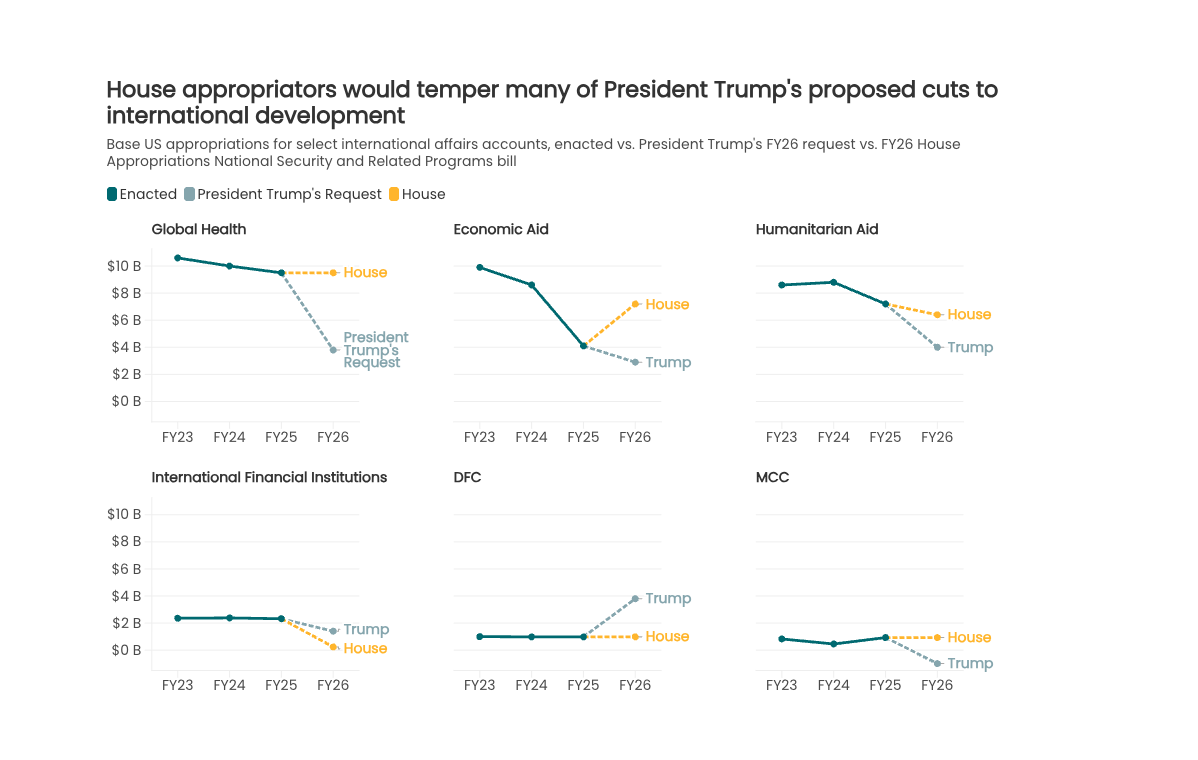
That doesn’t mean the situation is hopeless. Charitable giving in the US shows that foreign affairs attract a larger share of donations than its share of the government budget: about five percent of the total. That is one sign that there is a strong constituency for foreign assistance in the US. Meanwhile, the average American has pretty much always thought the US spends too much on foreign aid, while overestimating how much is spent, the share who agree with that sentiment is lower than in the past, about 62 percent). On Capitol Hill, bipartisan support for assistance still exists: Republican members of the Appropriations Committee passed an international affairs spending bill for FY26 that was ‘only’ an 18 percent cut from what was enacted in FY25, a far less draconian reduction than proposed by the administration. There is some evidence that the effort to protect lifesaving assistance has achieved partial victories. In that sense it is not naive to think that the constituency for foreign aid could push back, especially regarding assistance that can clearly demonstrate development results.
An agenda for philanthropy
Given all of that, if I were convening foundations to respond, I’d ask the assembled to work together to:
- Report their collective ongoing and likely future direct funding responses to fill the gaps created by the global assistance cuts.
- Target resources to high-impact interventions and projects and expand the beyond lifesaving programs to include other sectors, potentially enlisting groups like the International Initiative for Impact Evaluationand the Global Education Evidence Advisory Panel.
- Publicly acknowledge that private philanthropy can’t replace government assistance because of the scale of funding as well as the unique role, capacity and legitimacy of governments.
- Support tracking the impact of aid cuts, including through surveys, to improve response, and to build and strengthen the evidence base on aid impact.
- Back advocacy efforts that covers and extends beyond lifesaving assistance to other sectors that been the most affected by the cuts in the US in particular, highlighting work including proven approaches to community violence or using phonics in education, and working with legislative champions in those areas.
- Emphasize the irreplaceable role of aid especially in the poorest countries, where efforts to leverage private finance have largely failed and the local tax base is small, while foreign assistance has saved millions of lives and has helped deliver vital public services.
- Ensure that any agenda for ‘rethinking the aid architecture’ recognizes (i) the increasing urgency to preserve lifesaving and highly effective assistance at risk; (ii) the most effective development assistance is focused on the world’s poorest people and countries; and (iii) the strength of the constituency for such assistance, as well as for positive-sum global engagement in general.
Of course I’m hardly a disinterested observer in this discussion. Not least, I’m very grateful to CGD’s supporters, and CGD’s management, for the unrestricted funding that has enabled much of the work I’ve been doing over the past nine months on foreign assistance cuts, and I’ve been advocating for some of the above agenda points with donors. Discount appropriately. But this is a time for foundations to step up, not only in terms of funding, but also in terms of transparency around their role as well as implications regarding its limits.