Recommended
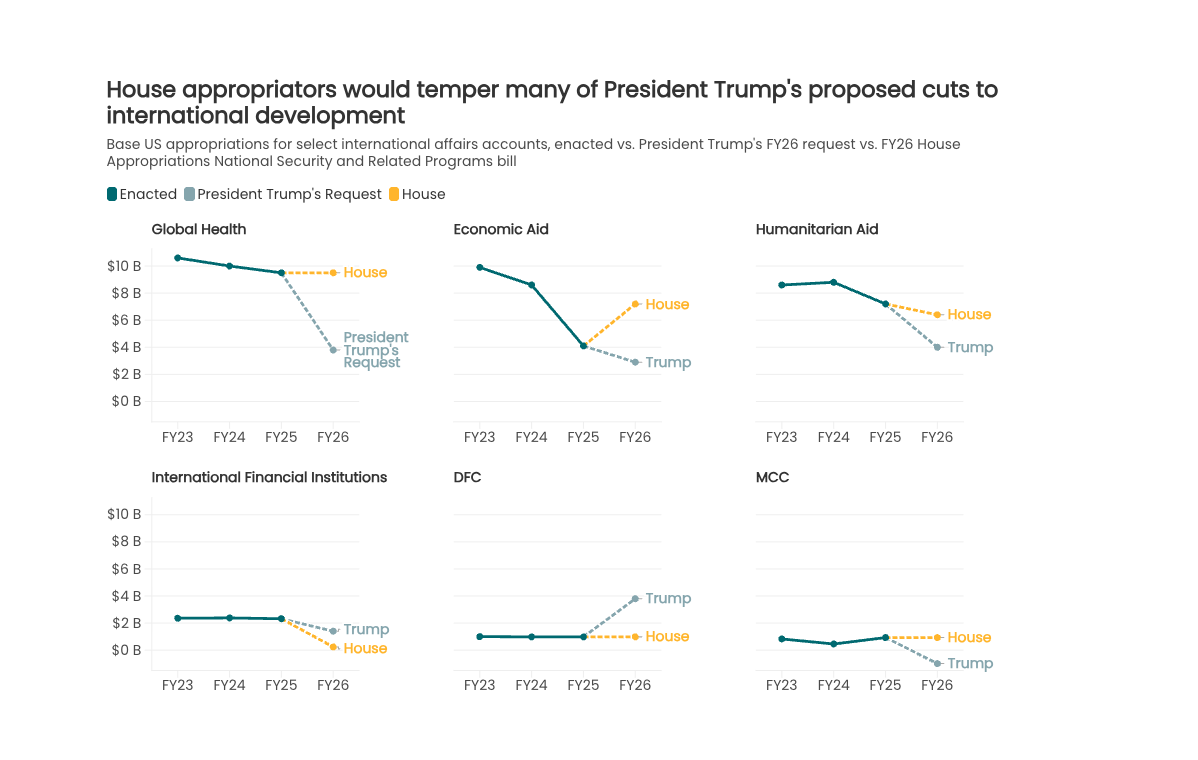
Since taking office in January, the Trump administration has made clear it conceives of a dramatically scaled-back role for US investment in development and humanitarian response. The administration has taken a host of actions to realize its vision—from instituting a wide-reaching foreign aid freeze to dismantling the United States's largest aid agency and terminating thousands of existing foreign aid awards. But top officials have suggested some international assistance will remain, and lawmakers have signaled an interest in preserving an even larger share. As our colleagues have sought to document, the details of what stays and what goes—and of how the administration might execute its alternative design, particularly given tense budget and appropriations dynamics with Congress—have been difficult to parse.
Data recently published by the Office of Management and Budget (OMB) offers insight into the status of major aid accounts at the end of fiscal year 2025 (September 30). Topline account numbers only tell part of the story, but provide an opportunity to compare trends in cumulative obligations and outlays with previous fiscal years. This Q4 update is significant since it's common to see an uptick in obligations for many aid accounts in the final month of a fiscal year.
Global Health Programs
There remains some political support on both sides of the aisle for continued US investments in global health. This summer, lawmakers stepped in to reduce proposed rescissions of global health funding—and the State Department's recent America First Global Health Strategy leveled plenty of criticism against actors across the sector, but also praised the accomplishments of US global health programs, including PEPFAR. Life-threatening disruptions in aid-supported health services have been documented around the world, but the latest data suggest global health disbursements and even new commitments lag prior years by less than many feared.
More detailed data will be crucial to understanding where this funding is going and what it's intended to support. Still, continued aid flows could help mitigate some of the negative impacts that early projections suggested.
International Disaster Assistance
Both disbursements and new commitments under key humanitarian accounts have fallen well behind their trajectories in recent years. Since humanitarian crises don't follow an annual budget cycle, Congress typically appropriates "no year" funding—meaning it has no expiration date. In recent years, lawmakers have periodically topped up these accounts with supplemental funds to address many pressing needs. But in the current climate, the lack of a deadline may mean less pressure to spend down—especially where the State Department has less capacity to move quickly to meet urgent needs than USAID, which had developed procedures and policies to move faster in response to emerging crises. (Though the recent social media announcement that the State Department was sending teams to support countries affected by Hurricane Melissa was encouraging.)
For a more complete look at US humanitarian support, check out the end-of-fiscal-year snapshot in the chart below (use the interactive feature to switch between obligations and outlays), which also includes food aid and support for refugees and select migrant populations overseas.
Development Assistance
USAID's primary bilateral economic assistance account was a catchall, funding a wide range of programs and interventions, though investments in education and food security regularly topped the list. The administration has sought to claw back much of the Development Assistance funding once managed by USAID through two rounds of rescissions and hopes to replace it entirely with a smaller and more flexible America First Opportunity Fund. The effects of those rescissions, along with the administration's dim view of this particular account, are evident in the limited spending and the sluggish pace of new obligations.
While this data sheds new light on trends in new US foreign aid commitments and the pace of spending, we still have plenty of questions. The (relatively) good news is that global health obligations picked up in September, reaching a level closer in line to prior years (see table below).
Table. Obligations and outlays across key US foreign assistance accounts: Q4 FY25 vs. prior years
Obligations
| Account | Q4 Sept 2025 Actual | % Change from 2024 | % Change from 2023 |
|---|---|---|---|
| GHP | $7.53 B | -34.42 | -10.65 |
| DA | $0.776 B | -82.26 | -80.98 |
| IDA | $2.52 B | -67.5 | -67.87 |
| MRA | $2.9 B | -48.9 | -38.73 |
| PL 480 Title II | $0.995 B | -56.9 | -45.62 |
Outlays (net)
| Account | Q4 Sept 2025 Actual | % Change from 2024 | % Change from 2023 |
|---|---|---|---|
| GHP | $7.47 B | -31.15 | -13.18 |
| DA | $2.48 B | -29.96 | -26.17 |
| IDA | $5.75 B | -9.97 | -37.87 |
| MRA | $2.94 B | -36.37 | -39.87 |
| PL 480 Title II | $1.5 B | 57.64 | -15.34 |
Source: OMB SF-133 Report on Budget Execution and Budgetary Resources; Author’s calculations
But humanitarian funding appears stalled, and traditional development assistance has largely been hollowed out. We still lack specificity on where, to whom, and for what purposes—the administration is channeling funds, including the degree to which the money might be allocated to lifesaving global health programs. On the ground, delivery capacity has eroded, and the State Department’s limited staffing presents challenges to managing aid effectively. We'll be keeping an eye out for new data to better understand the scope of US aid reductions—and their impact on people's lives and well-being, and America's own standing.
Note: One figure in the table (PL 480, year 2023) was updated post-publication to correct a data error.
Topics
DISCLAIMER & PERMISSIONS
CGD's publications reflect the views of the authors, drawing on prior research and experience in their areas of expertise. CGD is a nonpartisan, independent organization and does not take institutional positions. You may use and disseminate CGD's publications under these conditions.
Thumbnail image by: USAID / Maggie Moore