Recommended

Project

Blog Post
Development Agencies on What Being Effective Means to Them
Development cooperation is entering a period of profound disruption. Rapid declines in official development assistance (ODA) have shifted the narrative from “peak aid” to “post-aid,” while geographic uncertainty and changing political priorities are eroding support for development as a core government function—dramatically underscored by the 2025 closure of USAID. At the same time, structural changes in the global landscape—from the rising importance of financing global public goods to the growing influence of emerging providers—are challenging long-standing norms, institutions, and assumptions, with several efforts currently underway to “re-think” development cooperation for the years ahead. For development agencies, these shifts raise fundamental questions about why and how they cooperate, and what it will mean to be effective in the future.
In a new paper, we explore the challenges and characteristics of long-term agency effectiveness in a changing development landscape, drawing on interviews with officials from four bilateral development agencies: France’s Agence Française de Développement (AFD), the Korea International Cooperation Agency (KOICA), New Zealand’s Ministry of Foreign Affairs and Trade (NZ MFAT), and the Norwegian Agency for Development Cooperation (Norad). By focusing on the internal processes, structures, and capabilities needed to deliver on shifting demands, our research moves beyond the international development effectiveness principles outlined in the Busan Agreement—which our previous work showed are often no longer top of mind, not least due to implementation difficulties. Instead, we probe how organizational processes and factors support or undermine effective practice. Ultimately, we find that being effective in the future will require agencies to grapple with four key questions that clarify their purpose, offer, willingness to partner, and ability to communicate impact.
What are the main barriers to agency effectiveness?
When asked about the main challenges to effective agency practice, interviewees highlighted a range of issues related to both the internal capacities, resources, and processes that shape day-to-day operations, and the external pressures from political, legal, or partner-country factors that constrain their action but remain beyond their immediate control (see Figure 1).
Figure 1. What are the largest challenges for your agency’s continued effectiveness?
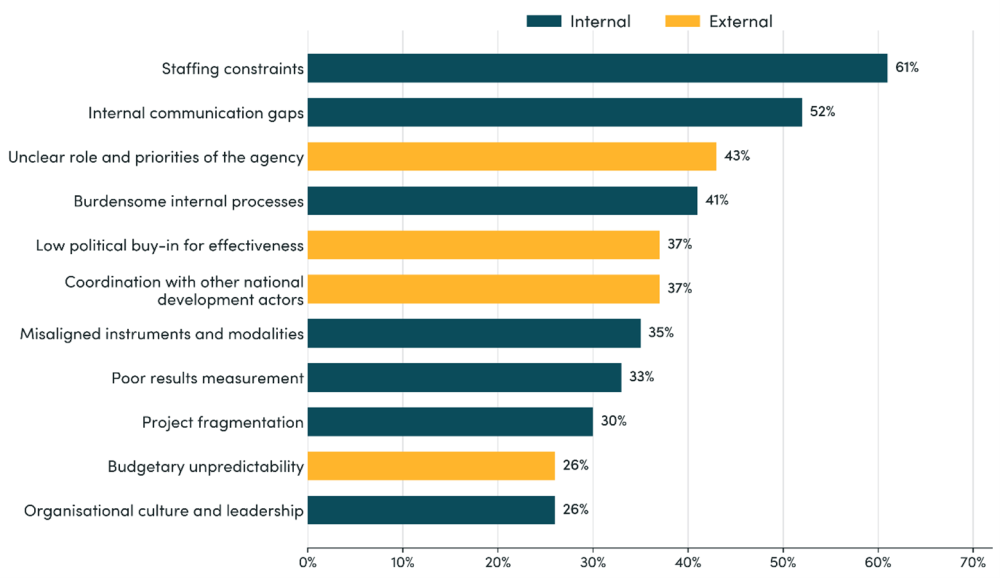
Note: Only challenges mentioned by 25% of interviewees or more are included in the figure. Other internal challenges mentioned by fewer than 25% of respondents included operational and IT challenges (24%) and pressures to balance speed with quality (15%); other notable external challenges mentioned by fewer than 25% of respondents included domestic accountability pressures and communication gaps (22%) and partner-country factors such as low capacities or political turbulence (11%).
Interviewees identified staffing constraints and internal communication challenges as the most common internal barriers to effectiveness. On staffing, many described overstretched teams, leaving limited time for learning, experimentation, or adapting projects when circumstances change. On coordination, interviewees noted that silos between teams hindered strategic, joined-up approaches. Other internal challenges included burdensome processes, which amplified staffing pressures through layered approvals or extensive reporting requirements; instruments that were misaligned with changing demands; inadequate results measurement; and project fragmentation.
In terms of external pressures, uncertainty about agencies’ role and priorities was the most frequently cited challenge, followed by low political prioritization of effectiveness and poor coordination with external partners. Most notably, interviewees stated that unclear agency objectives—particularly in relation to their expected role in advancing foreign policy priorities or addressing global challenges—creates internal confusion. At the same time, limited political interest in effectiveness was viewed as reducing incentives to experiment, adapt, or partner to improve impact, while poor coordination with implementing partners and other providers led to higher transaction costs for partner countries and limits opportunities to leverage comparative advantages.
What characteristics will define effective and resilient development agencies?
When asked what defines a future-fit development agency, interviewees across the four case studies consistently highlighted four traits:
- Strategic clarity: Clear mandates provide the strategic guidance necessary to clarify agency responsibilities (vis-à-vis other actors in national development systems), articulate desired impact, and enable agencies to map both the skills and capacities needed to deliver on stated objectives, as well as to identify the instruments, tools, or approaches necessary to achieve desired aims.
- Being equipped for partnership: Exploring partnerships with a range of actors —other providers, multilateral institutions, and local partners—are essential for delivering results at scale. Yet, doing so requires agencies to have the incentives to invest in shared systems or platforms that enable coordination in country, or to accept the risks and reduced visibility associated with pooled or co-financing ventures.
- Flexibility and adaptability: Given the frequency of urgent crises, processes that enable quick adjustments in response to changing contexts and needs in partner countries. Interviewees stressed that such adaptability often requires strong local relationships built on mutual trust, budgetary flexibility to account for crisis response, and access to a wider range of policy and financial instruments to support partners as priorities evolve alongside economic growth.
- Ability to demonstrate impact and value: With many agencies facing increased public scrutiny of development spending at home, clearly communicating the impact and value of their work is critical for their long-term resilience. Doing so requires the ability both to conceptualize and measure aggregate agency impact, and to communicate organizational value to non-specialist audiences.
Four questions development agencies can no longer avoid
Our research points to not a single blueprint for reform, but a set of hard questions that development agencies can no longer avoid:
- What is their role and purpose?
- How can they make the best use of scarce resources (both human and financial)?
- How can they stay relevant to partner needs as contexts shift?
- How do they evidence and communicate impact, particularly in sceptical political environments?
These questions are not new, but they are becoming more urgent—and more difficult—to answer, as the pace of change in the development landscape increases the cost of inaction.
For many agencies, the immediate priority is likely to be cost-effectiveness and efforts to “do more with less.” While important, our findings suggest that greater gains could come from pairing this with broader efforts to address underlying organizational constraints—on staffing, incentives, processes, and decision-making—that shape project design, delivery, and monitoring. In the years ahead, improving the impact of development agencies will require rethinking not just “what” they do, but also “how” they operate and the reforms needed to remain credible, legitimate, and relevant. The agencies that thrive will be those willing to reform not just their portfolios but also their ways of working.
Topics
DISCLAIMER & PERMISSIONS
CGD's publications reflect the views of the authors, drawing on prior research and experience in their areas of expertise. CGD is a nonpartisan, independent organization and does not take institutional positions. You may use and disseminate CGD's publications under these conditions.
Thumbnail image by: dennisvdwater/ Adobe Stock