Recommended
The next climate COP (Conference of the Parties) are fast approaching and Australia, as President of Negotiations, is keen to champion the cause of small island developing states (SIDS). Pre-COP meetings in Fiji put Pacific and wider SIDS priorities at the centre of COP31.
I’ve previouslydemonstrated that not only are SIDS significantly less vulnerable to climate change than least developed countries (LDCs), low-income countries (LICs) or fragile and conflict affected states (FCS), but they already receive much more adaptation finance per head than these countries, even though SIDS are also significantly richer.
But are the Pacific SIDS (in whom Australia understandably has a special interest, appointing three Pacific Climate Envoys) more vulnerable than other SIDS?
To answer this question, I've revisited my earlier analysis of climate vulnerability, this time distinguishing between Pacific SIDS and other small island states. I find that while they are indeed more vulnerable, they are still nowhere near as vulnerable as LDCs, LICs or FCS. And they have already been receiving significantly more adaptation finance per head than other SIDS. But the extreme consequences of the climate crisis are becoming ever more obvious and the existential threats faced by low-lying SIDS are very real.
This blog summarises my analysis, explores the implications for adaptation finance and for loss and damage, and outlines how Australia (and others) could best proceed to support SIDS at COP31 and beyond.
Pacific SIDS are more vulnerable than other SIDS…
My previous analysis of 140 developing countries across five different vulnerability indices covering overall risk, vulnerability and exposure, found that SIDS were much less likely than LDCs to rank among the most vulnerable countries. In fact, across most of the measures examined, more SIDS fell in the less vulnerable half of the rankings than in the more vulnerable half.
Figure 1 presents the average vulnerability rank across these five indices at each level. The first two sets of columns (from Table 6 of the original paper) clearly show that LDCs are significantly more vulnerable than SIDS at all levels (with average ranks of 33 and 76 respectively at the vulnerability level, for example). The final two sets of columns provide disaggregated data for Pacific and other SIDS, showing that Pacific SIDS (with an average vulnerability rank of 59, for example) are indeed significantly more vulnerable than other SIDS (average rank 85). However, they are still much less vulnerable than LDCs. Average ranks for LICs and FCS were even lower.
Fig.1 Average vulnerability ranks for LDCs and SIDS
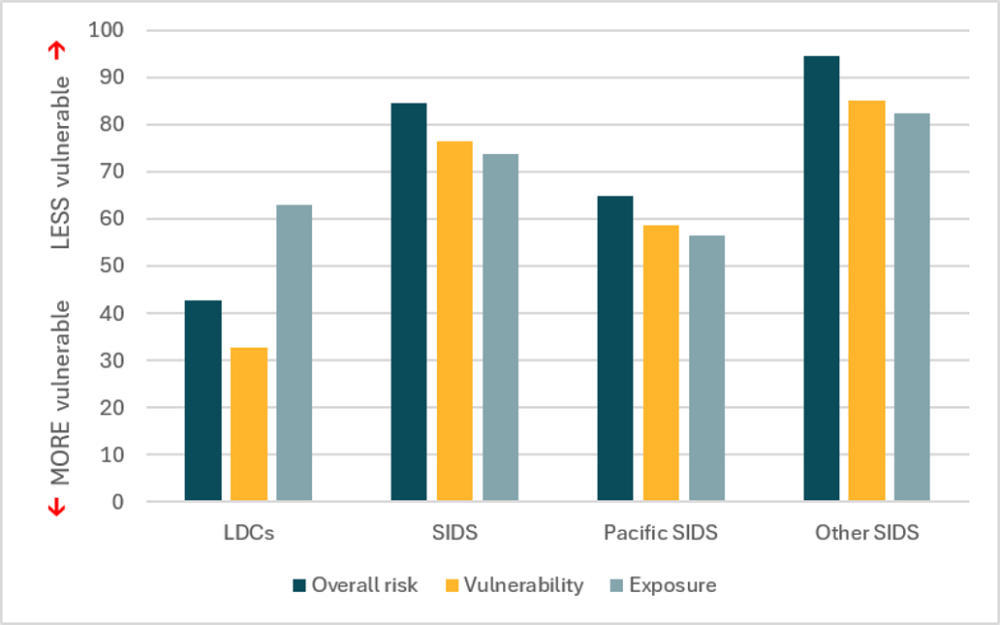
Note: Bars represent the average rank (out of 140) of countries in each country group using a normalised average of the five individual indices (ND-GAIN, WRI, INFORM CC, MVI and PVCCI, same data as used previously) at each of three levels: “exposure” focuses on physical climate hazards, “vulnerability” captures the sensitivity of a system to those hazards and its socioeconomic capacity to withstand them, and “overall risk” combines both with wider governance and institutional indicators. The analysis covers all 140 developing countries (of which 46 are LDCs and 37 are SIDS, with 12 Pacific and 25 other SIDS) that are common to all five indices. The lower the rank, the greater the vulnerability. Detail on ranks in each individual index available here.
…but already receive much higher levels of adaptation financing
Pacific SIDS' greater vulnerability might justify giving them particular attention at COP31. But they already receive high levels of adaptation finance in per capita terms, constituting seven of the eight highest-receiving countries. Overall, they receive nearly five times as much adaptation finance per person as other SIDS, whose levels are only marginally higher than LDCs (see Figure 2), although still significantly higher than LICs and FCS.
Fig 2. Adaptation finance $/hd per year (average 2016-2023)
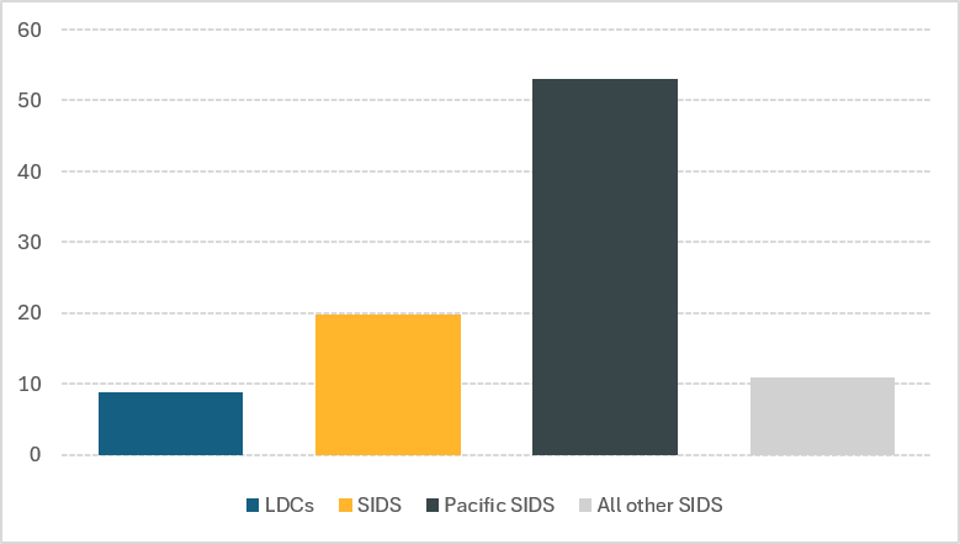
Note: these figures represent the average of each group’s adaptation finance per head in each year of the period 2016-2023. For details, see here. Figures for SIDS ($19.8/hd) are marginally higher than the $17.9/hd previously reported as population figures for Singapore and the Bahamas (which are not ODA eligible and do not appear in the CRDF dataset) have been deducted from the SIDS population total.
Source: derived from OECD Climate-Related Development Finance dataset.
Implications for allocation of future finance
Adaptation financing needs far exceed currently available resources, and hard choices have to be made in terms of where to prioritise. Adaptation costs per head may be higher in SIDS (around double that in LDCs according to previous analysis, partly a consequence of extreme remoteness and high unit costs, especially in the Pacific with their low-lying atoll geography), but SIDS are also significantly richer: overall, SIDS per capita income is around $6000 (GNI/hd, weighted average), even without Singapore and Bahamas (which are not ODA eligible and do not appear in the CRDF dataset). This is more than four times that of LDCs. Pacific SIDS are poorer, with a GNI of around $3000/hd, but that’s still more than twice that of LDCs. This analysis suggests therefore that there is no clear evidence or case for further prioritising SIDS in general, or Pacific SIDS in particular, when it comes to adaptation financing.
And yet, the extreme consequences of the climate crisis are becoming ever more obvious as the increased frequency, severity and cost of climate-related disasters attest. And whatever the evidence from vulnerability indices suggests, the existential threats faced by low-lying SIDS (virtually all in the Pacific with the exception of the Maldives) are very real. The emotional and political case for supporting SIDS is undeniably and understandably very strong.
Part of the issue for SIDS is that when climate-related disasters do strike, they tend to have a disproportionately large impact. Wilkinson and Panwar estimate that in low- and lower-middle income countries, the average annual climate-attributable economic losses from extreme weather events (primarily floods and storms) over the period 2000-2024 were roughly five times higher in SIDS (2.5 percent of GDP per annum) than in non-SIDS (0.5 percent). But these are heavily concentrated in a few countries (notably Dominica, Haiti and Grenada), with the Caribbean region accounting for 93 percent of all attributable economic losses in SIDS.
Two important points arise from this. First, these losses are generally the consequence of low-probability, high-impact events, to which insurance (especially as risks in the Pacific and Caribbean are largely uncorrelated) and/or ex-post assistance may represent a more appropriate response than excessively costly adaptation measures. (Though insurance may become increasingly expensive and less viable as climate change makes these disasters more frequent.) Second, the consequences of slow onset disasters (like sea level rise which represents a genuinely existential threat to some SIDS, particularly in the Pacific) are not captured in their analysis, nor are they as well reflected in some of the vulnerability indices as more sudden onset disasters. Taken together, this reinforces the case for further technical work to improve our understanding and assessment of vulnerability, and also suggests that much greater attention needs to be paid to the question of loss and damage, for which additional resources and a different set of allocation principles and criteria will be needed.
A way forward at COP31, and beyond…
Climate finance will inevitably feature at COP31, with around 150 civil society organisations lobbying hard for developed countries to make new commitments to deliver the New Collective Quantified Goal (NCQG) agreed at COP29. This is to be supported (though we’ve argued elsewhere that a far more nuanced distinction between developed and developing countries is required). There will be a particular focus on last year’s agreement to triple adaptation finance by 2035. This is also to be lauded, as adaptation is woefully underfunded, yet delivers high development benefits. And there will doubtless be renewed calls to improve access to such finance. This is also good: current procedures are far too cumbersome and time-consuming. Commitments to prioritise the most vulnerable should also be welcomed, but too narrow a focus on SIDS should be avoided. The opportunity costs are too high.
The claims and concerns of SIDS should absolutely be acknowledged and recognised, but in addition to the points above would perhaps be best addressed by focusing on these four issues:
- First, measures to reduce emissions and keep 1.5°C within reach. While this looks increasingly challenging (even allowing for a period of overshoot), every fraction of a degree still counts, particularly for those countries for which climate change represents an existential threat. This has long been a clarion call from SIDS.
- Second, better addressing loss and damage (L&D). Current commitments are far too limited and progress far too slow, as Nepal’s submission to the Fund for Responding to Loss and Damage following August’s catastrophic dam burst and floods illustrates. A process that delivers additional, faster, fairer support is essential. The fact that the final NCQG $300bn commitment agreed at COP29 (even though deeply unsatisfactory overall) fails to include a specific provision for L&D is perhaps to be welcomed, because it emphasises the need for L&D commitments to be additional.
- Third, taking forward further work on vulnerability assessments as recommended previously, but also in ways that better reflect the risks and effects of slow onset disasters.
- Fourth, improving support for and operation of insurance markets to provide better protection and faster recovery.
Australia, as COP President of Negotiations, has both a responsibility and an opportunity to shift the debate. Political tightropes have rarely been more challenging. But the stakes, certainly for SIDS, have rarely been higher.
With thanks to Ed Wickstead and Ian Mitchell for helpful comments.
Topics
DISCLAIMER & PERMISSIONS
CGD's publications reflect the views of the authors, drawing on prior research and experience in their areas of expertise. CGD is a nonpartisan, independent organization and does not take institutional positions. You may use and disseminate CGD's publications under these conditions.
Thumbnail image by: Yusnizam Yusof/ Adobe Stock