Recommended
The global development landscape is undergoing a profound transformation. As aid budgets are cut and geopolitical tensions rise, development policy is increasingly being driven by strategic interests rather than shared goals. In this challenging environment, coordination among providers is both more necessary and more difficult.
This blog draws on recent CGD research as well as forthcoming work on agency effectiveness, to outline three practical pathways toward a more coordinated, resilient, and effective global development system.
In a world of increasingly limited concessional resources, development agencies must decide where they can add the most value, based on a clear-eyed assessment of their strengths vis-a-vis others. They will need to actively rebuild trust in cooperation by playing bridging roles and advancing a credible, evidence-based case for the collective benefits of investing in countries’ self-reliance.
The rise of a fragmented development system
In many ways, the closure of USAID was the last nail in the coffin of an old aid paradigm, in which North-South aid flows dominated global cooperation. Recent budget cuts in major OECD DAC countries—expected to reduce annual aid flows by some $40 billion, and putting dozens of countries at risk of losing a significant portion of their gross national incomes—have accelerated the need to rethink the purpose of aid. The cuts have also increased the importance of development finance institutions (DFIs) and multilateral development banks (MDBs), which can recycle capital from successful investments and are more resilient to fiscal pressures. At the same time, emerging powers like China and the UAE have taken on larger roles, not only by providing finance, but also reshaping the rules of the international system. Beyond these, at least 50 other non-DAC countries have now established their own international development assistance capacities, further diversifying the donor landscape.
Today, the development landscape is more fragmented than ever, but avenues for effective coordination have not kept pace. On average, developing countries now juggle inputs from more than 80 donors, while the median project has shrunk to less than $100,000 in size. For development agencies, pressures to “do more with less” have often led to the creation of smaller, yet ever more complex projects, rather than focusing on larger, more transformational programmes that clearly support countries’ paths to self-reliance.
Coordination and cooperation: missing links for effectiveness
While new actors can introduce valuable new approaches to development, as well as increased capacity, this expanding ecosystem also presents significant risks. For recipient countries, the sheer number of actors can overwhelm administrative systems, increase transaction costs, and dilute the potential for interventions to achieve transformational impact. Indeed, one of the most consistent requests from developing country leaders is for greater coordination among donors.
Development agencies also recognise that working better together with others is essential to maximise the efficiency and impact of their efforts. Even before the most recent round of aid cuts, the declining share of official development assistance (ODA) relative to other financial flows—such as non-concessional loans, remittances, foreign direct investment, and non-DAC assistance—had exposed its limitations. As expectations grow for ODA to become more “catalytic” and complementary, strong coordination with other government departments, as well as with other bilateral or multilateral agencies, becomes ever more crucial. However, our ongoing research shows that while staff across agencies recognise the benefits of better coordination, it continues to be a huge challenge for them (Figure 1).
Figure 1. Answers to “what are the biggest challenges for your agency’s effectiveness” among development agency staff (preliminary)
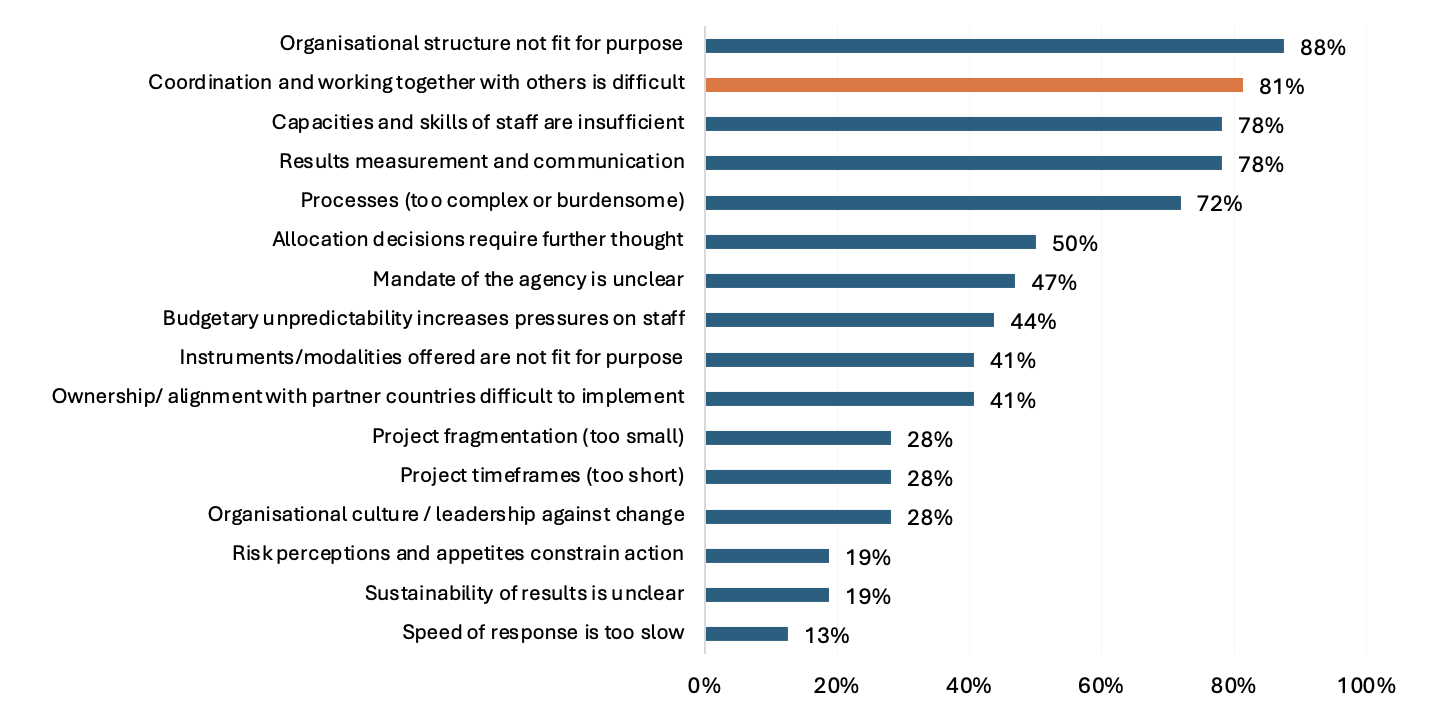
Note: these are preliminary findings for an ongoing research project, based on 32 interviews across 4 development agencies.
Why is coordination not materialising?
Our research shows that most non-DAC providers remain at least partially open to partnerships with other providers, as evidenced by their participation in international forums, co-financing arrangements, joint project implementation, and data sharing. Similarly, a recent survey of DFI and development agency staff found that over 80 percent of DFI respondents were interested in stronger coordination with bilateral agencies.
But, in practice, collaboration has remained limited. Cooperation between DFIs and bilateral agencies is largely confined to “knowledge sharing”, with more active cooperation hindered by three main obstacles: limited understanding of each other’s tools and resources; misaligned objectives and incentives; and procedural hurdles such as conflicting procurement and reporting rules. On a broader scale, competition and go-it-alone nationalism have often led to more bilateral engagements rather than the type of multilateral cooperation which, in theory, would be most ideal to tackle the global nature of the challenges at hand—with the international COVID-19 response serving as an illustrative example. Our research has also identified four key barriers to cooperation between DAC and non-DAC agencies: differing principles and visions of cooperation, a lack of staff capacity, low political appetites, and crucially, a lack of trust.
Three pathways to working better together
In light of these risks, we identify three practical ways in which development actors can contribute to a more coordinated, collaborative, and resilient global development system:
1. Engage in mini-lateral, regional, or “bridging” activities:
In today’s challenging geopolitical climate, some providers are stepping into the role of “bridge-builders,” maintaining relationships across DAC, non-DAC, and other agencies to keep communication channels open, foster cooperation, and encourage mutual learning. These “bridging” countries often leverage their unique geographical, political, or historical positions to influence collective action, particularly through mini-lateral and regional cooperation mechanisms, which may offer alternative spaces for progress when global consensus remains elusive.
“Bridging” can take several forms, including joint project implementation, hosting forums for development dialogue, brokering multi- and mini-lateral agreements, and promoting more inclusive global norms. Triangular cooperation—where donors combine financial resources with the contextual expertise of a Southern partner in a third country—has emerged as a particularly promising “bridging” modality. This approach not only potentially addresses trust deficits through practical collaboration, but may also deliver more cost-effective, locally tailored solutions by leveraging complementary strengths across DAC, non-DAC, and recipient countries.
2. Clarify comparative advantage and division of labour across actors:
Interviews for our forthcoming research series on agency effectiveness reveal that development agency leaders are shifting their focus beyond simply improving “coordination” at the country level, and are now keen to clarify their distinct roles and positions within the global aid system. Rather than just aiming to reduce duplication through country-level coordination, there is an increasing emphasis on establishing a clearer global division of labour among providers. This means defining which agencies are best suited to lead in specific sectors or regions, allowing each to focus where they have the greatest comparative advantage. Given ongoing aid cuts, this approach may demand difficult decisions about priorities and simplification —including, in some cases, exiting certain countries or sectors altogether.
Different types of actors will be best placed to take on different roles. For bilateral development agencies, this may be concentrating their scarce grant resources in areas where they can have the most transformative impact—such as health, climate adaptation, and foundational investments that enable countries to progress toward self-reliance. Meanwhile, DFIs are well positioned to drive long-term investments, especially as their ability to recycle capital and align with national interests becomes more valuable in a world preoccupied with securing supply chains and critical minerals, and MDBs can leverage their access to capital markets, but must evolve to mobilize significantly more private finance. Philanthropies, while smaller in scale, can help fill critical funding gaps, pilot innovative solutions, and support neglected issues, but their impact depends on effective coordination with larger actors.
3. Rebuild trust through a credible narrative and better evidence:
Persisting confusion on what ODA is for, and what it is meant to achieve not only makes the type of effective prioritisation described above more difficult but also erodes trust in development cooperation writ large. Without restoring this trust and building a shared understanding of the roles and objectives of different development actors, fragmentation will continue to undermine the potential for collective action, putting the very scaffolding of global cooperation at risk of collapse.
As a part of rebuilding trust—with partners and taxpayers—a new narrative is needed, framed as an investment in countries’ pathway to self-reliance. This must start with listening to partner countries and aligning with their priorities. Many Global South country leaders have been clear that they want providers to help them achieve long-term self-reliance by prioritising their local capacities and integrating them into global capital markets—not simply providing more aid. On the domestic front, so far, arguments that justify aid solely in terms of national interest have failed to sustain public support, and people want to see development action making a real difference for those who need it most.
Our ongoing research on what makes agencies "fit for purpose" has shown that development practitioners see two characteristics as being particularly essential: first, staff want a clearer mandate that honestly assesses what each agency can achieve, and where it has a comparative advantage, and, second, they stress the need for clearer and more evidence-based communication on the results of their work. When people believe aid works, they are more likely to support it.
Building a more resilient system
In a rapidly changing and increasingly fragmented development landscape, coordination and cooperation are more vital—and more challenging—than ever. As new actors emerge and traditional funding models contract, the risks of duplication, inefficiency, and eroded trust threaten the effectiveness of the entire system. Adapting to this new reality will require more than piecemeal fixes to plug existing gaps: instead, development agencies must clarify ODA’s unique value compared to other flows, place greater focus on their own comparative advantages, embrace bridging roles, and actively rebuild trust in cooperation through supporting more credible, evidence-based narratives around country self-reliance.
Only by working together effectively will development actors be able to deliver lasting impact. The 4th International Conference on Financing for Development (FfD4), taking place imminently in Seville, will provide an important opportunity to double down on coordination and cooperation.
The authors are grateful to Sara Casadevall Bellés for her comments and contributions.
Topics
DISCLAIMER & PERMISSIONS
CGD's publications reflect the views of the authors, drawing on prior research and experience in their areas of expertise. CGD is a nonpartisan, independent organization and does not take institutional positions. You may use and disseminate CGD's publications under these conditions.
Thumbnail image by: Adobe Stock Images